Guide
Cacabey built the medrese that carries his name and is buried beside it. Born in Kırşehir in 1240, the son of Emir Bahaddin Caca of the Ceceli tribe, he was formally Cacaoğlu Nureddin Cebrail but everyone knew him by the short name. He served as emir of Eskişehir in the last Seljuk years, spent a period in Tokat and then governed Kırşehir; Mevlâna praised him in a letter. He spoke Turkish and wrote his orders and state correspondence in it, and he protected Hacı Bektaş, who lived under his administration. He endowed a mosque and a han in Eskişehir and contributed to the repair of seventeen mosques and lodges. He was killed fighting the Greek lords in 1301 and brought back to Kırşehir for burial.
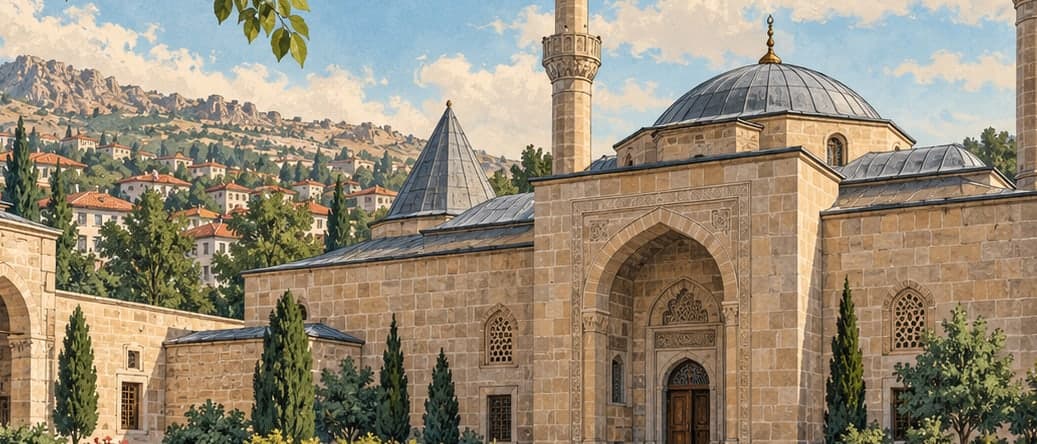
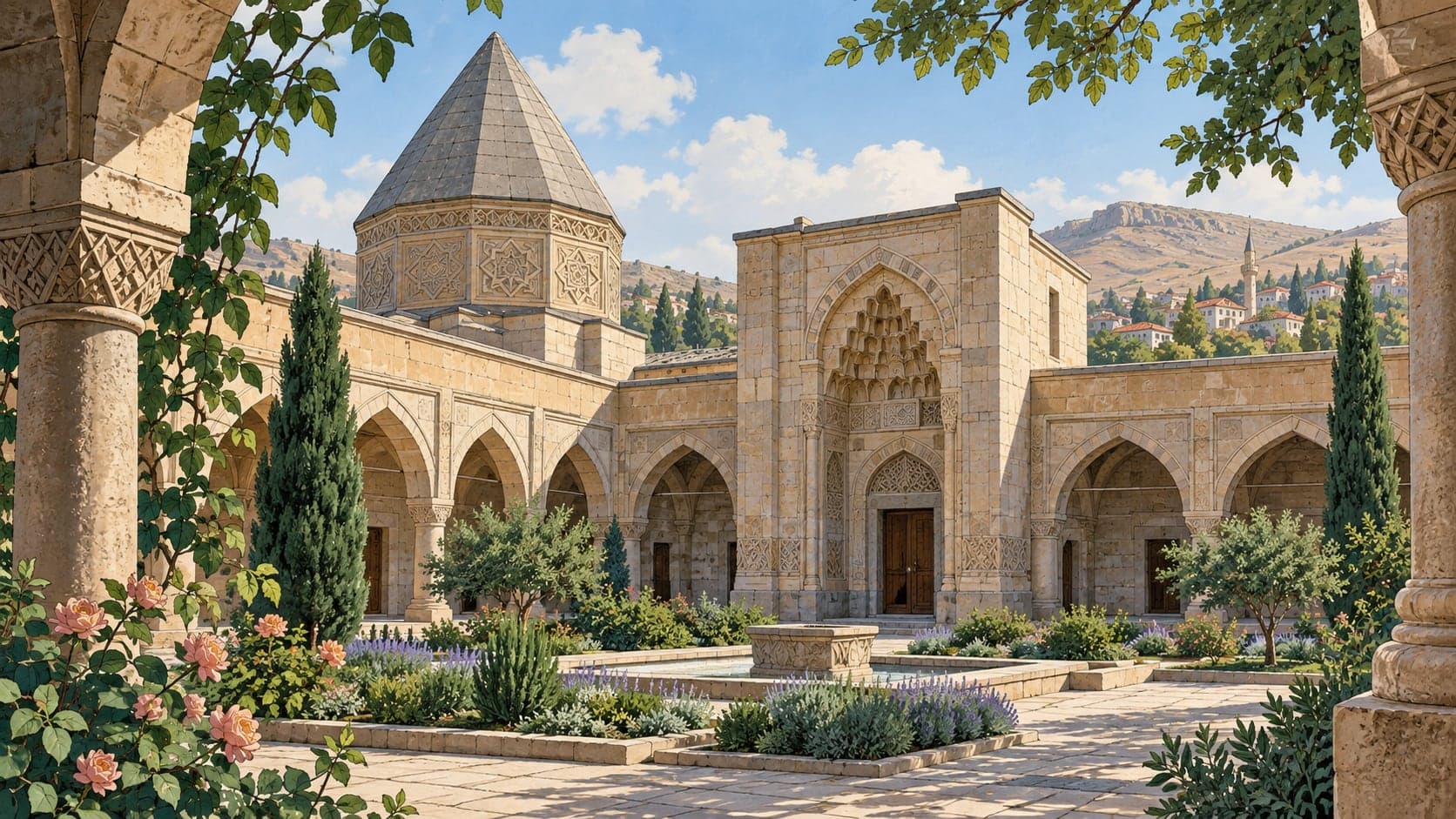
The medrese was finished in 1272, and it was built for mathematics, natural science and astronomy rather than for religious teaching alone. It stands in the centre of town on a nearly square plan running east to west, with a closed courtyard and eight rooms for students. Its endowment deed, drawn up in Mongolian before the building was complete, is the only one of its kind known from thirteenth-century Anatolia.
The two-coloured crown portal is counted among the finest pieces of Anatolian Seljuk decoration, and the Arabic inscription sits on it, together with verses from the Qur'an; the carving there and around the tomb window is unusually careful work.
The astronomical readings of the building are interpretations rather than established fact, and the source presents them as such: the small columns set at three points on the outer face have been read as a rocket at the moment of firing, some of the shapes on the portal as sun and moon, the circles in the lower corners of the pediment as the equator and the tilt of the earth's axis, and the stacked cones and spheres of the inner colonnettes at the corners of the main eyvan as the planets.
What is not in doubt is the equipment. An observation well sits in the middle of the courtyard with a light lantern directly above it, and a brick observation tower 21 metres high stands on the south-west face.