Guide
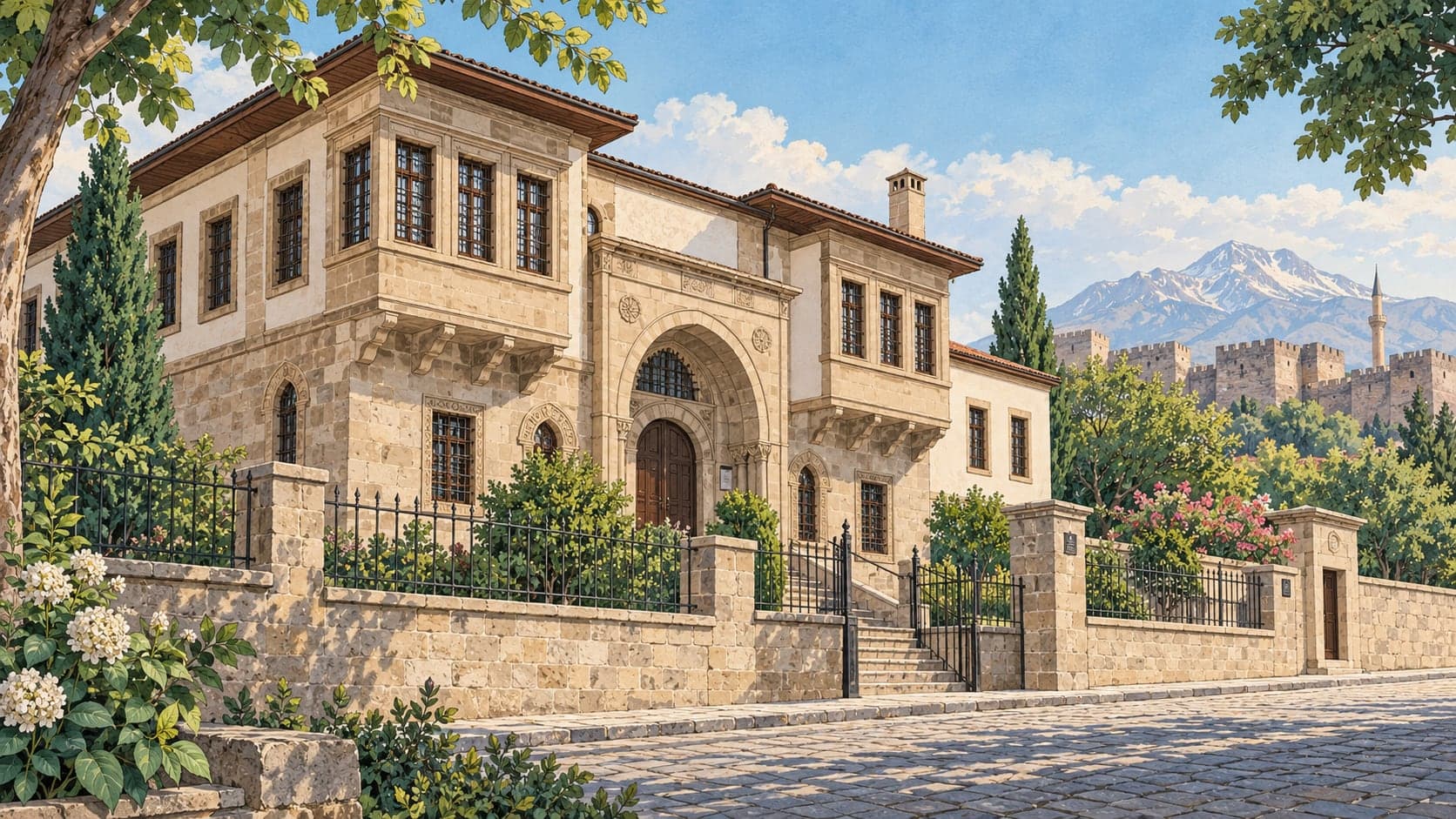
The Kayseri Ethnography Museum occupies the Güpgüpoğlu mansion on Tennuri Sokak in the Cumhuriyet quarter of Melikgazi. The building was put up between 1419 and 1497, with work continuing into the eighteenth century.
The museum was first established in the Hunat Hatun medrese. After the archaeological material moved in 1969 to the new building in the Gültepe quarter, the medrese was restored and opened as the Ethnography Museum on 6 March 1983. By order of the ministry the medrese was later vacated and handed over to the regional directorate of foundations.
The Ministry of Culture expropriated the Güpgüpoğlu mansion in 1976 and registered it as immovable cultural property requiring protection. After restoration, the western side of the mansion opened as a house museum on 18 May 1995. The ethnographic works were then moved to the section added later on the eastern side, and the Ethnography Museum opened there on 18 May 1998.
Part of the mansion is laid out to show the arrangement of an Ottoman house, while the rest serves as the museum, showing Turkish-Islamic works of the Seljuk and Ottoman periods: tiles and ceramics, weapons of various kinds, objects of wood and metal, manuscripts, carpets and kilims, men's and women's dress, jewellery and ornaments.
The museum is on the second floor of the building, reached by a stone stair with a wooden balustrade. The rooms are arranged around a central hall, with a half-open pavilion on its northern side.
In the large room east of the hall are glass, tile, wooden and metal works; in the corridor leading to the second room, firearms and edged weapons along with men's dress; and in the small second room, women's ornaments and dress. In the large room at the entrance on the southern side, coins of the Islamic states are shown in order of date, and in the other small room manuscript Qurans, writing sets and certificates of accomplishment. The large room west of the hall holds copper household goods, carpets and kilims.
In the half-open pavilion stand a Turkmen tent and storage jars of the Seljuk and Ottoman periods, and in the garden Islamic gravestones and carved stone ornament are displayed.
Visit status for this record: open to visitors.