Guide
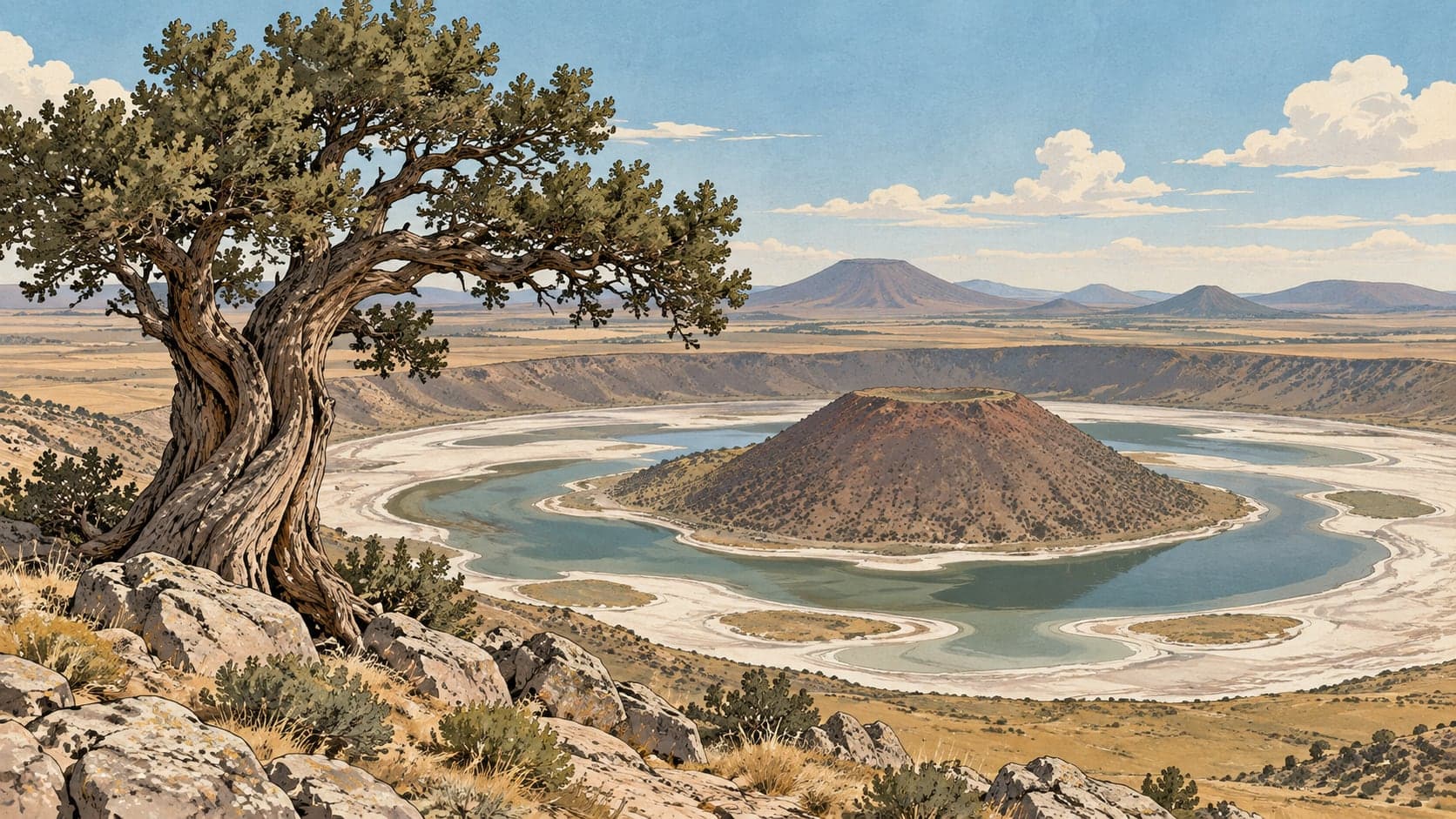
Meke Lake is a crater lake in the Karapınar district of Konya, on the salt steppe of central Anatolia, and it was declared a natural monument in 1998. The protected area is 256.95 hectares. It is also a Ramsar site. Türkiye has many crater lakes, but the Directorate General of Nature Conservation and National Parks calls this one a rare example because the water inside the caldera is bitter; islets stand in the middle of it. The lake formed in a volcanic eruption five million years ago, and its shape, likened to an evil-eye bead, has given it the name Eye of Anatolia.
Anyone coming to watch birds should know what the directorate itself reports. Local people say the area held around a hundred bird species until 2003; the condition of the site has not been good in recent years and most of the birds no longer come to the lake. The species recorded include greylag goose, ruddy shelduck, common shelduck, Egyptian vulture, long-legged buzzard, golden eagle, saker falcon and black-winged stilt, and among those protected under the birds directive are marsh harrier, black-winged stilt, great bustard and little bustard. The directorate says the lake takes its name from the Meke bird, without identifying the species.
Steppe vegetation surrounds the lake, dry and adapted to salt, growing on fine sandy soil: deep-rooted, thorny, stunted, long-lived plants able to stand drought, among them milkvetch, speedwell, sage, knapweed and couch grass. Seven plants of the region are listed as endemic and threatened. Three are bulbs or bulb-like: Allium sieheanum, and the gladiolus of salty ground, Gladiolus halophilus. The others are Astragalus cicerellus; Lepidium caespitosum, a cushion-forming cress; Limonium lilacinum; the legume Sphaerophysa kotschyana; and Verbascum pyroliforme, a mullein.
Volcanic ash absorbs a great deal of light, so a microclimate keeps the lake and its surroundings warmer than the land around; reptiles usually found in hotter regions live here as a result, including the steppe agama, the roughtail rock agama and the golden grass mabuya, alongside the Greek tortoise. Brown hare, red fox and various mice are the mammals seen. The directorate recommends the site for getting away from city noise, for birdwatching and for photography. It lies at the 100th kilometre of the Konya-Adana road, one kilometre off the main road.
- Designated
- 3.08.1998
Entry fee
- Marmara group 3 · category 1 · Per person
- 65 ₺