Guide
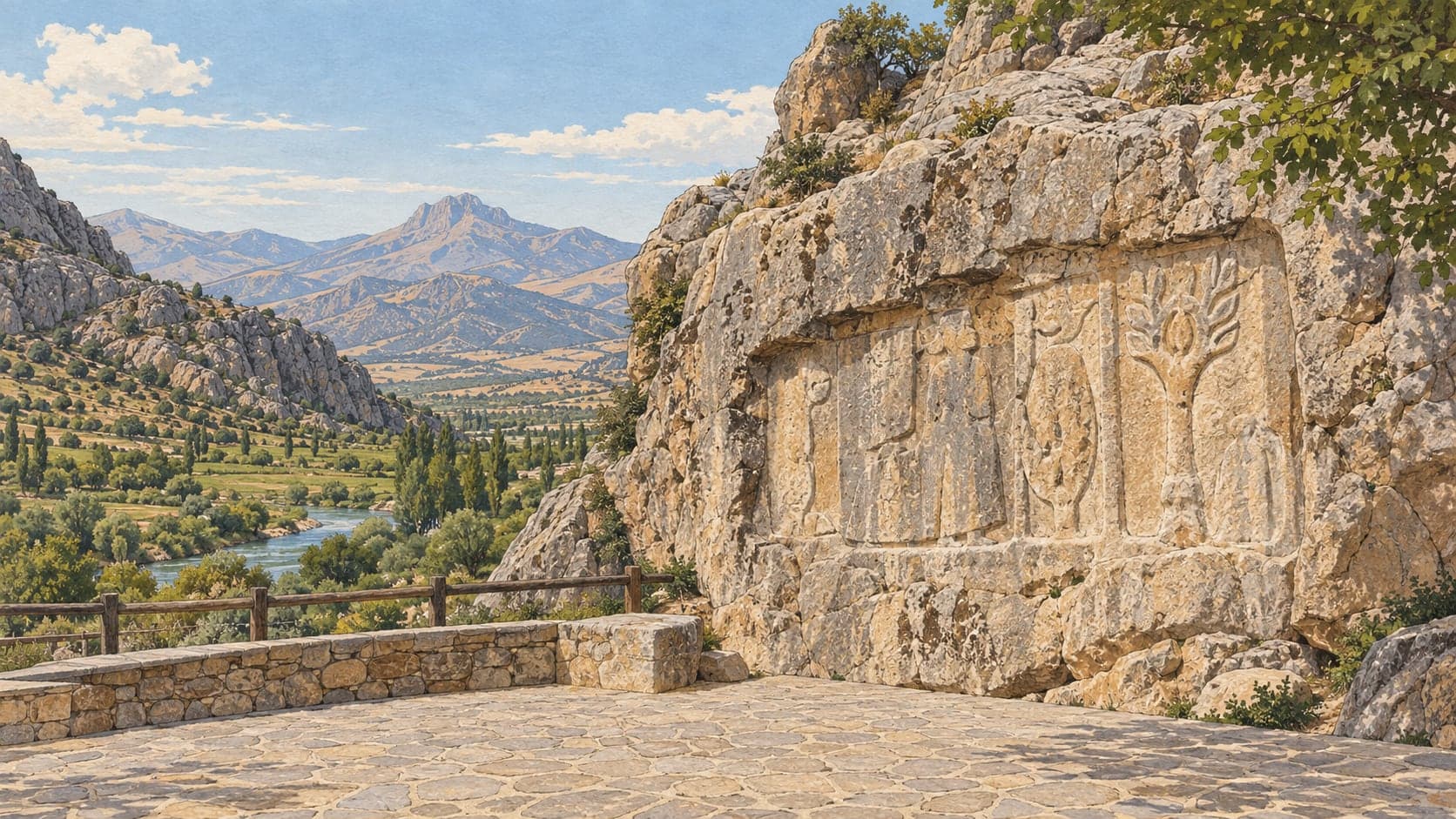
The İvriz rock relief is carved on a natural rock face beside the İvriz stream, about four kilometres south of Halkapınar in Konya province. It shows the god Tarhundas facing Warpalavas, one of the most powerful kings of the land of Tuwanuwa, and for centuries it also served as a boundary marker of that kingdom. It was cut in the eighth century BC, in the Late Hittite period, and the Ministry describes it as the oldest agricultural monument in the world.
The composition is simple and unusually direct. The priest-king Warpalavas raises his hands in prayer towards Tarhundas, who stands opposite him and is carved considerably larger; the god holds a bunch of grapes in one hand and a sheaf of wheat in the other. The hieroglyphic inscription between the figures has the king say that while he was still a prince in the palace he planted these vineyards and raised these ears of wheat, and asks the god to grant them abundance. The carved panel measures 4.2 by 2.4 metres. Alongside Hittite tradition it shows features of Assyrian, Aramaean and Phrygian art. Its placement matters as much as its subject: it was cut, with the engineering of its day, at the head of the spring where the İvriz stream rises, integrating the landscape into belief and making a cult site around sacred water — one that kept its religious meaning in later centuries. Besides the relief the area holds an altar, a monastery and caves. The İvriz cultural landscape has been on the UNESCO World Heritage Tentative List since 2017.