Guide
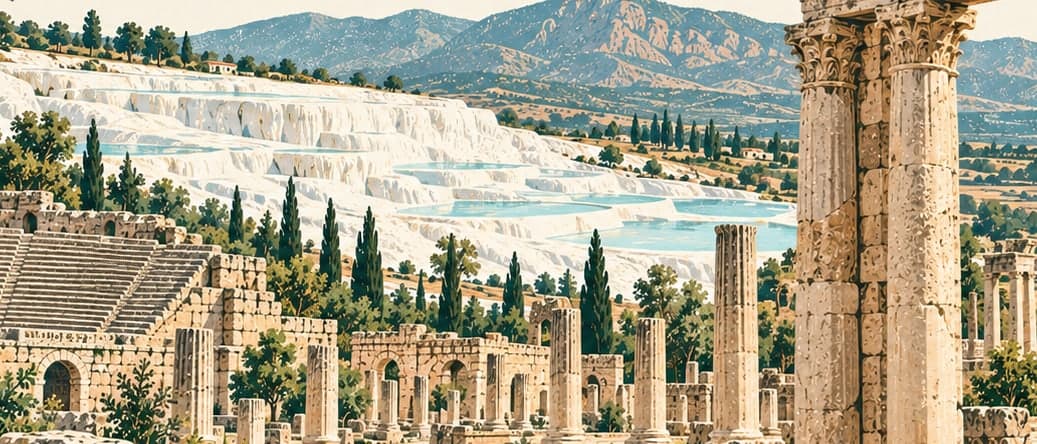
Laodikeia lies six kilometres north of Denizli, within the bounds of the Eskihisar, Goncalı and Bozburun quarters — once separate villages. Excavation and restoration at the site are carried out by Professor Celal Şimşek of Pamukkale University.
In ancient geography the city stands in the middle of the Lykos valley, today the Çürüksu, where the regions of Phrygia, Lydia and Caria met. Babadağ, the ancient Salbakos, rises to the south of the valley, Çökelez to the north, Honaz — the ancient Kadmos — to the east and the Buldan mountains to the west. The Asopos stream runs to the west and south-west of the city, the Kapros to the south-east and the Lykos to the north-east.
Surveys in the settlement area, particularly west and south-west of the city, have turned up pottery and flint dated to the Late Chalcolithic, around 3500 BC, and to the first phase of the Early Bronze Age, around 3000 BC. These show that the early settlement grew up around the Asopos, which was the main source of water. Vessels found in the western necropolis belong to the Early Chalcolithic, around 5500 BC, and are the earliest finds so far recorded in the Lykos valley.
The city was founded in the middle of the third century BC, between 261 and 253, by the Seleucid king Antiochos II Theos, who named it after his wife, Queen Laodike. Standing where important ancient roads met, chosen in keeping with Seleucid policy on terrain, and holding a military, administrative and economic position, Laodikeia became the main centre of the region.
The city first enters the historical record with the revolt of Achaios in 220 BC, when he declared himself king at Laodikeia and struck coins in his own name. Grave inscriptions found in the city and dated to the third century BC already speak of a market, a strategeion, a gymnasium and a theatre, which says a good deal about how important the place was even then. Alongside the beliefs of the Greek pantheon, the cults of Zeus Aseis and of Isis, mingled with eastern culture and belief, are found here; the founding chief god of the city was Zeus Laodikeus.
Laodikeia remained under Seleucid rule until the battle of Magnesia in 190 BC, fought between the Seleucids and the Romans with the support of Pergamon. After the Peace of Apameia in 188 BC the kingdom of Pergamon, victorious in that war, took control of the region, and the city gained important privileges by binding itself closely both to the Attalids and to Rome.