Guide
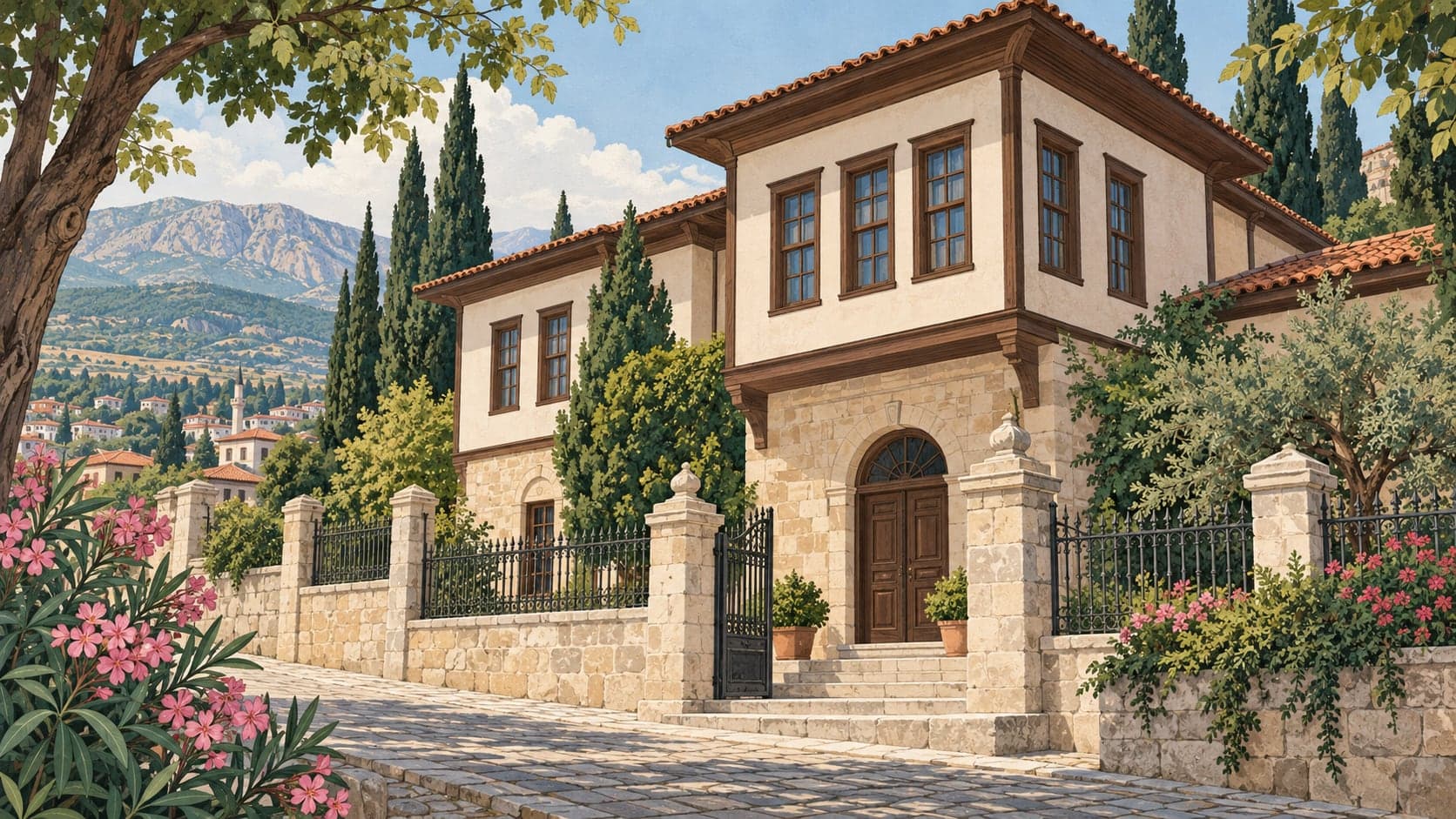
The museum is a house on 459 Sokak in the Saraylar quarter of Denizli. No document gives its building date; the ministry says only that local accounts put it in the late 19th century. Its exterior, plan, window forms and ornament place it in what is called the Chios manner. It has two storeys, with rooms opening off a central hall on each.
In the first years of the republic the house served as a party building, and Atatürk was a guest here for one night on 4 February 1931, during a visit to Denizli. After 1950 it was allocated to the Ministry of Health and worked for a time as a tuberculosis clinic. The Ministry of Culture registered it as a monument in 1977, repaired and fitted it out between 1981 — the centenary of Atatürk's birth — and the end of 1983, and opened it as a museum on 1 February 1984.
The object to look for is a banner, given to the museum by Haluk Muftuler in 1984. It is embroidered in gold thread on red satin. The front carries the Ottoman phrase 'Long live the homeland' across the top and the Ottoman imperial arms in a wreath at the centre, with three star-and-crescents, one above and two below. Along the bottom runs an inscription recording it as a keepsake of the 24th conscript class, 2nd Battalion, 67th Regiment, from the Head Mosque at the flour market in the Denizli bazaar. The reverse carries the basmala, the profession of faith and Qur'anic verses of victory, with a star and crescent in each upper corner and metal-thread fringing at the edges.
What makes it the museum's most important piece is a single morning. On 15 May 1919, the day İzmir was occupied by Greek forces, the mufti of Denizli, Ahmet Hulusi Efendi, made his historic speech under this banner at a protest meeting in Denizli's Bayramyeri and called the town to resistance — the first response anywhere outside İzmir.
Visit status for this record: open to visitors.