Guide
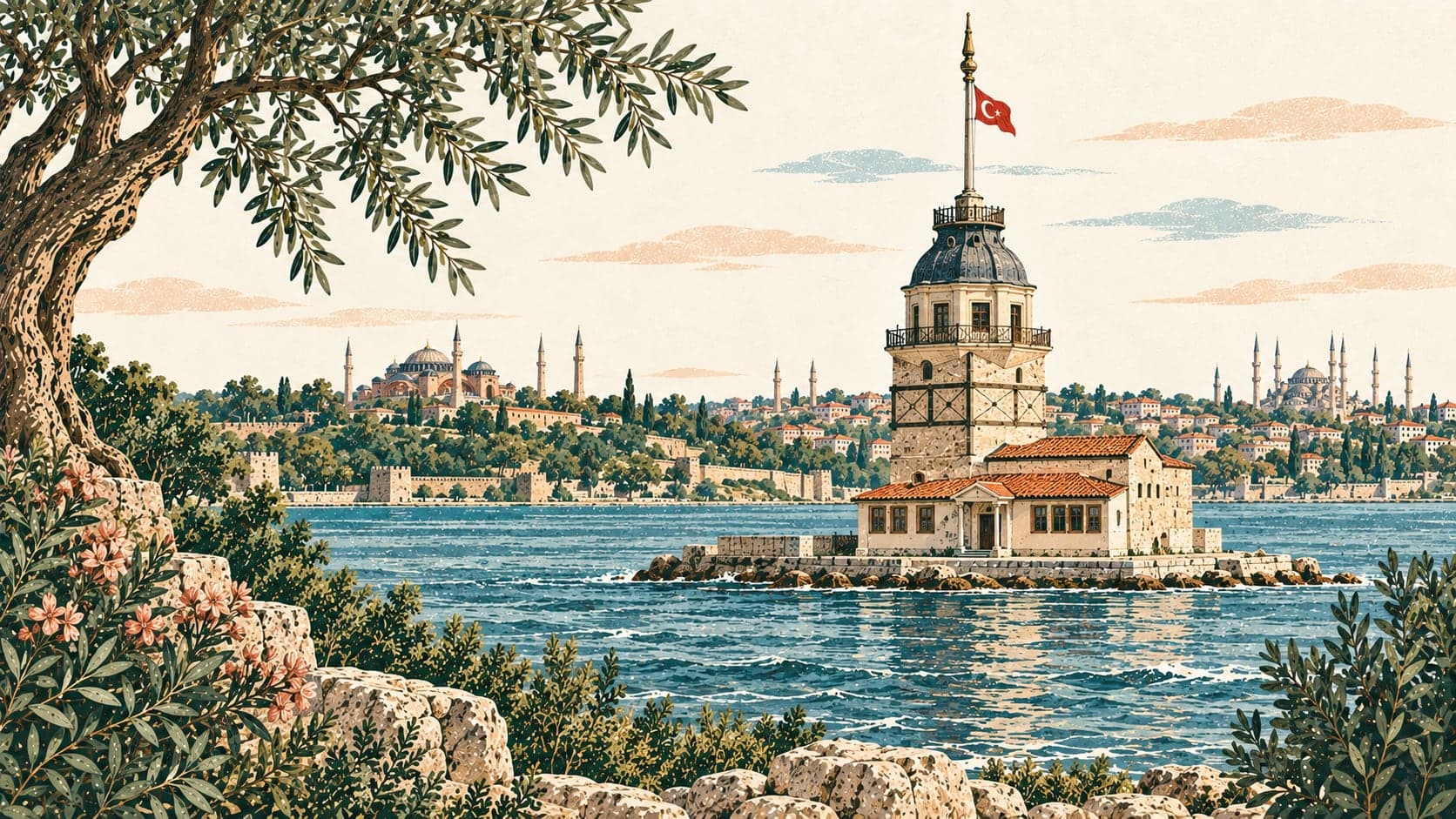
The Maiden's Tower stands on a small islet off Salacak near Üsküdar, in the part of the Bosphorus close to the Sea of Marmara. It has become the emblem of Üsküdar and is the only work of the Byzantine period surviving there.
Its beginnings are given in more than one way. The source records that the Athenian general Alcibiades built a special station on a small rock in front of Üsküdar in 408 BC, after the naval victory at Cyzicus, probably for ships coming from the Black Sea, and also that the tower has a past reaching back to about 24 BC.
In 1110 the Byzantine emperor Alexios I built a wooden tower protected by a stone wall. An iron chain was stretched from it to another tower raised in the Mangana quarter of Constantinople, on the historical peninsula, and the islet was later joined to the Asian shore by a defensive wall whose underwater remains can still be seen. At the conquest of İstanbul in 1453 the tower held a Byzantine garrison commanded by the Venetian Gabriele Trevisano; afterwards the Ottoman Turks used the building as a watchtower in the reign of Mehmed II.
The island held a tomb in the Greek period and was used as a customs station with the building added under the Byzantines. In the Ottoman period it took on many functions, from a platform for displays to a defensive fort, from a place of exile to a quarantine room. It has never lost the work that is properly its own — guiding, with the lighthouse that has stood here for centuries and that winks at night to the ships passing by.
Some European historians call it the Tower of Leander. Many stories are told about it. In antiquity it was known by the names arkla, a small fort, and damialis, a calf, and for a time it was famous as the Tour de Leandros; today it is bound up with the name Kız Kulesi.
The tower was once used to take dues from ships passing along the Bosphorus. A great chain was drawn from it along to the European shore, and ships were allowed through between the Anatolian shore and the tower, which was possible because ships were small at the time. After a while the tower could not bear the weight of the chain and fell towards the European side; looking down into the water from the tower, the ruins can be seen.
The tower was thrown down in the earthquake of 1509 and rebuilt, and it burned in 1721. The grand vizier Damat İbrahim Paşa ordered its rebuilding and the new building was used as a lighthouse, with the surrounding walls repaired in 1731 and 1734. It was finally rebuilt in more durable stone in 1763.