Guide
Note before planning a visit: the Directorate of National Palaces states that the Clock Museum is closed for restoration work. When it reopens, the ticket office hours it publishes are 09:00 to 17:00, closed Mondays.
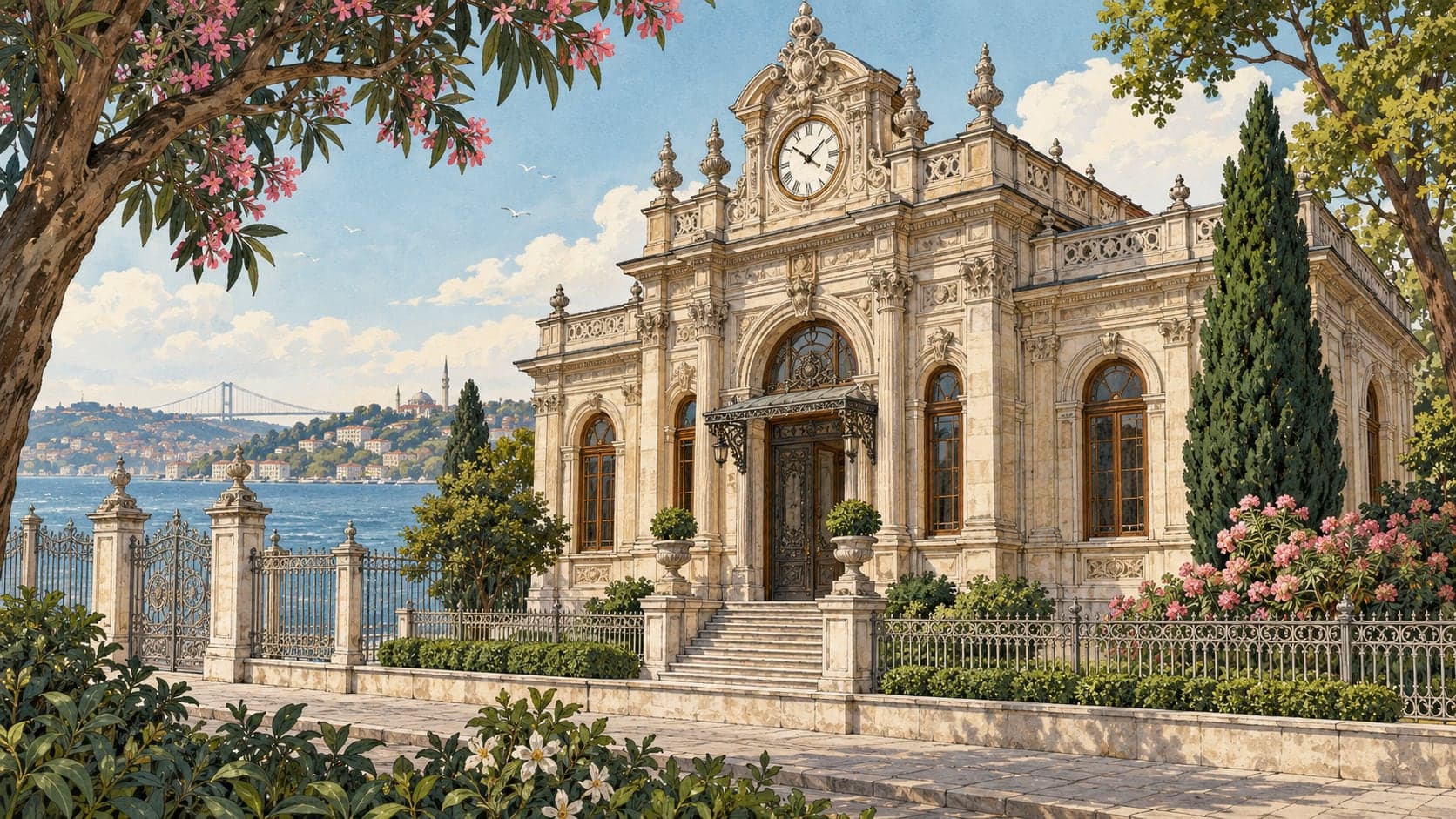
The collection sits inside Dolmabahçe Palace, a 19th-century building, and it is mostly 19th-century clocks with a smaller number from the 18th. Some were gifts, some were bought, some were commissioned. They were chosen to hold their own in very large rooms — heavy, showy, and made in bronze, gilt, marble, boulle, tortoiseshell and silver, mostly French, so that they furnished and decorated the room as much as they told the time.
The Directorate treats the mechanisms as seriously as the cases. French clocks are described as the product of painters, sculptors, founders and clockmakers working together, mechanically clear and precise, with the striking and chiming trains, rack or count-wheel strike, and pendulum or escapement varying elegantly from maker to maker. English clocks are the next largest group and were built differently: weight-driven longcase, musical, automaton and calendar clocks, with cases in wood, tortoiseshell, silver or crystal rather than cast, and sometimes a wholly different layout of the wheelwork. In the 19th century French clocks were made in series while English ones were made by hand, so an English clock in this collection reflects one particular maker. German and American clocks appear mainly as wall clocks of the late 19th and early 20th century, and Austrian ones as small porcelain table clocks and the classic wooden Vienna wall clock.
The Ottoman side of the collection is the part with no European equivalent. Where clockmaking in the West grew up alongside philosophers and mathematicians, its Ottoman counterpart was the muvakkit — the timekeeper who had to know the hour exactly, because the times of prayer required it, and who calculated it with instruments descended from the astrolabe and the quadrant. Most master clockmakers were muvakkits or Mevlevi dervishes, and Turkish makers produced outstanding skeleton clocks, where every movement and turn is left visible. The collection holds clocks by three of the greatest Mevlevi clockmakers — Eflaki Dede, Mehmed Muhsin and Mehmed Şükrü — men who made one, at most two, clocks in a lifetime.
Visiting hours
- Visiting hours
- 09:00:00 - 17:00:00