Guide
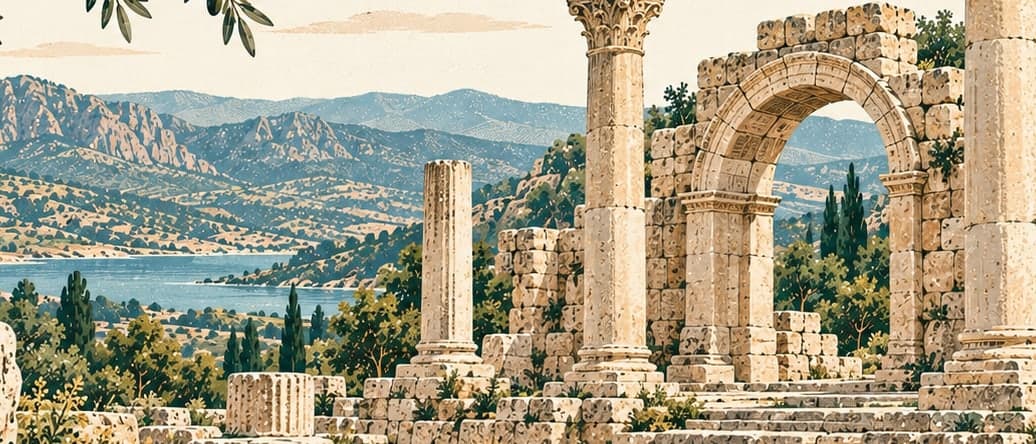
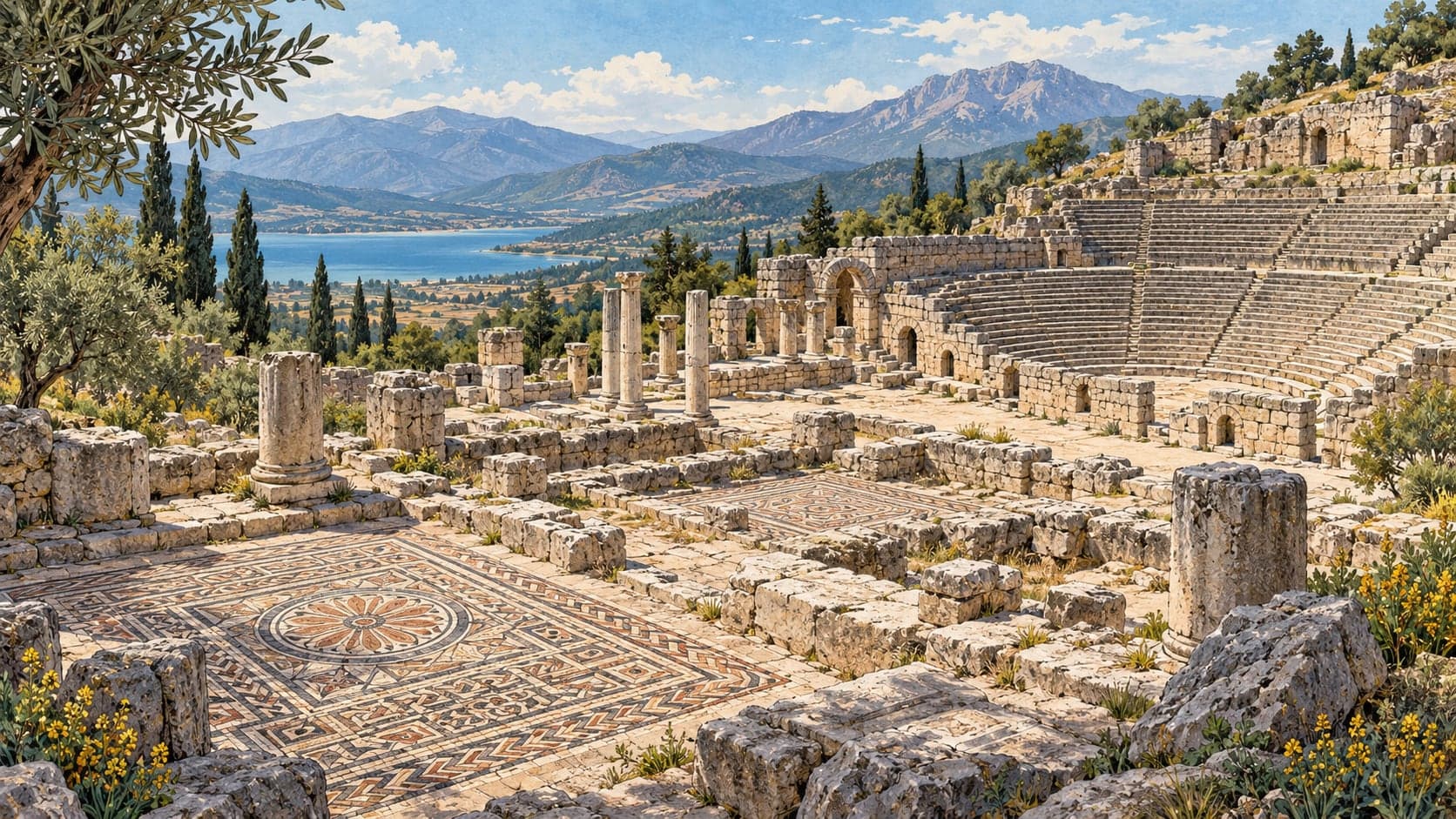
Kibyra occupies three commanding hills separated by deep ravines, in the Horzum neighbourhood of Gölhisar in Burdur. The settlement is large, and its planning is the first thing that registers: the buildings are set symmetrically on terraced hillsides looking out over the lake and the plain, and arranged so that no building blocks another's view.
The approach passes a monumental gate on the left and then the stadium, which with a capacity the Ministry gives as 12,000 to 13,000 it calls the most imposing in ancient Anatolia. Further in come a basilica, upper and lower agoras, baths, a gymnasium, a theatre and the council house, along with a planned monumental tomb, further baths, an arch with a round tower and the water lines. The council house, which doubled as an odeon, held 3,600 people. At the exact centre of its orchestra lies a Medusa mosaic in red, green and white marble — snakes for hair, a gaze that turns people to stone — which the Ministry describes as unique in Anatolia. In 2011 a mosaic of 540 square metres was uncovered in front of the same building, the largest and best-preserved mosaic area in the country by the Ministry's account, and beside it a late Roman bath of the 6th–7th centuries AD and a pottery workshop. Every piece of architecture visible on the site today belongs to the Roman imperial period.
Excavation in 2016 uncovered a round fountain building at the centre of the third agora terrace. Its position within the city and the style of its architectural members indicated that it was put up after the earthquake of AD 23, and additions and alterations over a long period kept it working as both an ornamental water monument and a practical supply.
Kibyra appears under the Pergamene kingdom in the reign of Eumenes II (197–159 BC). Soon afterwards it formed a four-city council with the neighbouring cities of Boubon, Balboura and Oinoanda, which lasted through the 2nd and 1st centuries BC until the Roman general Murena dissolved it in 82 BC, attaching the cities to the province of Asia and the Lycian League. The great earthquake of AD 23 levelled the city and Tiberius rebuilt it; its finest years were the 1st to 3rd centuries AD. The city was known for ironwork, leather, pottery and horse breeding, and its people had a decidedly warlike reputation. Finds from Kibyra are displayed in the Burdur Museum.