Guide
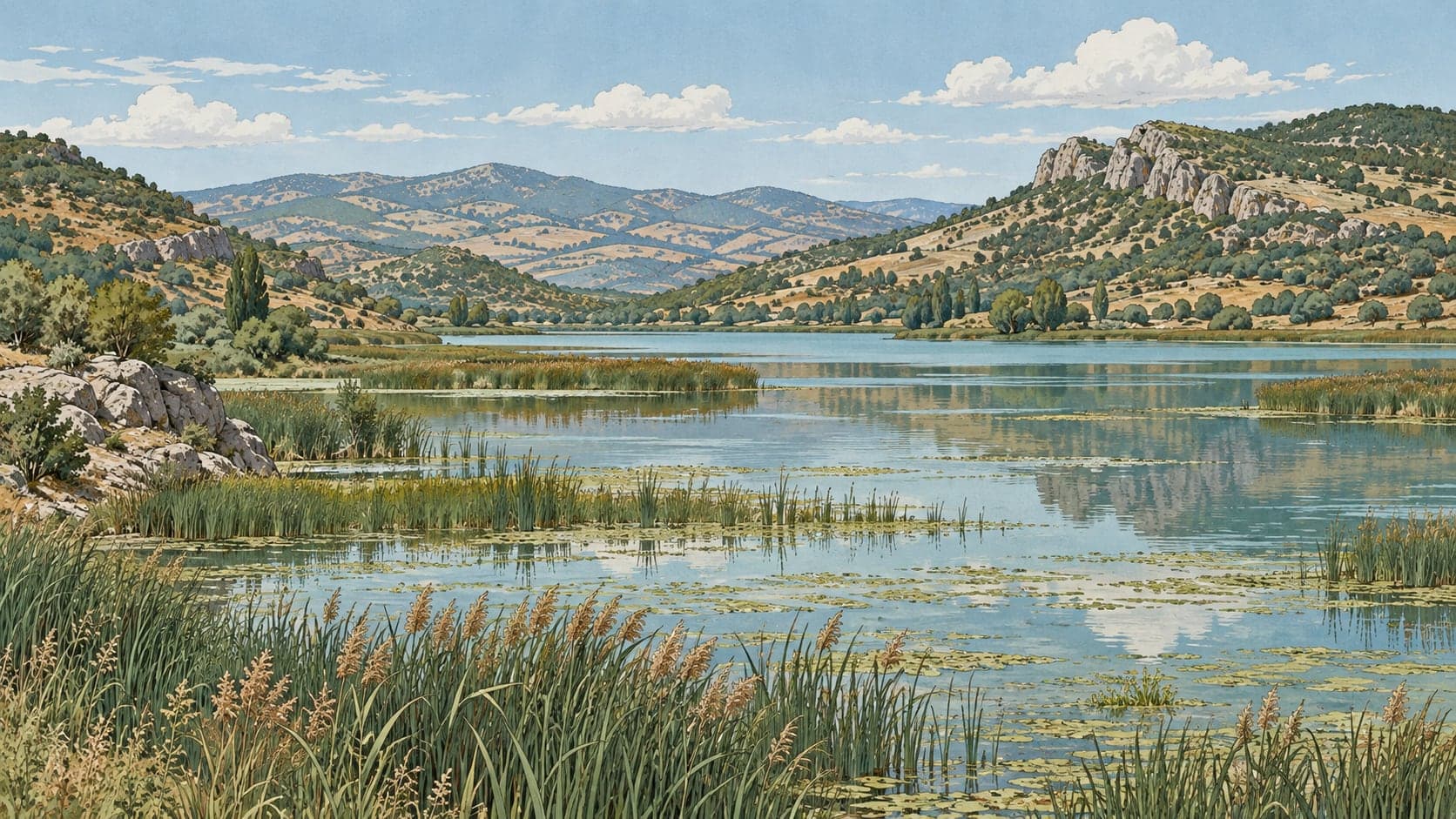
Kaz Gölü is a tectonic lake in Tokat province, on the Zile–Pazar road near the town of Üzümören, lying in the Kazova plain close to the boundary of the Pazar district. It stands at 540 metres, runs only one to one and a half metres deep, covers 180 hectares, and measures three kilometres from south to north and nine hundred metres across. Underground springs and the Çayköy and Bahçebaşı streams feed it, and the Yeşilırmak passes about two kilometres to the north.
Attempts to drain the lake have been made since 1950. Its surface measured 2,960,000 square metres in 1987 and had fallen to 1,650,000 by the measurements of 2010. Where the water has withdrawn, the ground is farmed.
A request was made in 1870 on behalf of the province of Sivas that the lake be drained, on the grounds that it gave off a bad smell and spread disease. It was proposed that water coming from the Pazar district be let into the lake and that the raised lake be connected to the Yeşilırmak, but the plan hung fire because the work would have cost more than the farmland gained was worth. A second proposal was to break through the rock at Karakaya and carry the water to the river at the Amasya boundary; since the lake sits at the lowest point of the Kazova, that too proved impossible. Planting trees around the lake was another suggestion.
After the Almus dam came into service in 1966 the Yeşilırmak no longer flooded and its water stopped reaching the lake. In 1980 a bank was built on the eastern side to reduce the area the lake flooded, and a drainage channel was cut towards the river. The lake was not drained entirely, and the villagers turned the dried ground into fields.
Carp of commercial value live in the lake and reeds cover its edges. Kaz Gölü is a nesting and breeding ground for resident and migrating birds, and 108 bird species live in this wetland, the mix changing over time. Among them are the great white, grey and squacco herons, white and black storks, the ruddy shelduck, ducks and geese of several kinds, moorhen, coot, pochard, grebe, reed warbler, lapwing, garganey, magpie, blackbird, robin, starling, sparrow, woodcock and white wagtail.
The lake and the country around it — 274 hectares of water within a total of 1,170 hectares — have been declared a wildlife development area. There are two bird-watching towers and a guest house on the site. Because there is no industry around the lake, it is not polluted.