Guide
Also known as the Fatih Mehmet Paşa han, the Deveciler han stands south of the Takyeciler mosque and west of the Yağıbasan medrese. It has no inscription.
Its date is an estimate, and the portal gives the reasoning. Judging by the architecture, the historical development of the muqarnas above the niches on either side of the entrance, and the building and decorative techniques used, it is thought to have been built in the reign of Çelebi Mehmed (1413–1421) or of his son Murad II (1421–1451) — a period when there was intense building activity in the region, from which a good many other works survive. The han is registered to the endowment of Mehmed the Conqueror.
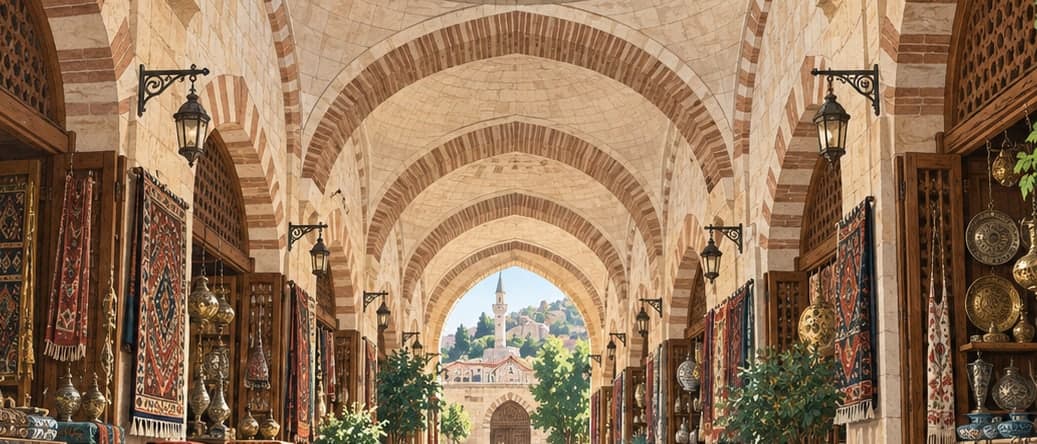
It was built on two floors, with the entrance at the middle of the north front. In front of the door is a domed area with niches on either side carrying muqarnas decoration. Flanking the door, facing the street, are ten shops on the east side and five on the west. The courtyard is reached through the vaulted area. There are 27 rooms and one lavatory on the lower floor and 28 rooms and one lavatory above — 55 rooms in all — each room with a cupboard niche for possessions and a hearth.
On the east, through a door on that side of the courtyard, is the camel section under two great vaults. Its outer door was closed up during renovation, and the space is used today as a concert and conference hall; Gaziosmanpaşa University holds conservatory classes in the han, which is also open to visitors. Standing on the Silk Road, it is among the oldest of the town hans that offered lodging for a single traveller.