Guide
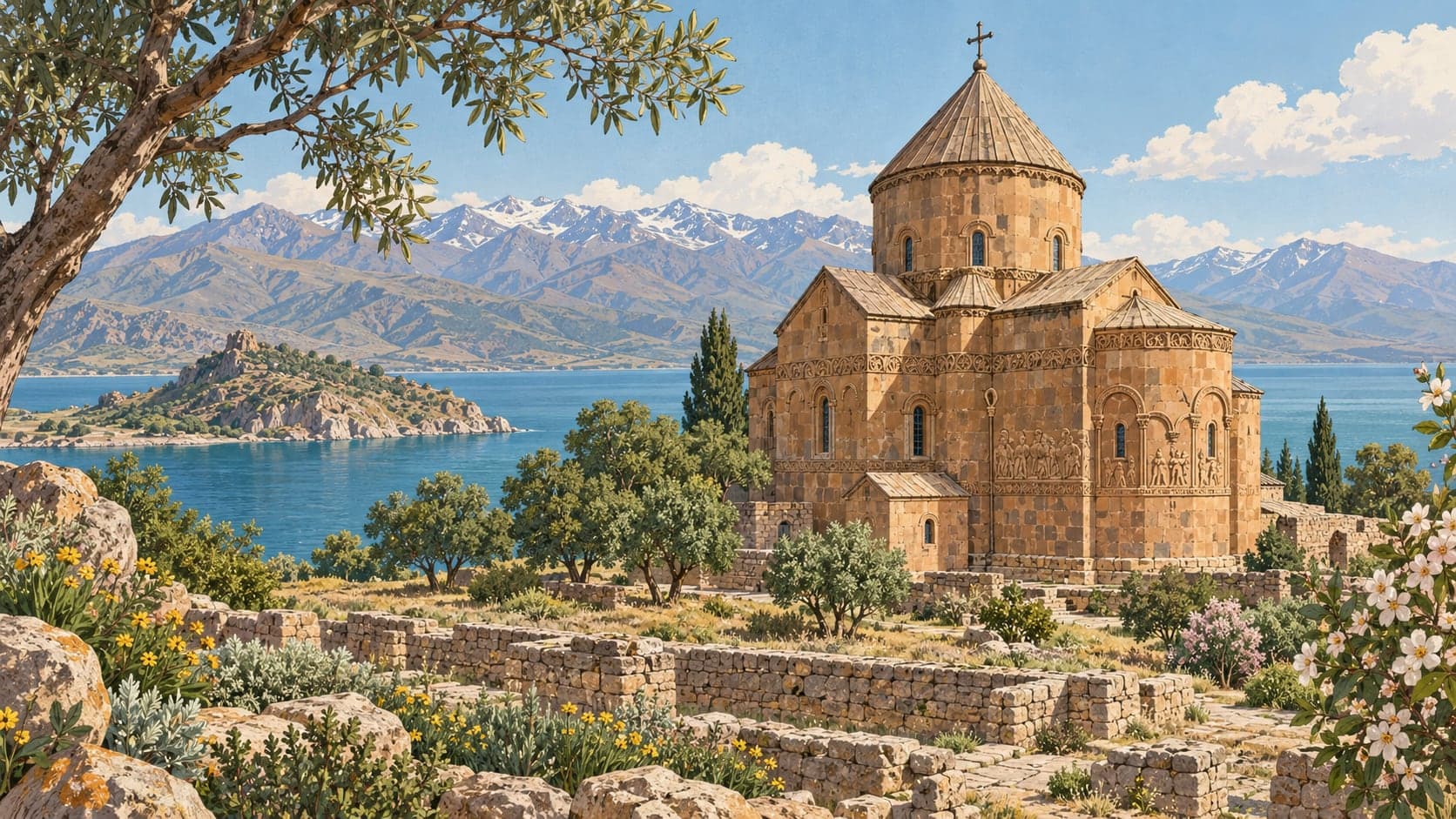
The Church of the Holy Cross stands on Akdamar, the second largest island in Lake Van. It lies within the district of Gevaş, fifty kilometres west of Van and about four kilometres off the shore; the crossing takes some twenty minutes. After restoration the building opened in 2007 as a monument museum.
The church takes its name from the island, and the island's name is explained locally by a legend. Tamara, daughter of a monk who lived on the island, was loved by a young man from the far shore who swam across each night to see her. One night a storm took him, and he drowned crying out her name — Ah Tamara. Hearing of it, the girl died of grief, and from that day the island was called Ahtamar, Akdamar.
The main building was raised between 915 and 921 by Gagik I Ardzruni, ruler of the kingdom of Vaspurakan, which held Van and its region from 908 to 1021 under Abbasid suzerainty. The architect was Manuel, and the church belonged to a palace complex.
In 1021 and 1022 the Byzantine emperor Basil II put an end to the kingdom, and the last king, Senekerim, was moved with forty thousand Armenians to Sivas and in part to the country around Kayseri. With the annexation the church ceased to be a palace church and became a monastery. From 1113, when various sections were added to the main building, until 1895 it served as the seat of the Armenian patriarchate of the region, and it was abandoned after the events of 1895 and 1915. The island itself was left in 1918.
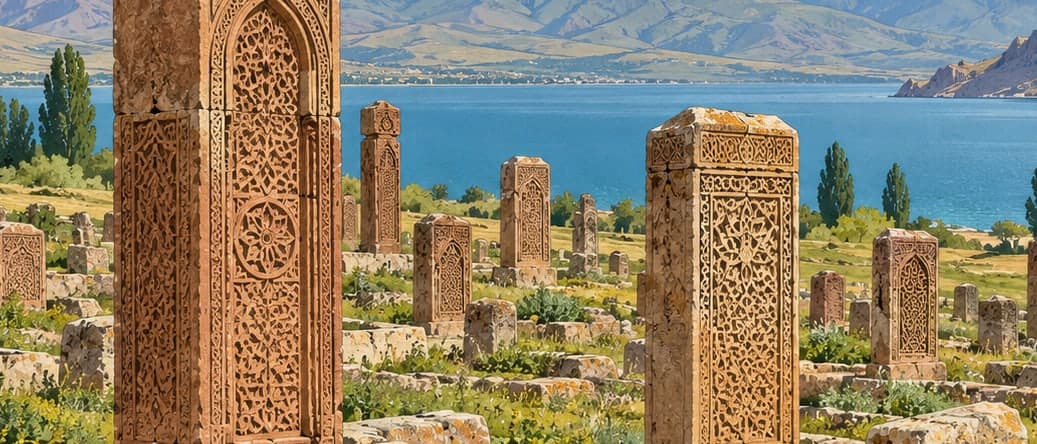
As it stands today the site has eight parts: the Church of the Holy Cross, the chapel of the katholikos Zacharias I, the jamatun of the katholikos Thomas, the bell tower, the service building, the chapel of Saint Stephen, and the cemetery.
In plan the building is a centrally domed cross with four lobes, like a four-leafed clover. The central space is covered by a dome on a high drum, seen from outside as a pyramidal cap; the height of the drum is what gives the interior its upward pull. There are doors on the west and the south, and later buildings were added around the structure. The western entrance is reached from the jamatun, through a portal framed by mouldings and borders stepping inward under a pointed arch, richly worked with muqarnas, rumi scrolls, cross motifs and torus mouldings.
What visitors come for, from all over the world, is the figured stone carving on the outer walls. The scenes include the prophet Jonah, Christ Pantokrator with his mother Mary, the Vaspurakan prince Hamazasp with his brother Sahak, David and Goliath, the prophets Elijah and Adam, Saint Thomas with the widow of Zarephath, Adam and Eve and the forbidden fruit, the three Hebrew youths in the furnace, and Daniel in the lions' den. On the west front, to the left of the central window, King Gagik I is shown; to the right of it he presents a model of the church to Christ.