Guide
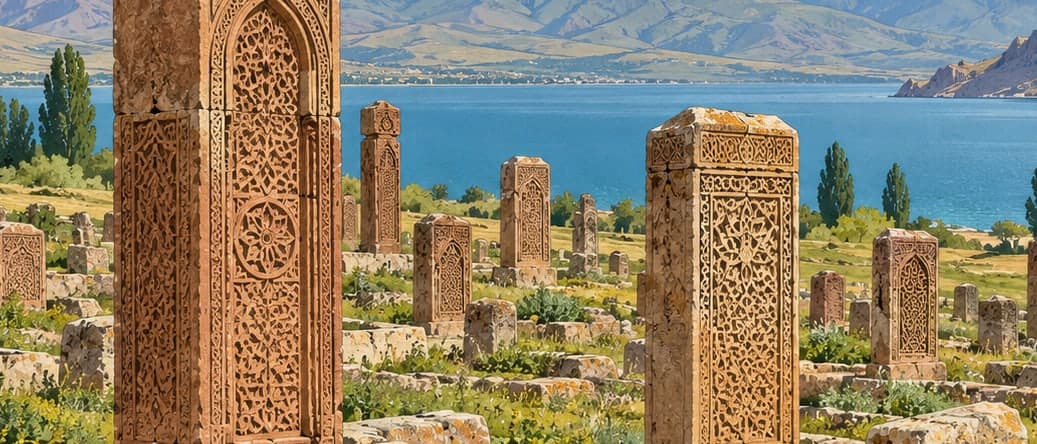
The tomb of Halime Hatun stands east of the historic Islamic cemetery of Gevaş, the second largest Turkish Islamic cemetery of the medieval period in Anatolia, and is one of the important emblems of the region. According to the inscription above its entrance it was built in 1335 by İzzettin Şir Bey, thought to be the founder of the Hakkâri principality, for his daughter Halime Hatun. The name of the architect, Esed son of Pehlivan of Ahlat, is written on the lintel of the south window.
In plan the building repeats the tombs of Ahlat. It has two levels: a twelve-sided body on a square base, with a conical cap. A door on the east side leads down by stairs to the burial chamber.
White limestone is used throughout. The ornament concentrated on the outer faces — plant motifs, geometry and inscriptions — is the tomb's most important feature. Inside there is no decoration apart from the small scallop-fluted cells at the corners, used in the transition from the twelve-sided body to the dome.
A four-storey student hostel was built immediately behind the tomb in 2007. After photographs of it circulated on social media in 2014, the building drew public objection on the grounds that it damaged the historic setting visually. The district governorship of Gevaş applied to the Ministry of Education in 2015 for the hostel to be demolished, and it was pulled down in 2022.