Guide
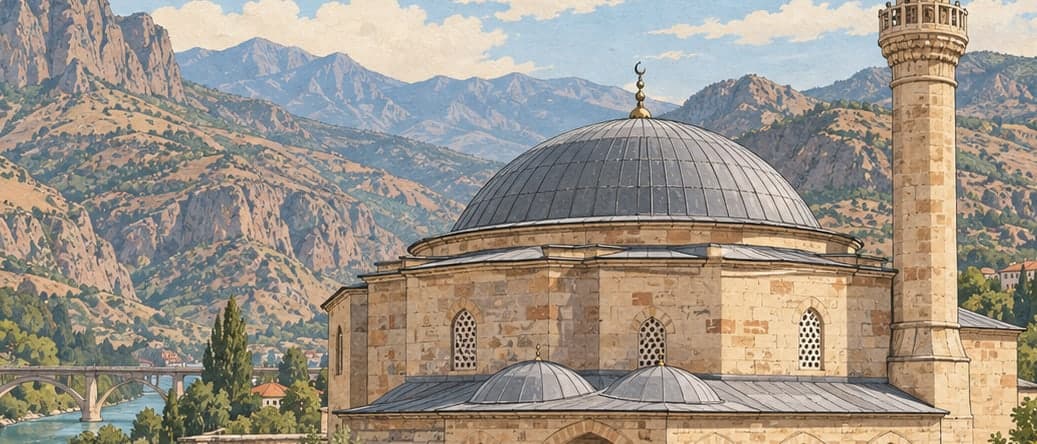
The mosque at Ulukale village, in the Çemişgezek district of Tunceli, is wedged in among the houses. Old records show it to be an endowment of Yusuf Pasha, who served as governor in Diyarbakır, built in 1793-94. The Ministry's page describes the fabric of the building in two different ways — first as rubble stone, then as cut stone — and both are given here as they stand. Entry is through the porch added in the nineteenth century, which has five bays with round arches under vaults, and the door is not on the central axis but shifted to one side.
Three thick piers stand at the middle of the prayer hall. The space is divided transversely into four aisles and, towards the mihrab, into two, with the central piers tied to the east and west walls by arches. Because the mosque was built on sloping ground, the windows lighting the hall were opened in the west wall, and the single window in the east wall was set high up. Those three central piers are also why the mihrab, like the door, is shifted towards the east. The hall is covered by a vault, with a dome on a drum over the section near the mihrab. The minaret beside it — stone-based, polygonal, with a single balcony — is of a later period. Inside and out the building is plain.