Guide
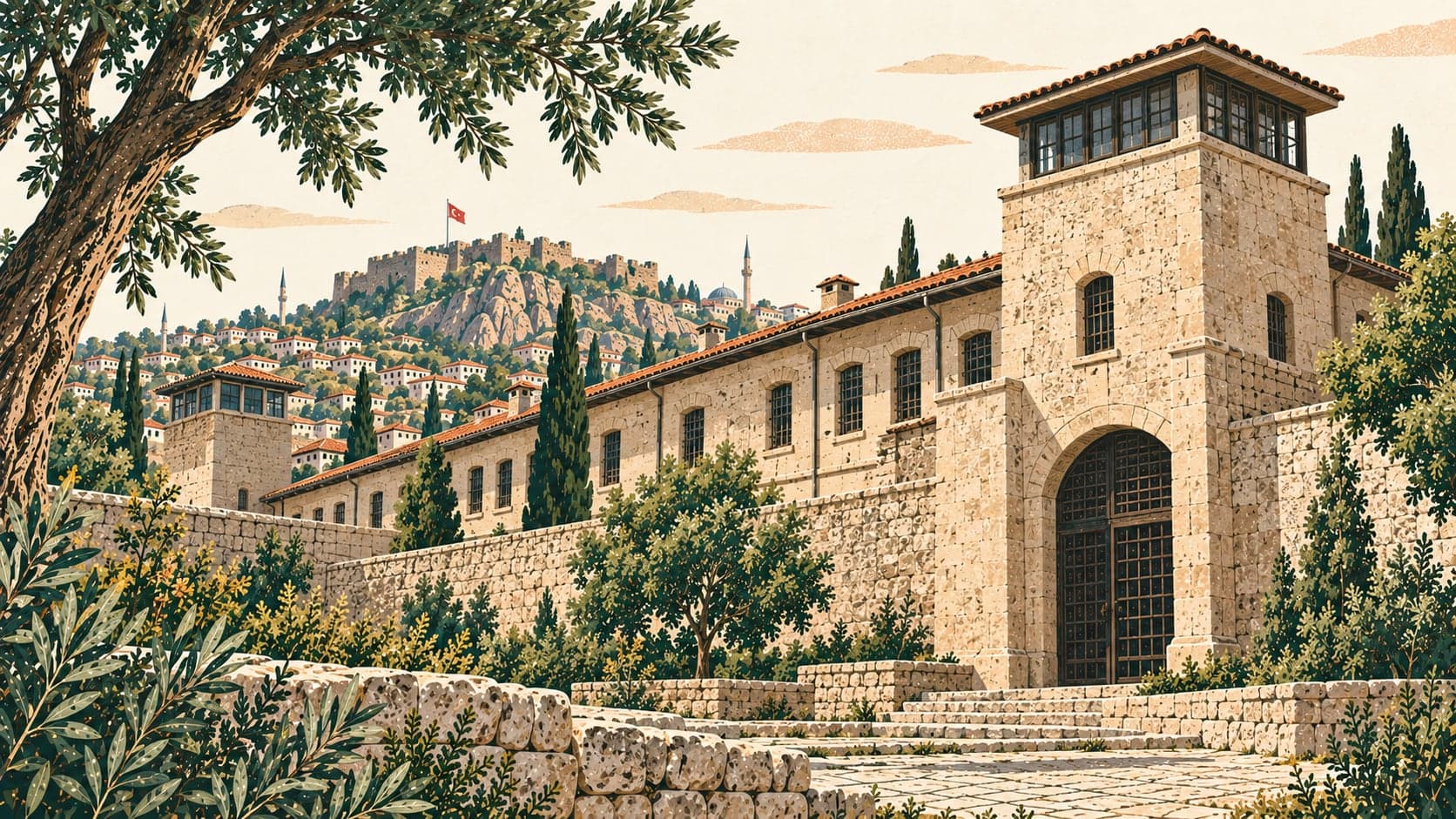
Ulucanlar Prison, officially the Ankara central closed prison and house of detention, was in use between 1925 and 2006 in the Ulucanlar quarter of the Altındağ district of Ankara. It holds an important place in Turkish political and literary life.
The building was put up in 1923 as a military store, but because its position and structure were thought better suited to a prison, alterations and additions were made and it began work as a prison in 1925. It was the first prison built after the republic was founded.
The project of restoring it and turning it into a museum and centre for culture and the arts was given to the Altındağ municipality, which began the restoration in 2009, finished it in 2010, and opened the prison as a museum in 2011. After eighty-one years as a prison it has since received more than a million visitors.
The museum holds courtyards displaying detailed accounts of the journalists, writers, poets and politicians imprisoned here over those eighty-one years for what they thought, along with personal belongings obtained from their families and photographs taken while they were inside. Twenty-two wax figures of prisoners have been placed in the wards and isolation cells, which were laid out as they had been, and from the loudspeakers in the corridors come the sounds of screaming that stand for the torture carried out in the isolation cells.
The first executions took place in 1926, those of İskilipli Atıf Hoca and Ali Rıza Hoca, and five more prisoners were put to death the same year after the İzmir assassination plot. In 1964 Colonel Talat Aydemir and Major Fethi Gürcan, who had led the risings of 22 February and 20 May, were executed here. Deniz Gezmiş, a leading figure of the 1968 generation, and two of his friends were executed on 6 May 1972, and the last prisoner put to death here was the ASALA militant Levon Ekmekçiyan in 1983.
Seven executions were carried out in Atatürk's time, two after the failed coup attempt of 20 May 1963, three after the memorandum of 12 March 1971 and seven after the coup of 12 September 1980. Of the nineteen executions eighteen were political; Ednan Kavaklı, put to death in 1982, went into the records as the only ordinary criminal among them.
Among the many well-known prisoners held here were the writers and poets Nâzım Hikmet, Yaşar Kemal, Kemal Tahir and Fakir Baykurt, the film-maker Yılmaz Güney, the journalists Cüneyt Arcayürek and Metin Toker, and the politicians Bülent Ecevit, Muhsin Yazıcıoğlu, Leyla Zana, Hatip Dicle, Orhan Doğan, Mahmut Alınak, Selim Sadak and Sırrı Sakık.