Guide
Before planning a visit, note that the museum has been closed for restoration.
The building came first. Bayezid II had this medrese raised between 1506 and 1508 as part of his complex at Beyazıt, and for a long time people called it the Havuzlu Medrese, the medrese with the pool, after the large rectangular pool that stood near the entrance.
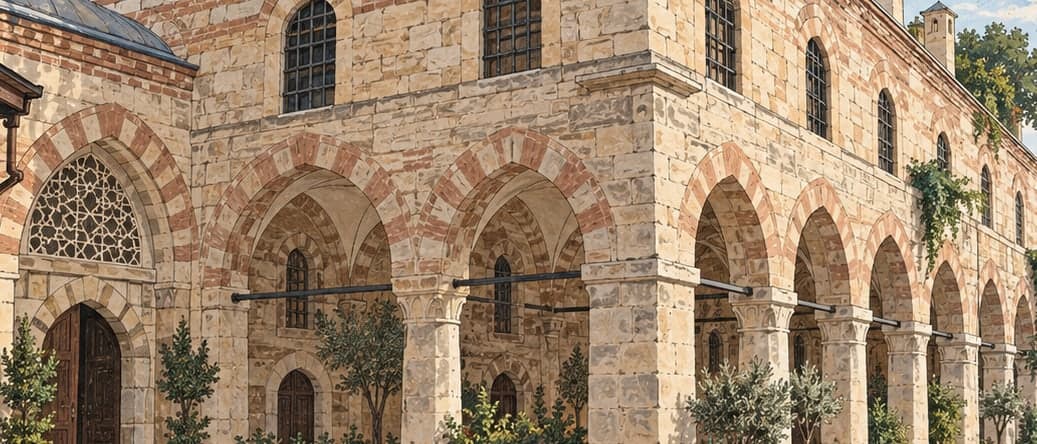
Its plan is the classical one: a lecture room at the centre with the students' cells ranged around it. Twenty-five domes cover the arcade. The lecture room has nine windows below and twelve above, round-arched under the dome, and its doorway is framed in pink and white marble.
The museum itself began elsewhere. A museum of writing opened in 1968 in the Yavuz Selim medrese; after the directorate general of foundations restored the Bayezid medrese, the collection moved here and opened as the Museum of Turkish Calligraphic Art on 28 October 1984.
The holdings run to 3,638 works, of which 277 have been on display: manuscripts, panels, and calligraphy worked on stone, glass, fabric and metal, alongside the tools and materials of the art.
The works are shown in chronological order and include pieces by masters such as Mustafa Dede, Murad III, Hâfız Osman, Yedikuleli Seyyid Abdullah, Ahmed III, Mahmud Celâleddin, Mahmud II, Abdülmecid, Râkım Efendi, Kazasker Mustafa İzzet Efendi, Sâmi Efendi, Abdülhamid II, Kâmil Akdik, Necmeddin Okyay and Hamit Aytaç.
The lecture room is arranged as the section of the Sacred Relics. At its centre is the covering of the door of the Kaaba, dated 1884. The pieces most valued here are a hair from the Prophet's beard and earth from his tomb, kept in a bottle, and there are miniatures showing Mecca, Medina, Mina and Muzdalifah.
The museum stands in the grounds of the Bayezid Mosque and is reached by tram or by municipal bus.