Guide
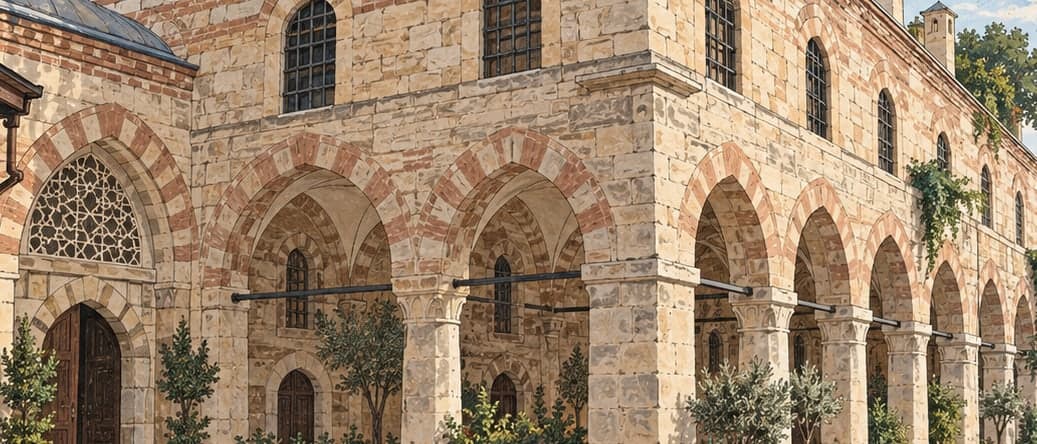
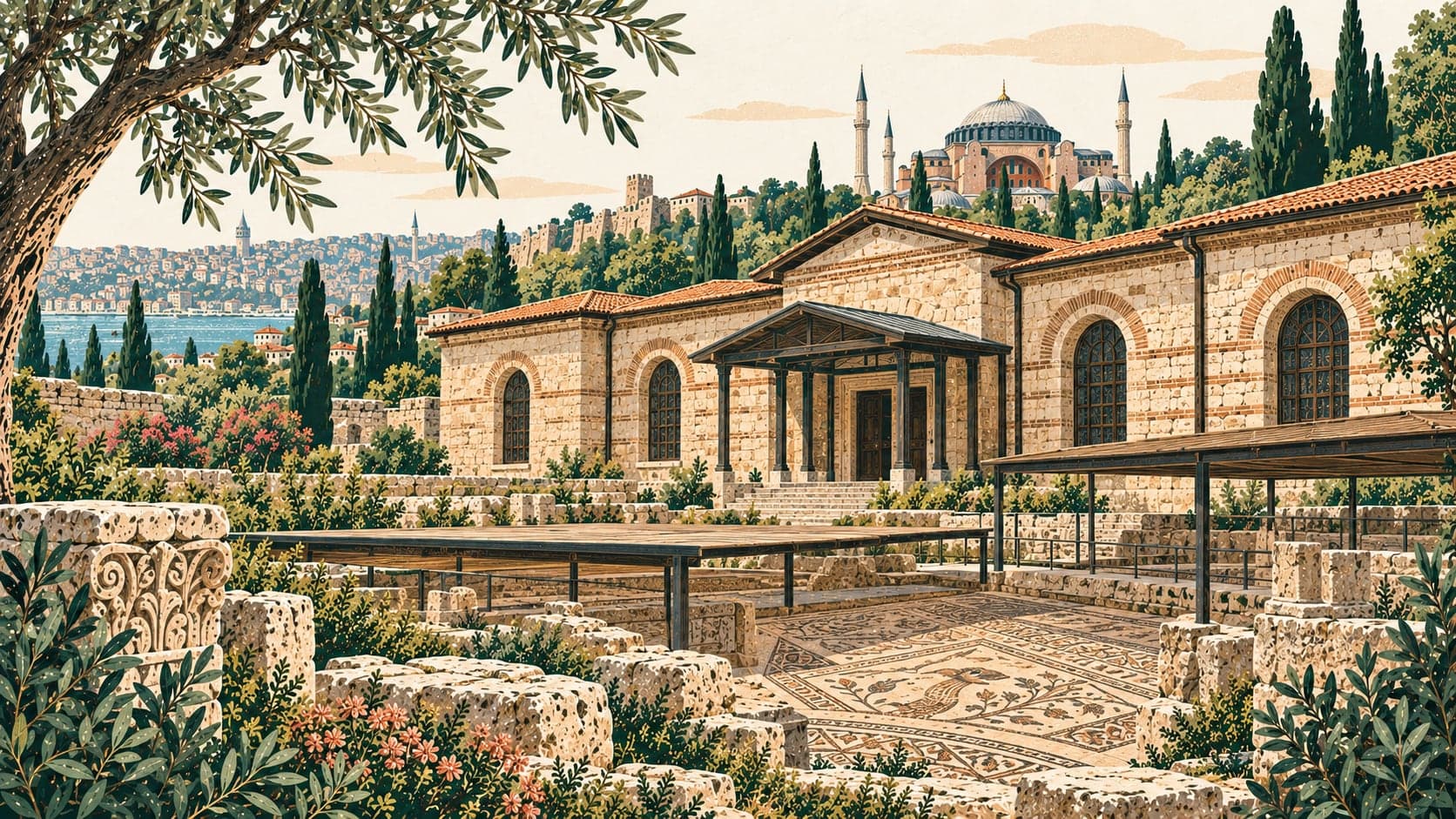
The Great Palace Mosaic Museum stands in the Arasta bazaar beside Sultanahmet Square in İstanbul, built over the remains of the part of the Great Palace it displays: a peristyle, a colonnaded courtyard open at the centre, whose floor was laid with mosaic. The bazaar of the Sultanahmet mosque was later built on top of it. Mosaics from the other parts of the peristyle have been brought into the museum building from where they lay.
The mosaic covers 1,872 square metres and is one of the largest and most varied landscape compositions to survive from late antiquity. In the surviving pieces there are ninety separate subjects, told with 150 human and animal figures. The scenes are given over to the open air: shepherds' life, peasants at work, the courage of hunters, children at play, animals wild or grazing, and creatures of myth and fable. There is no explanatory text anywhere in it — whoever saw it then needed none.
The main picture was six metres wide, with coloured scenes set out along four bands of frieze, and a border a metre and a half wide ran round the inside and outside edge, worked with acanthus-leaf scrollwork and interrupted at regular intervals by large mask figures, the gaps between the spirals filled with coloured animals and fruit — a border that ties the whole to the world of Dionysos. On either side of it ran a wave band of many-coloured geometric shapes. The main picture was meant to be seen from the courtyard side of the peristyle, and in the north-east hall the movement of the scenes runs left to right, towards the palace hall on the south-east edge.
The scenes fall into eight main groups. In the tiger hunt, two hunters with long hunting spears face a tiger springing at them; they wear sleeveless shirts, broad shoulder cloaks and tunics, with their legs bound in bandages for protection, and the badges on their clothing, resembling the arms of the guards regiment, suggest they belonged to the palace. In the boar hunt a hunter in a coat-like garment and sandals kneels waiting with his spear while a grey-black boar, bleeding from wounds in several places, charges at him from the left. In the lion hunt a mounted hunter draws his bow on a lion about to attack the horse from behind.
The peristyle belonged to the Great Palace and dates from between AD 450 and 650; it was built on roughly the same axis as Hagia Sophia and Hagia Irene so as to agree with them. Researchers from St Andrews University uncovered it, along with several other buildings, in excavations in the 1930s on the middle terrace of the palace. These buildings stood on an artificial terrace of underground vaults and covered about 4,000 square metres; the peristyle measured 66.50 by 55.50 metres, an area of 3,690.75 square metres, and the halls around the court were nine metres deep and ringed by ten by twelve Corinthian columns about nine metres high. The floor was laid with the mosaics now in the museum when the peristyle was renewed in the reign of Justinian I, between 527 and 565.
The date of the mosaic was disputed during the research project until three separate soundings in an undamaged part of the north-east hall gave the same result: the mosaic and the new colonnaded court were built at the same time. Pottery and building debris in the insulating layer beneath settled the matter. In it were fragments of the kind of amphora called a Gaza amphora, in which wine made from grapes grown in the oases of the Negev was carried across the Mediterranean in the closing decades of the fifth century, along with fragments of other pottery of the last quarter of that century. The mosaic was therefore made in the first half of the sixth century, in all likelihood for Justinian I.
The technique had appeared in Anatolia and been developed over centuries in Greece and Italy; for this floor craftsmen were probably gathered from every corner of the Byzantine empire. The paving was laid in three layers, and on top of them the mosaic itself, made of coloured cubes five millimetres across: limestone and marble in fine gradations of colour, glass in reds, blues, greens and blacks, rust-coloured clay, terracotta, and in places even precious stones. A square metre took about 40,000 cubes; the whole floor took some 75 to 80 million.
The south-west, north-west and north-east halls of the peristyle were badly damaged after Justinian's reign as other buildings went up on the site. The 250 square metres uncovered are about one eighth of the original floor. After conservation and the building of the museum, the mosaic on the floor of the north-east hall was opened to visitors in the place where it was laid. The museum opened in 1953 under the İstanbul Archaeological Museums, passed to Hagia Sophia in 1979, and took its present form when the last restoration — carried out under a 1982 agreement between the General Directorate of Monuments and Museums and the Austrian Academy of Sciences — was completed in 1987.
Visit status for this record: open to visitors.