Guide
Ordu's museum is housed in a mansion rather than a purpose-built gallery, and the building is the reason to come. It stands in the Selimiye quarter of Altınordu, on the road up to Boztepe, and was put up in 1896 for Paşaoğlu Hüseyin Efendi. With its garden it covers 625 square metres.
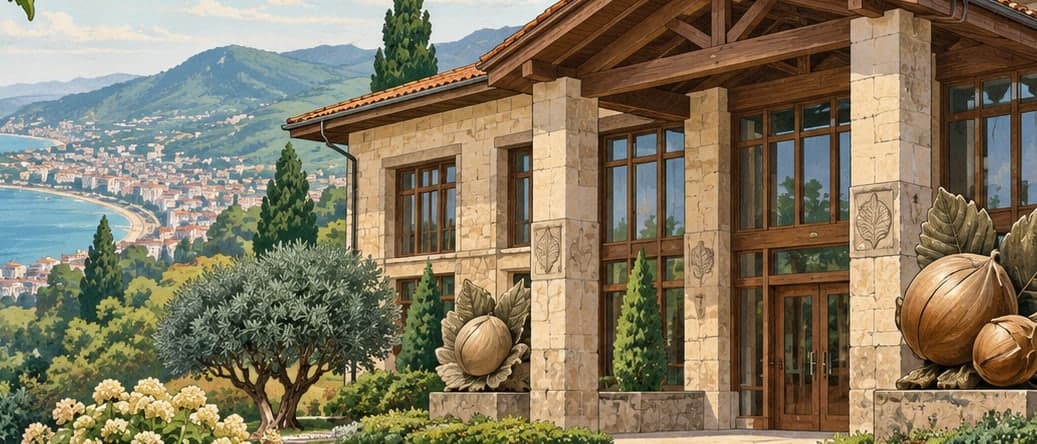
The stonework is what the provincial directorate singles out, and it is unusual for a private house of this date. The stone was brought from Ünye, the timber from Romania, and a master builder was fetched from İstanbul for the work. Three storeys including the ground floor, a moulded band separating the first and second, capitalled and plinthed columns at the corners, windows framed in dressed stone and carried on decorated corbels under deep eaves: all of it is registered as a protected work. The garden wall, the steps, the balcony and the carved stone balustrades along the roof edge belong to the same scheme.
Inside, the ceilings are boarded in timber. The one over the upper-floor hall is painted in oils on paper, with a lozenge of plant motifs at the centre and landscapes set into medallions at the corners; the bathroom is faced with patterned tiles. In the garden there is a pool with a fountain and the original stone hearth, now sheltered under a wooden roof.
The house was expropriated by the Ministry of Culture and Tourism's General Directorate of Monuments and Museums in 1982 and opened to visitors in 1987, once repairs were finished, as the Paşaoğlu Mansion and Ethnography Museum.