Guide
The Nebi Mosque stands in the Sur district of Diyarbakır. It was built in the fifteenth century under the Akkoyunlu and is also known as the Mosque of the Prophet.
An inscription on the minaret dated 936 of the Hijri calendar, 1530, shows that a Diyarbakır butcher named Hacı Hüseyin had that part built, but who built the main structure is not known for certain; the single-domed mosque under its stone roof is thought to be an Akkoyunlu work of the fifteenth century, with some changes made in the sixteenth. The name comes from the inscriptions on the minaret, many of which report sayings of Muhammad with the words the Prophet said, which is why the building is called the Nebi Mosque, the Mosque of the Prophet, or Camiu'n-nebi.
The sources say that when it was first built the mosque covered a very wide area. It was once divided into a Hanefi and a Shafi'i section; the building standing today belongs to the Shafi'i side. During the First World War the Hanefi section was used as a barracks, and its tiles and other parts were damaged as a result. That section collapsed entirely in 1927, and in 1955 what was left of it, together with the minaret, was pulled down by the municipality and taken into Gazi Avenue, which was being widened at the time. In the same year the minaret was moved from beside the entrance to where it stands today and the mosque took the form it now has. In 1960 the Directorate General of Foundations repaired what remained and the minaret was rebuilt in its present position. The mosque also had a courtyard with an arched gate adjoining the minaret, small shops on the eastern side of it, and a medrese to the north, part of which survives.
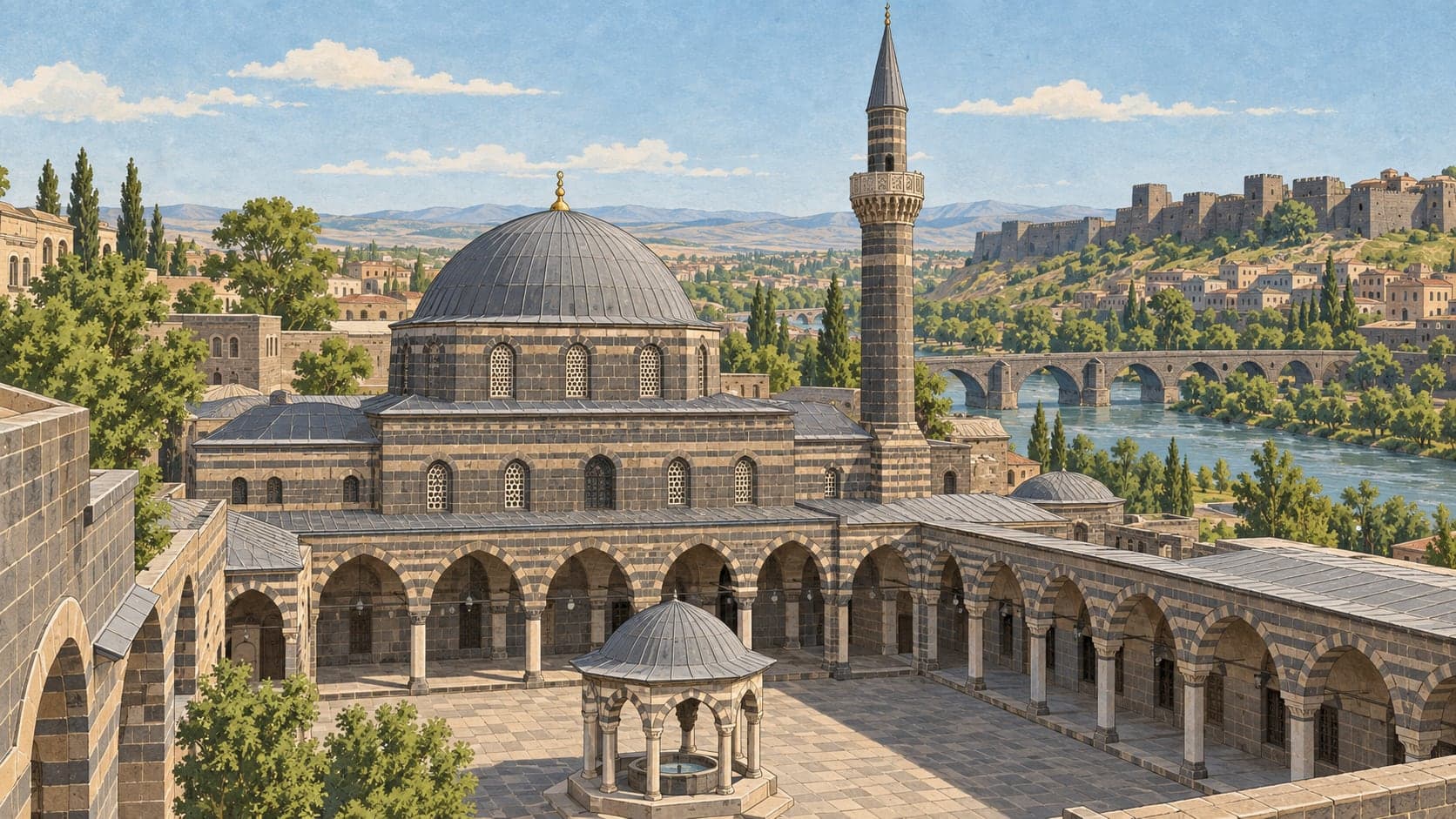
The mosque is built of the black basalt characteristic of Diyarbakır. On the face of the porch and on the minaret, courses of white and black basalt were alternated to break up a uniform appearance. The plan rests on six supports. The columns of the porch have cylindrical shafts, with capitals chamfered at the edges into the form of a truncated pyramid, and the pointed arches of the arcade are framed and emphasised by hollow and round mouldings.
The Hanefi section lay east of the Shafi'i one and was rectangular across its width, with four aisles on piers and arches, while the Shafi'i section is likewise rectangular across its width and covered by a dome. The minaret is four-sided and ringed with decorated inscriptions. The building has a single storey and opens to the outside through one door on its northern face, which looks onto the courtyard, with two window openings on each face, eight in all.