Guide
The Meydan Medrese stands on a level platform east of the Kale Altı cemetery in Hakkari, and it is an early eighteenth-century example of the courtyard medrese — the plan that began in Anatolia under the Seljuks and developed through the beyliks and the Ottoman period. In plan and detail it resembles the medreses at Bitlis, Hoşap and Pizan. Its inscription over the door records that it was built in 1700-1701 by İbrahim Bey, son of İzzeddin. Writing in 1959, Oktay Aslanapa reported that the arcaded courtyard of this two-storey building was in ruins.
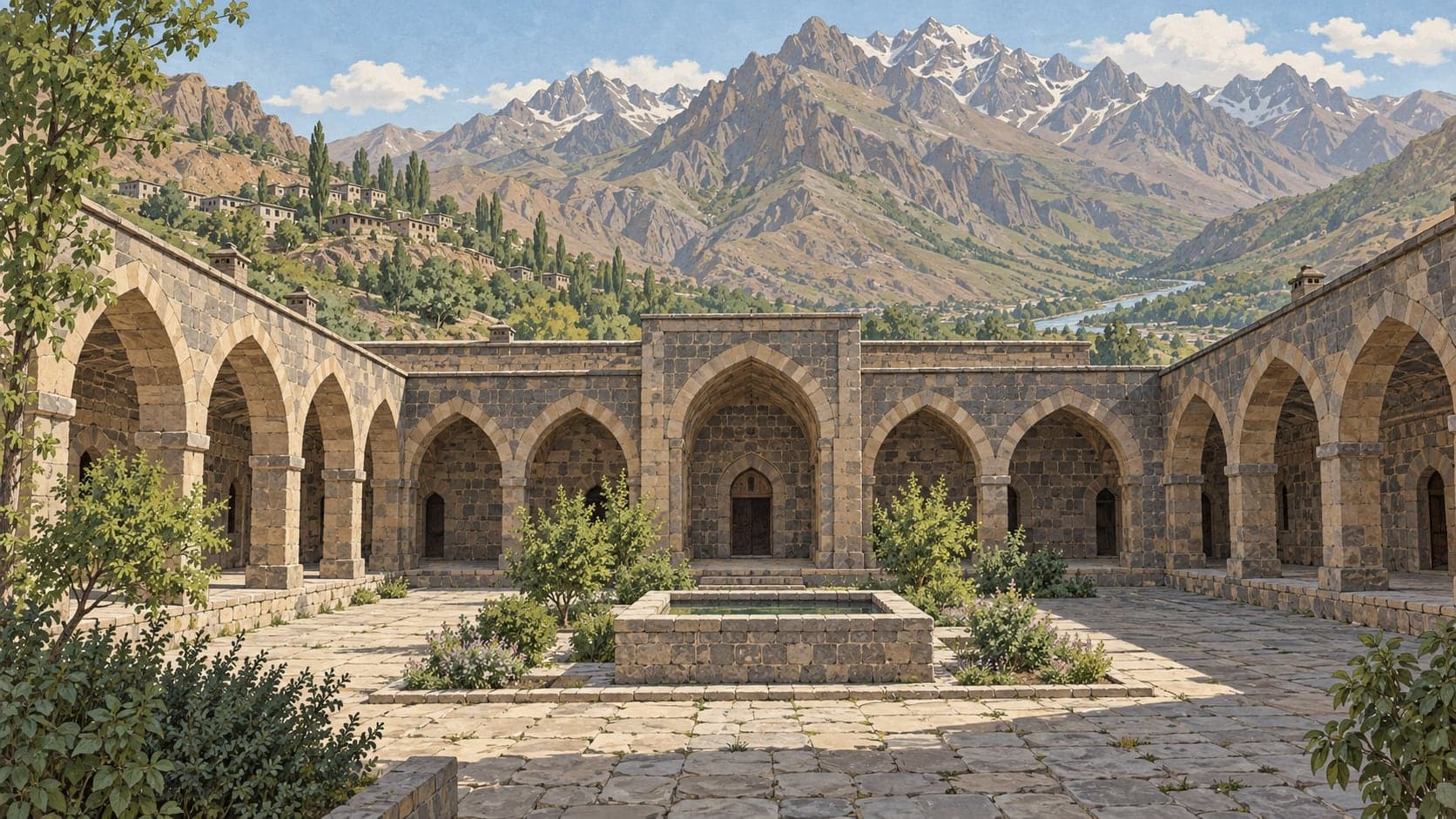
The building covers a broad rectangle of 18.25 by 23.40 metres on its outer dimensions. It belongs to the group of flat-roofed medreses with an inner courtyard, two storeys and two wings, and it is built of regular cut stone bonded with lime mortar. The portal is in the middle of the south front: a shallow recess under a pointed arch, framed from the corner by a spirally fluted round moulding and then by a band of muqarnas. On the ground floor the arcades rest on cylindrical columns with capitals and bases of varying forms, and on the upper floor on piers. Each level has three arcade bays north and south and four on the sides, and the students' cells are ranged in two wings on the east and west of the courtyard.