Guide
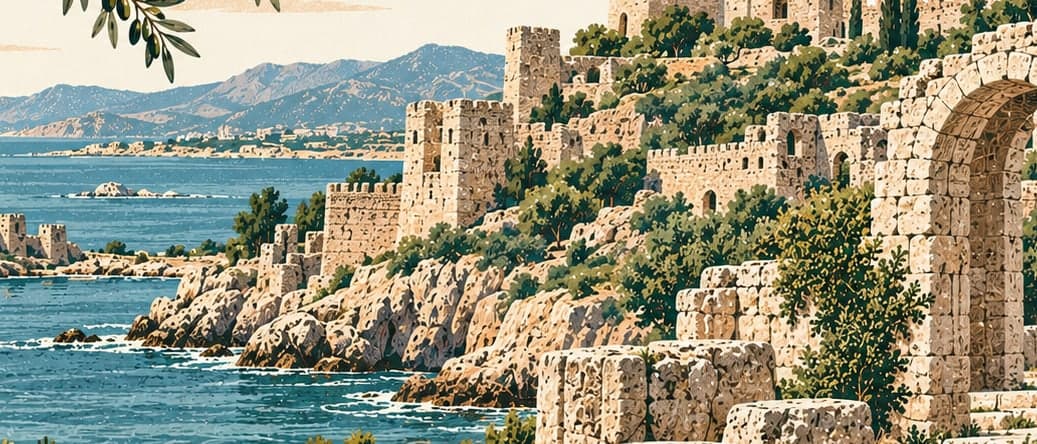
Kız Kalesi, the maiden's castle, stands on a small island in the Erdemli district of Mersin, about eighty kilometres from the city and some three hundred metres off the shore. The island covers about 15,000 square metres and the castle takes up most of it; the holiday town on the coast takes its name from the castle.
Strabo records that the island was used by pirates in antiquity, but the castle was probably built by the Byzantine emperor Alexios I after the First Crusade. It was extensively rebuilt in the thirteenth century by the Armenian king Levon I and by at least one ruler of the Armenian kingdom of Cilicia after him.
Archaeological studies published in 1982 and 1987 showed that the original Byzantine plan survives mainly on the south side, with its characteristic square towers. The Armenians rebuilt the north and west sides with round towers and with the rustic cut stonework particular to them, rather than material reused from the late antique town, and they refaced much of the rest of the structure. Two Armenian inscriptions are reported to record rebuilding by King Levon I in 1206 and by King Hethum I in 1251. The Armenians also built a barrel-vaulted chapel inside the castle.
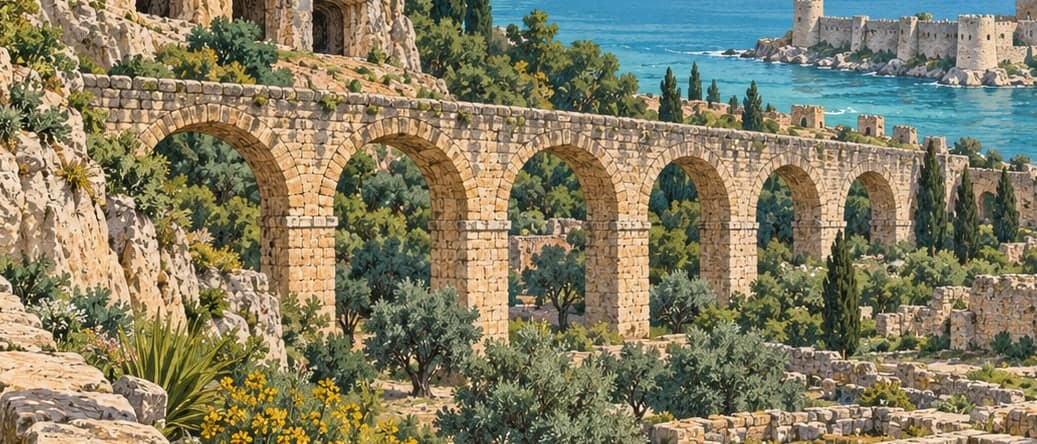
The island was once joined by a breakwater to the castle on the mainland at Korykos, which the Armenians called Gorygos. In the fourteenth century the kingdom of Cilicia was close to collapse, and in 1360 Peter I, king of Cyprus, took the island at the request of its people. The castle was taken in 1448 by the Karamanids, an Anatolian emirate, and in 1471 by Gedik Ahmet Pasha, grand vizier of the Ottoman empire.
Restored in recent years, the castle is guarded by eight towers, each of a different shape. Its outer circuit measures 192 metres. The south and west walls stand at right angles to one another, while the north and east faces are ringed by curved walls. The main gate is on the north side, with a small gate and a gallery on the west. A thorough photographic survey including plans of both castles at Kızkalesi was carried out between 1973 and 1981.
A legend explains the name. The king of Korykos prayed constantly for a child, and at last a daughter was born to him who grew more beautiful as she grew up, until kings and princes who heard of her wished to marry her. One day a seer invited to the palace started at the sight of her, and pressed by the king to say why, told him that his daughter would be bitten by a snake and die, and that no one could turn that fate aside.