Guide
The Gordion Museum stands in the village of Yassıhüyük in the Polatlı district of Ankara, founded in 1963 beside what was then a village of five hundred people. The tumulus of King Midas lies within the site. The source adds that Midas's skull was later taken to the Museum of Anatolian Civilisations in Ankara, and that his skeleton is claimed to have been lost afterwards — it gives this as a claim, not as an established fact.
The display runs in chronological order, each period shown through characteristic pieces. Three cases hold Early Bronze Age work, among it the handmade, beak-spouted jugs typical of central Anatolia in that period. Then comes the Early Phrygian material, the age that ends with Midas: handmade pottery of the Early Iron Age, iron tools, implements for working textiles. In the new hall a panoramic case reconstructs a typical building from the destruction layer dated to about 700 BC, and the rest of that hall holds imported Greek pottery of the sixth century BC to the fourth century AD alongside Hellenistic and Roman material. The last section shows the seals and coins found at Gordion.
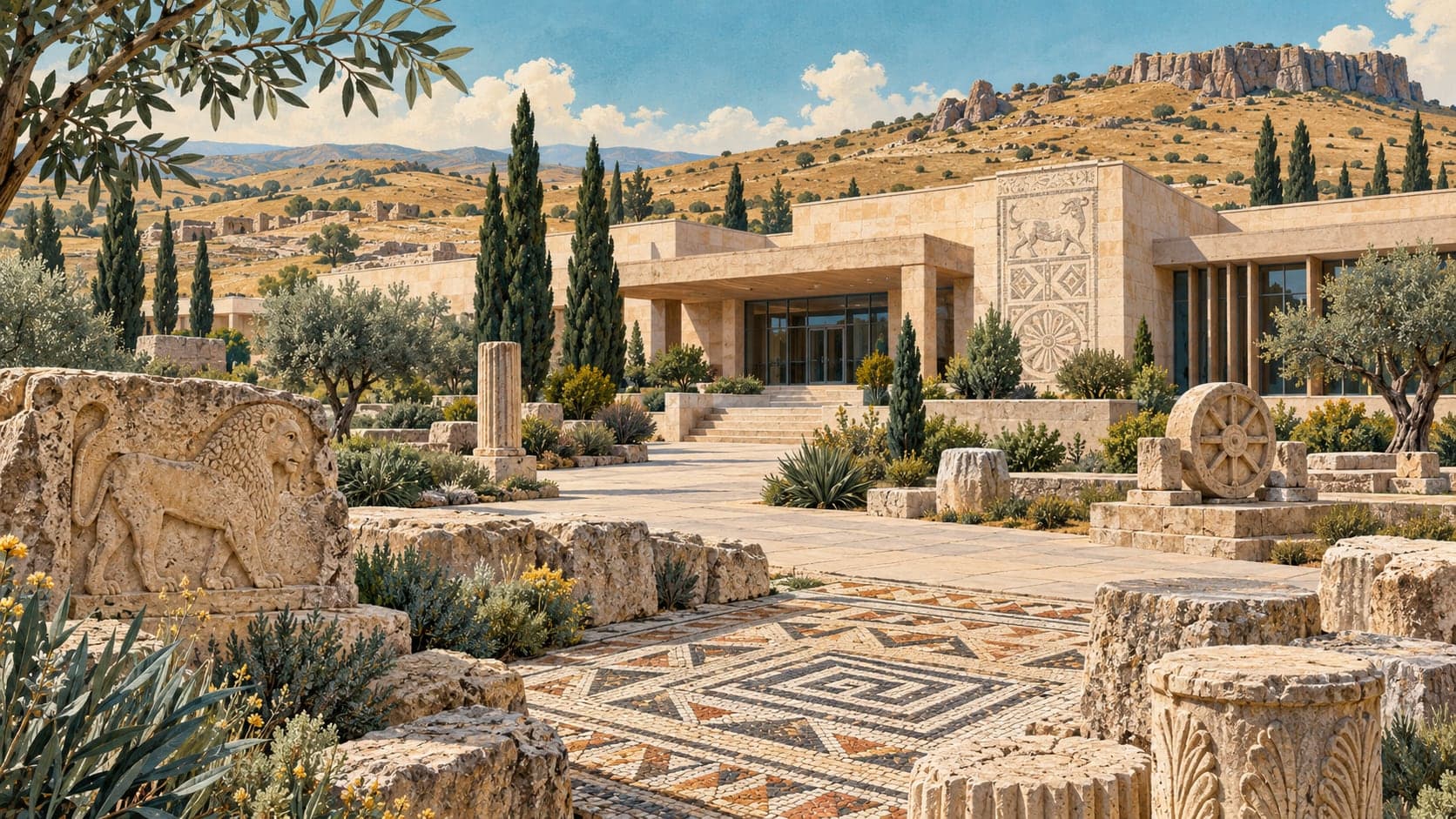
Outside, the newly excavated area has been planted with the trees the Phrygians used for their furniture — cedar, scented juniper, box, Scots pine, walnut and yew. A Roman mosaic and a Galatian tomb were moved into this open-air area as part of the same work.