Guide
Göbeklitepe is a prehistoric place of worship on a hill overlooking the Harran Plain, near the village of Örencik in Şanlıurfa. Nobody lived here: the site served worship rather than settlement. Its past reaches back roughly twelve thousand years, and it is regarded as the oldest and largest cult centre known anywhere. It remained in use until around 8000 BC and was then abandoned, never put to a comparable purpose again.
What makes the site matter is what it shows about belief and the shift to settled life. It is a reference point for understanding the move from hunting and gathering to farming, and the beginnings of temple architecture and of art. Its finds reopened much of what was assumed about the Neolithic. Excavation began in 1995 under the German archaeologist Prof. Dr. Klaus Schmidt and continued for twenty years, until his death in 2014. The site joined the UNESCO World Heritage List in 2018, and Türkiye declared the following year the Year of Göbeklitepe.
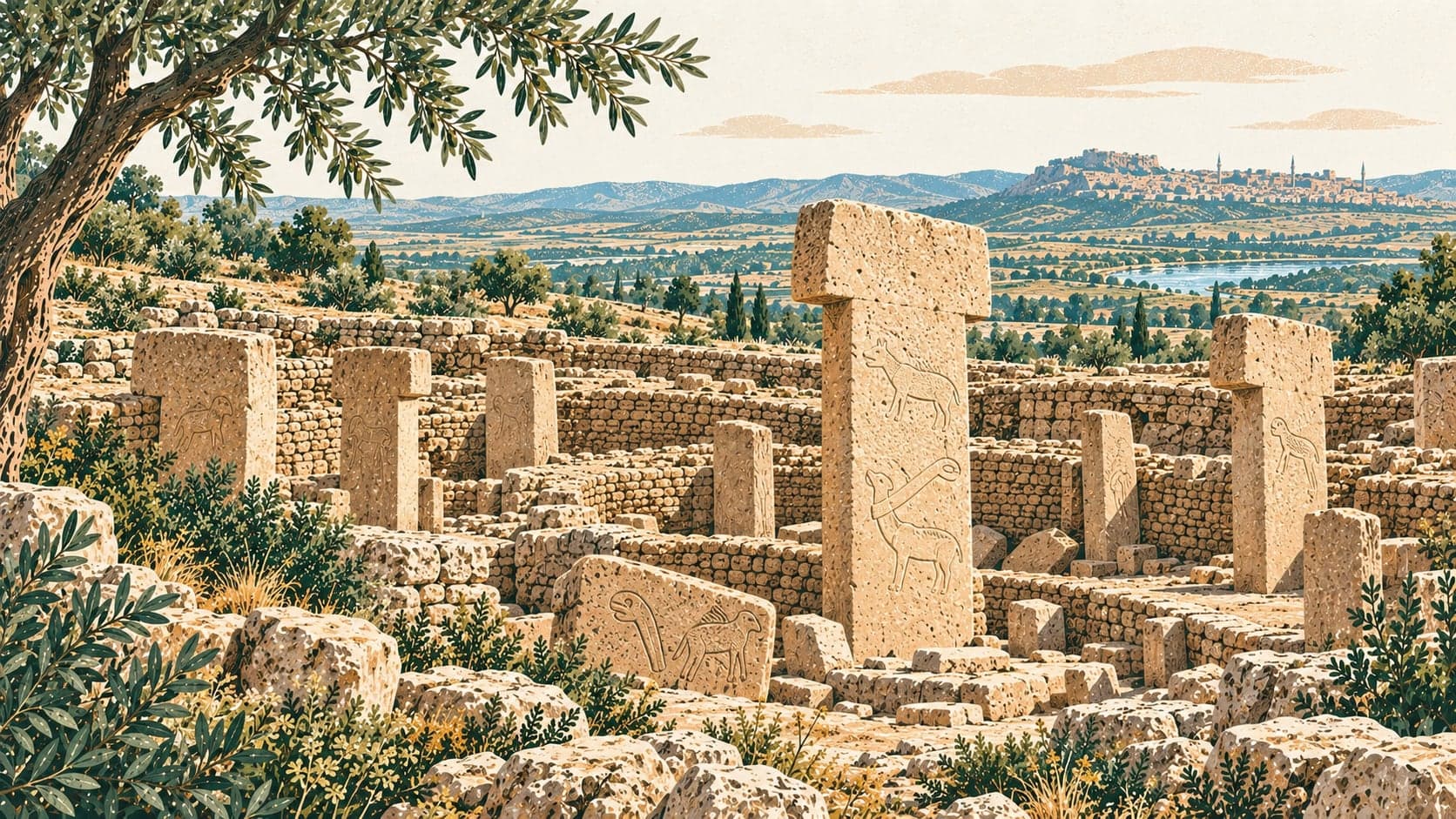
What you see are monumental T-shaped pillars, some six metres tall and weighing up to forty tonnes. Ten to twelve of them stand in a circle with stone walling between, and at the centre of each enclosure rises a larger facing pair. Excavation has uncovered six such structures; geomagnetic survey suggests the number approaches twenty. Most pillars carry human, animal or abstract symbols, and those worked with hands, arms and fingers are read as stylised human figures.
Visits start at the reception building, from which a shuttle reaches the excavation in about a minute; an introductory presentation is shown at the entrance. The excavation area, divided into sections A, B, C and D, is ringed by a walkway and sheltered by a roof. The finds and figurines are displayed at the Şanlıurfa Archaeology Museum, where the leopard, wild boar, stork, fox, gazelle, scorpion and snake reliefs and the headless human figure can be seen. The museum also holds a large replica of the site.
Getting there
The site is near the village of Örencik, outside Şanlıurfa. Visits begin at the reception building rather than at the excavation itself; a shuttle covers the remaining distance in about a minute.
When to go
The excavation area is roofed and a walkway runs around it, so the visit does not depend on the weather. An introductory presentation is shown at the entrance and is worth arriving in time for.