Guide
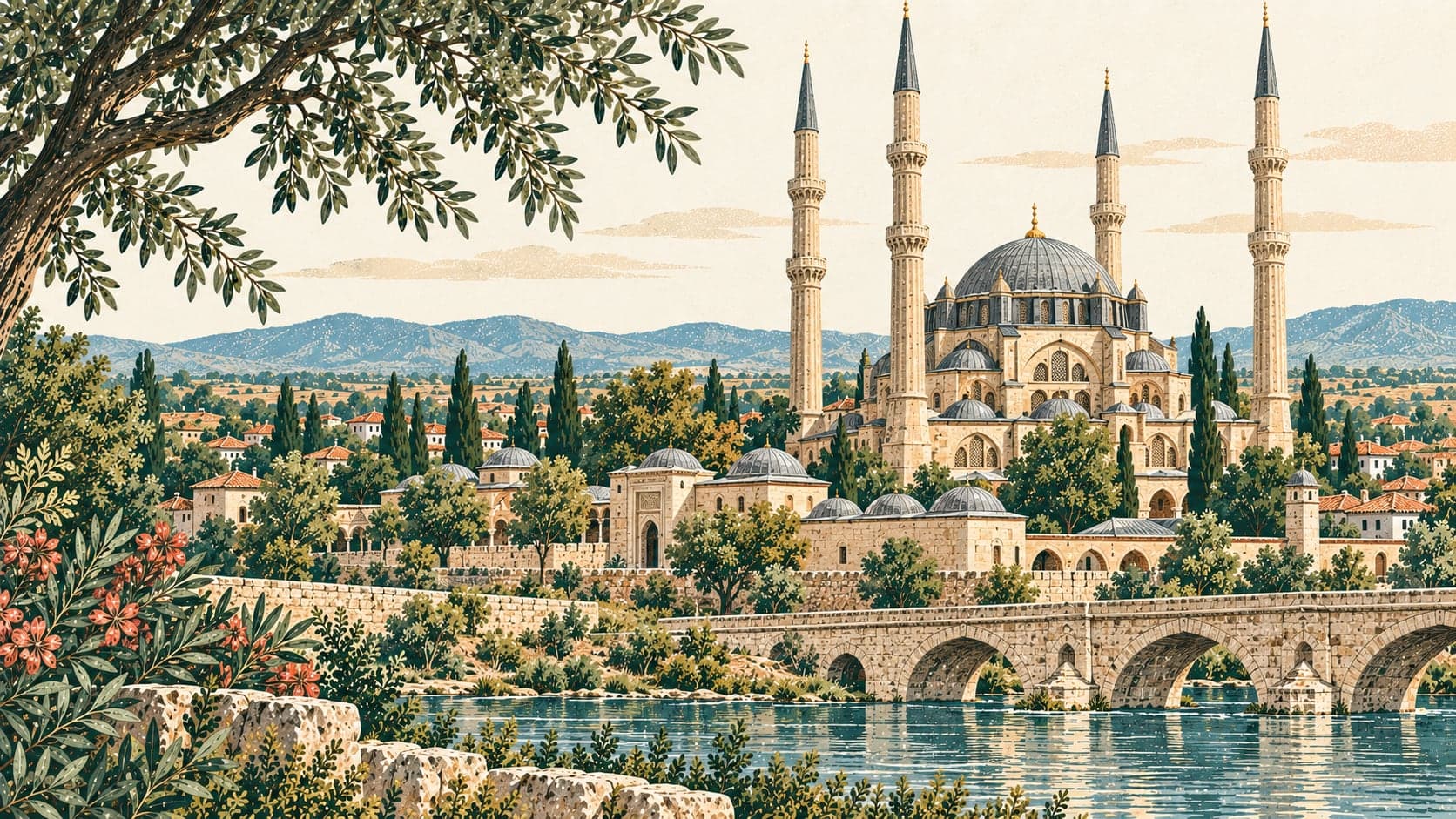
The Selimiye is the work Mimar Sinan built at the age of eighty and called the work of his mastery. It is counted among the masterworks not only of Ottoman-Turkish architecture but of world architecture, and it is the emblem of Edirne and of the Ottoman period alike.
It was built by order of Selim II. The provincial directorate gives the years as 1569 to 1575; the inscription, as read in the Wikipedia article, puts the start in 1568. The opening was planned for Friday 27 November 1574 but took place on 14 March 1575, after the sultan's death. Ownership rests with the Sultan Selim Foundation.
The site, now in the centre of the city, had held Edirne's first palace — begun under Süleyman Çelebi and developed under Bayezid I — together with the quarters of the halberdier guards; in the sources the area is also called Sarıbayır or Kavak Meydanı. Standing out from far off with its four minarets, the mosque shows in the choice of its site that Sinan was also a master of town planning.
Why the sultan chose Edirne is not known for certain. Evliya Çelebi wrote that Selim saw the Prophet Muhammad in a dream and was asked to build a mosque in memory of the conquest of Cyprus; but Cyprus was taken in 1571, three years after building began, so that account cannot hold. More plausible readings note that İstanbul had no need of another great mosque at the time, that Edirne was the centre of Ottoman rule in Rumelia, and that Selim had felt a particular affection for the city since his youth.
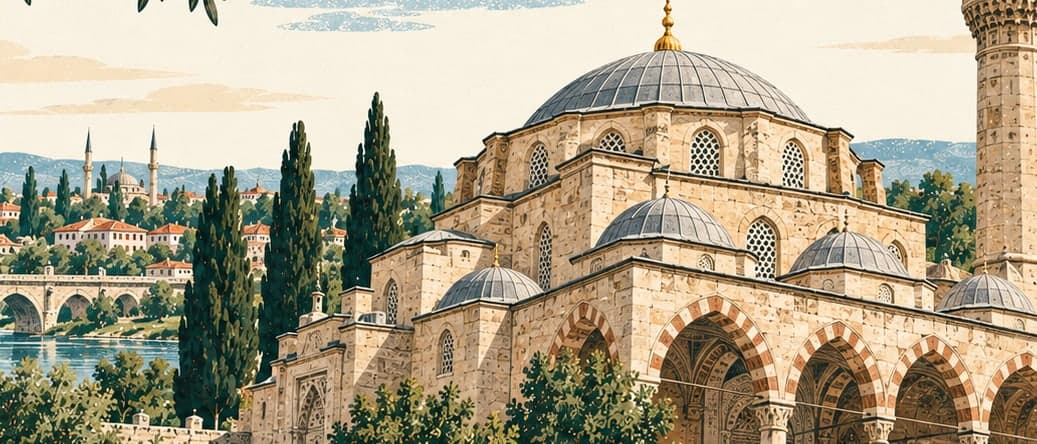
The mosque is built of cut stone and covers 1,620 square metres inside and 2,475 square metres in all. Where earlier domed buildings raised the main dome above stepped half-domes, here a single dome covers the whole interior: about 31.30 metres across and rising some 43.28 metres above the floor. It rests on a drum carried by eight great piers, tied to them by arches six metres wide — the most accomplished example of the eight-pier plan Sinan used. Covering the interior this way gave it a width and airiness that let the whole space be taken in at once, and the same dome sets the outline of the building seen from outside.
The four slender minarets each carry three balconies and stand 70.89 metres high. On the entrance side each balcony is reached by its own stair; the other two are reached by a single stair.
Beyond its architecture the mosque matters for its ornament in stone, marble, tile, wood and mother-of-pearl. The mihrab and minbar are masterpieces of marble work. The muezzin's platform at the centre, on twelve marble columns, is among the finest of the classical period, with gilded Edirne-style painted decoration. The tiles, made at İznik in the underglaze technique, hold a place of their own in Ottoman and in world art.
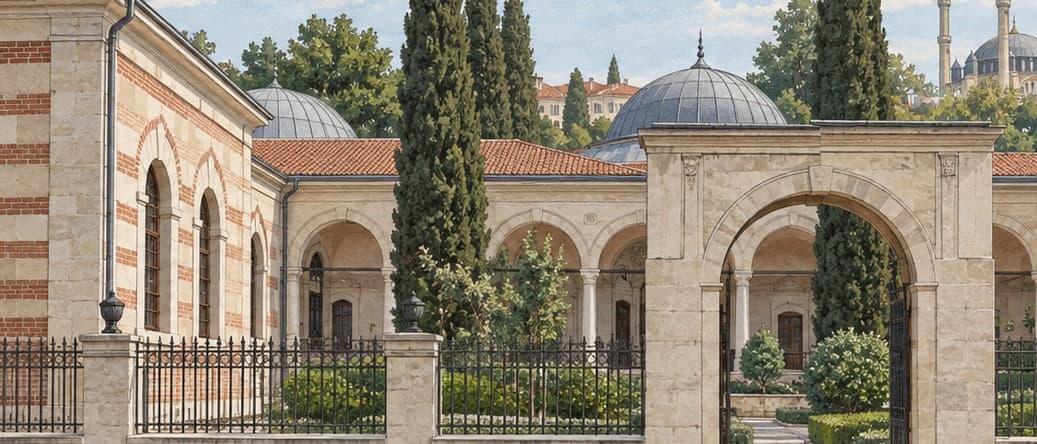
In the wide outer courtyard, enclosed by stone walls, stand the primary school, the school for reciters of the Quran and the school of hadith. The school of hadith serves today as a museum of Turkish and Islamic works and the school of reciters as a museum of foundation works. The arasta market beneath the terrace was built in the time of Murad III to bring in income for the mosque; Sinan built its first row and the architect Davut Ağa completed the rest.
UNESCO placed the complex on its tentative list in 2000 and inscribed it as World Heritage in 2011, as cultural property under criteria one and four, by decision 35 COM 8B.37 of the thirty-fifth session of the World Heritage Committee, held from 19 to 29 June 2011.