Guide
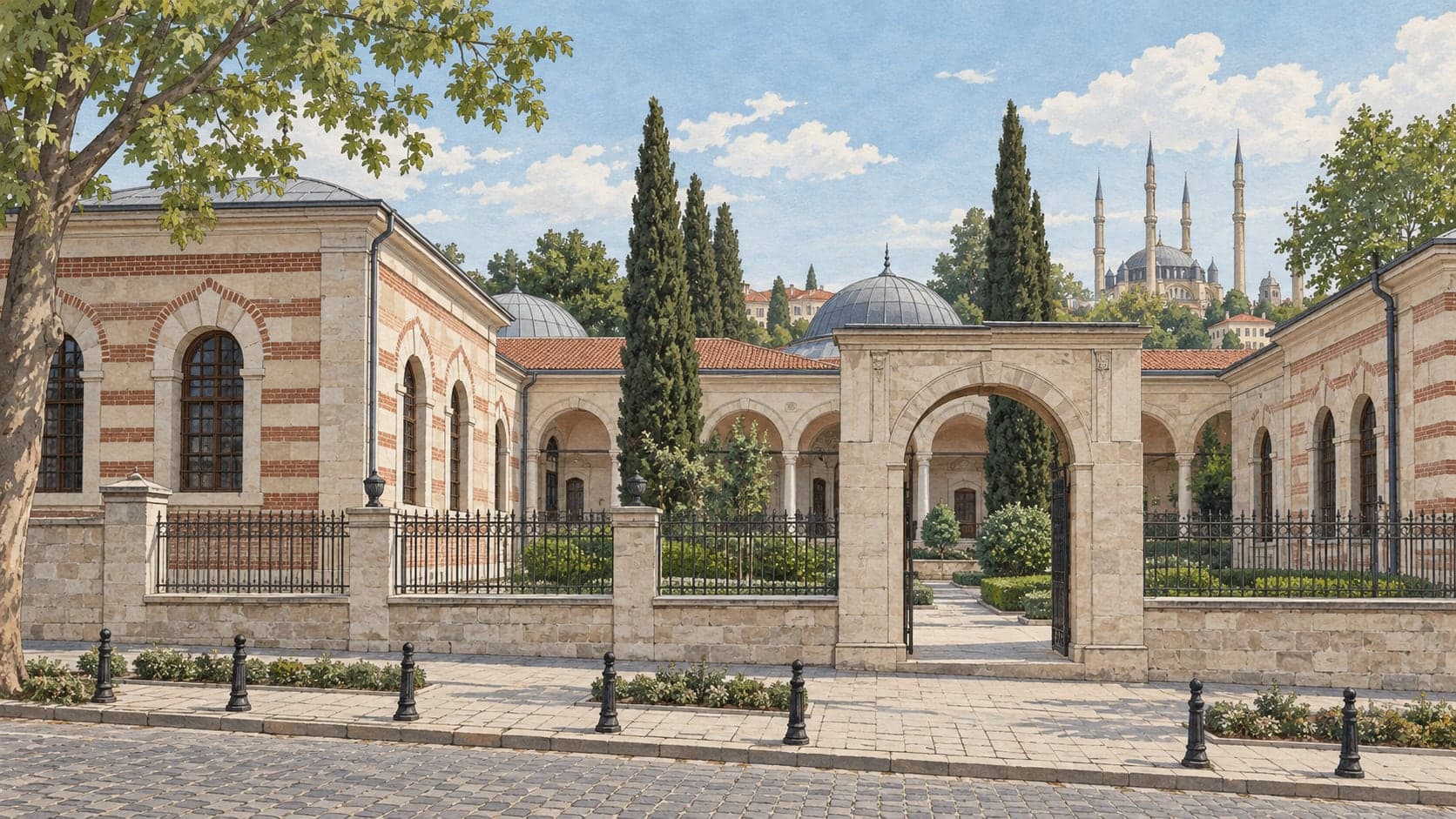
The Edirne Archaeology and Ethnography Museum stands on Kadirpaşa Mektep Avenue in the centre of Edirne, fifty metres from the eastern gate of the Selimiye Mosque, right beside the ground where Ottoman gravestones are displayed.
The first museum in Edirne was founded in 1925, on Atatürk's instruction, in the Darülhadis medrese of the Selimiye Mosque by Dr Rıfat Osman, Arif Dağdeviren and Necmi İğe. Although it was known as an archaeological museum, it also held valuable ethnographic works and gravestones.
Edirne was the Ottoman capital for some ninety-four years, and the court left its mark on the folk arts and gave the city an ethnographic richness of its own. A second museum was therefore needed. The Darüssıbyan medrese in the courtyard of the Selimiye Mosque was restored by the society of friends of the antiquities of Edirne and its region, chaired by Kazım Dirik, inspector general of Thrace, and a second section opened there under the name Ethnography on 25 November 1936. Valuable works were transferred to it from the Ankara Ethnography Museum and the Topkapı Palace Museum.
As the number of works grew, that building too became too small, and the same society repaired the Darülkurra medrese of the Selimiye Mosque, where the ethnographic works were moved and laid out as the Ethnography Museum.
During the Second World War, against the possibility of an attack on the city, most of the valuable pieces were moved to museums in İstanbul and Anatolia, and what remained was displayed only in the Darülhadis medrese. In later years purchases, gifts and finds from excavations increased the holdings, and in 1966 it was decided to build a new museum in Edirne. Built on a plot behind the Selimiye Mosque to a design by the architect İhsan Kıygı, it opened on 13 June 1971 as the Archaeology and Ethnography Museum, while the museum in the Darülhadis medrese was given the name Museum of Turkish and Islamic Works.
The ethnography hall holds regional dress of the Balkans, examples of calligraphy, carpets and kilims, and reconstructions of an Edirne bridal room and sitting room, along with some personal belongings Atatürk used during his visit to Edirne.
The archaeological section begins with fossils: tusks, jawbones, teeth and vertebrae of rhinoceros and horse found in and around Edirne. Among the marble statues and stelae are grave stelae carrying the Thracian horseman, shown together with finds from excavations in Edirne. An important part of the museum is given to the finds from the excavation at Enez — figured amphorae and terracotta figurines.