Guide
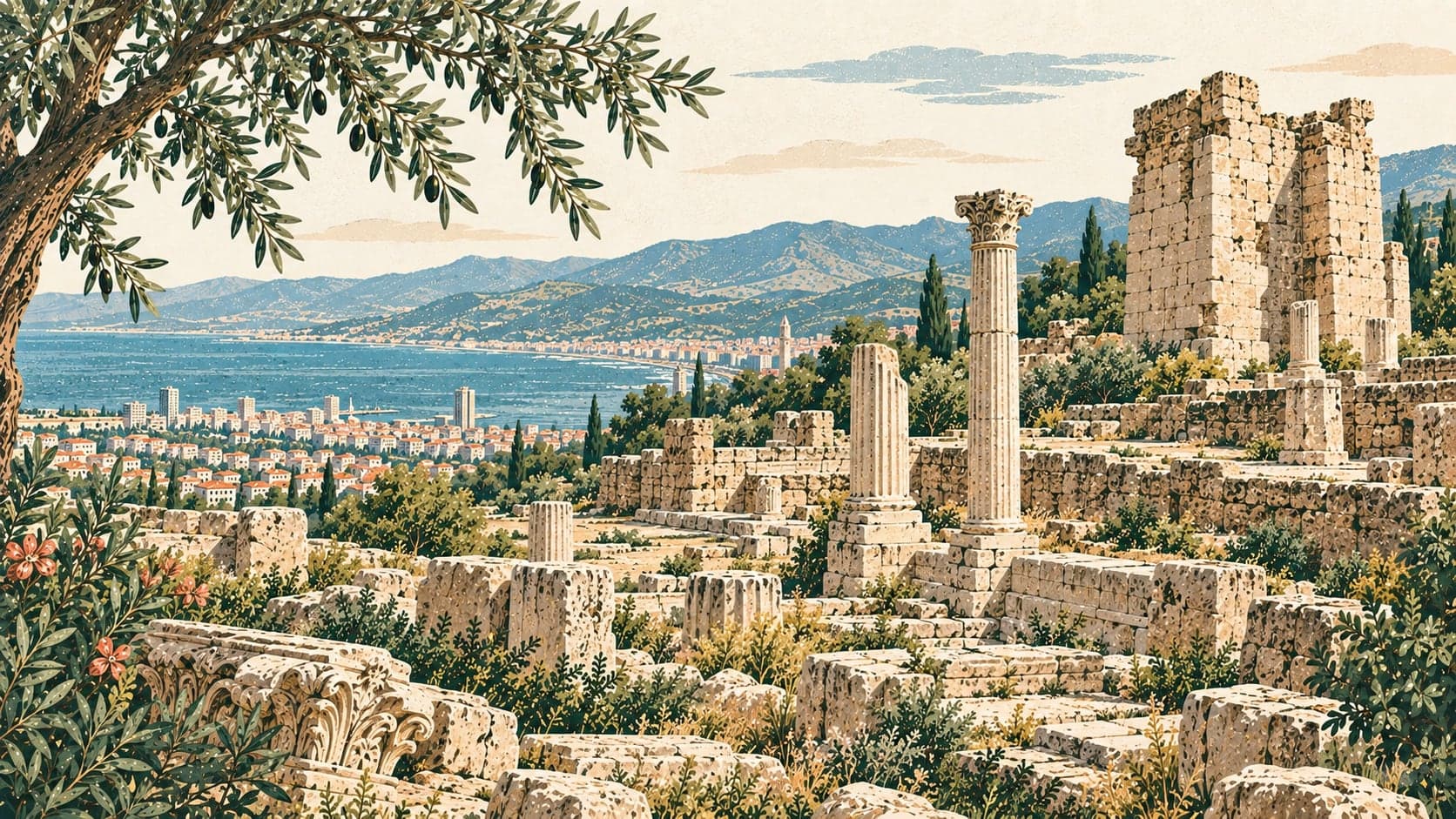
Smyrna sits on the mound at Bayraklı in İzmir — in antiquity a small peninsula with sea to the west and south. The mound covers about a hundred dönüm, a low rise on flat ground, and the city spread from it out across the plain.
The first scientific work here was carried out between 1948 and 1951 by Ekrem Akurgal and John M. Cook with a joint British and Turkish team. What that work established is that Smyrna, founded as an Aeolian city in the eleventh century BC, made a great advance in architecture particularly between 700 and 550 BC. Lydian attacks after the accession of Gyges in 680 BC, and especially under Alyattes around 600, show that the Lydians were a standing danger — and yet these were the city's brightest years.
With its wall, its many-roomed houses with bathrooms, its sacred building, its public fountain and its geometric street plan, Smyrna is an ideal example of an archaic city in western Anatolia. Open to the sea on the west and south, ringed by mountains to the north and the plain to the east, it is for now the city in western Anatolia whose defences have been uncovered most fully. Uncovering the early mudbrick wall of the ninth century BC and the early archaic stone wall of the beginning of the seventh on the west — the sea side — is not possible at present because of modern building there.
The excavations have produced results of real scientific weight, the foremost being that the Hellenic migration took place around 1050 BC and that the temple in the city is, according to the Culture Portal, the oldest Hellenic temple found in Anatolia. Akurgal resumed work at Smyrna in 1966 and, through to 1992, brought to light the geometric, archaic and classical levels of the mound. Hundreds of lamps and two tabula ansata found here show that the place kept a sacred character in the Roman period too. The portal notes plainly that Smyrna is not an attractive site in tourism terms.