Guide
The Amasya Museum of Archaeology and Mummies, usually called simply the Amasya Museum, was founded in 1958 and covers ethnography, archaeology and mummies. It is one of the few museums in Türkiye holding mummies, and the fourteenth-century mummies displayed in the tomb of Mesud I in the museum garden are the part visitors come to see.
The museum grew out of a store set up in 1925, when a small number of archaeological objects and mummies of the Islamic period were brought together in two rooms of the medrese of the Bayezid II complex. The store was run by an honorary officer until June 1958, when it became a museum directorate, and the objects were moved to the Gökmedrese Mosque in 1962.
The collection runs to about 24,000 objects belonging to eleven different civilisations: archaeological and ethnographic material, coins, seals, manuscripts and the mummies.
The tomb in the garden belongs to Mesud I, sultan of the Anatolian Seljuk state, and six Ilkhanid mummies of the fourteenth century are shown in it. They are those of Prince Cumudar, governor of Anatolia, of İşbuga Noyan, emir of Amasya, and of İzzettin Mehmet Pervane with his concubine and his son and daughter, brought here from the tombs of the Burmalı Minare and Fethiye mosques. Unlike the Egyptian mummies, these were embalmed without the internal organs being removed, and they are the first Turkish and Muslim mummies treated in this way.
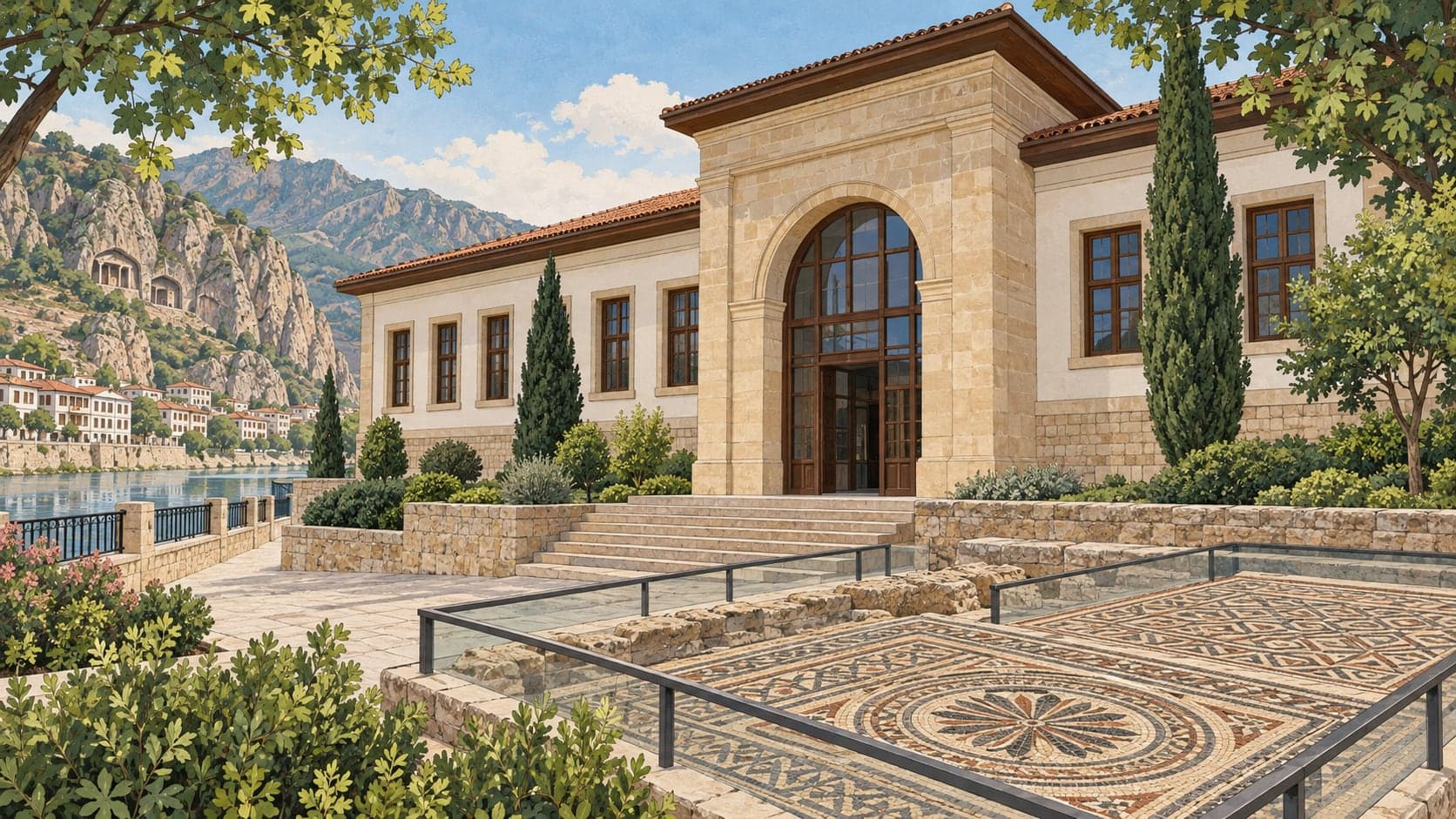
The museum building has three floors. The basement holds the store and the laboratory; the lower floor has a display and rest hall; two halls on the upper floor hold the archaeological material. Stone works and the tomb stand in the garden. On the first floor are the Roman floor mosaic known as the Apple Mosaic and a bronze figure of the Hittite storm god Teshub.
Among the finds on display are terracotta amphorae of the Byzantine and Roman periods recovered from a wreck off Bafra, which entered the collection in 1977, and four sarcophagi — one of the Hellenistic period worked in beaten bronze, the other three of terracotta. Sculpture of the Hellenistic and Roman periods includes a high relief of Dionysos with his son and a headless statue of a priest.
The upper hall falls into two parts, one for the archaeology, with the coins and the burials, and one for the ethnographic material. Three cases hold objects of the Bronze Age: bowls, pots, daggers, stamp seals and axes.