Guide
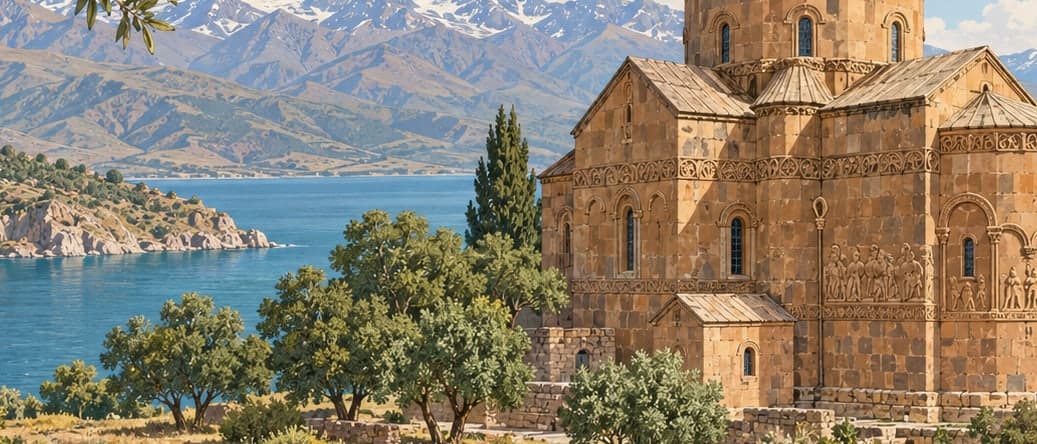
The monastery stands on Adır island in Lake Van. Founded in the eleventh century on the south of the island, it was made up of the church of Saint George, the chapel of Saint Sion, a school for priests, the monks' cells, a guest house and a harbour. Of these only the church and the chapel survive, and those only in part.
A manuscript records that the church was renewed in 1305 by Zacharias I. It is small, laid out on a free cross plan. The central dome, rising on the corner walls under a cylindrical drum and a conical cap, is widened on all four sides by the arms of the cross. The eastern arm ends in an apse that is semicircular within and does not project outside. The rectangular pastophoria flanking the apse each open into the northern and southern arms. When the building was renewed, a square jamatun was added at the western entrance.
Cross-shaped plans with the arms expressed on the outside appear in the earliest period of Christian architecture, in martyria and baptisteries, and were later used as a church plan in a few early Byzantine buildings, though the type was not continued afterwards. The earliest examples in Armenian architecture are the seventh-century churches of Astarak, Artik and Lmbatavank in the Caucasus.
In the placing of its pastophoria and the arrangement of its apse, the church on Adır resembles the eleventh-century church of Çengelli at Kağızman.