Guide
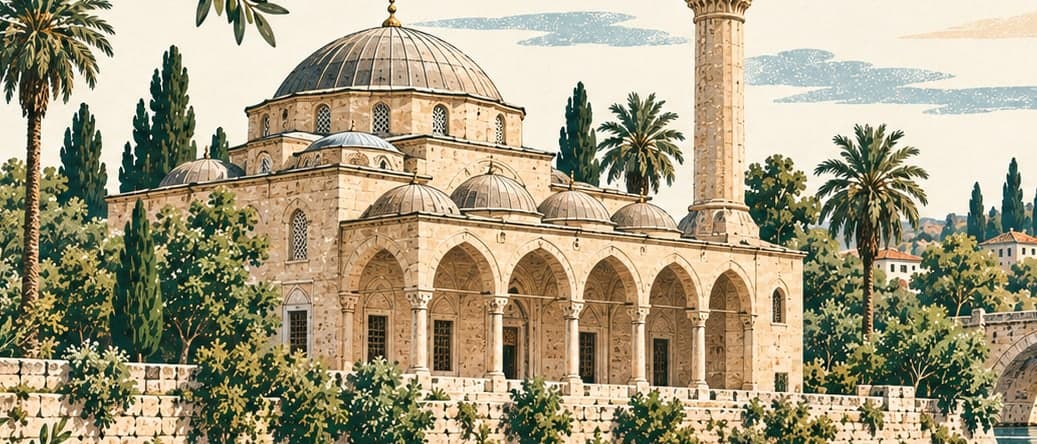
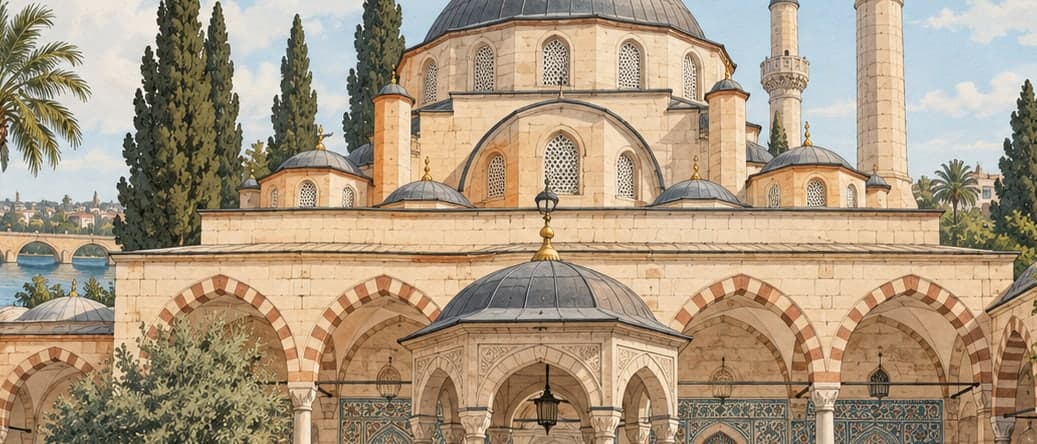
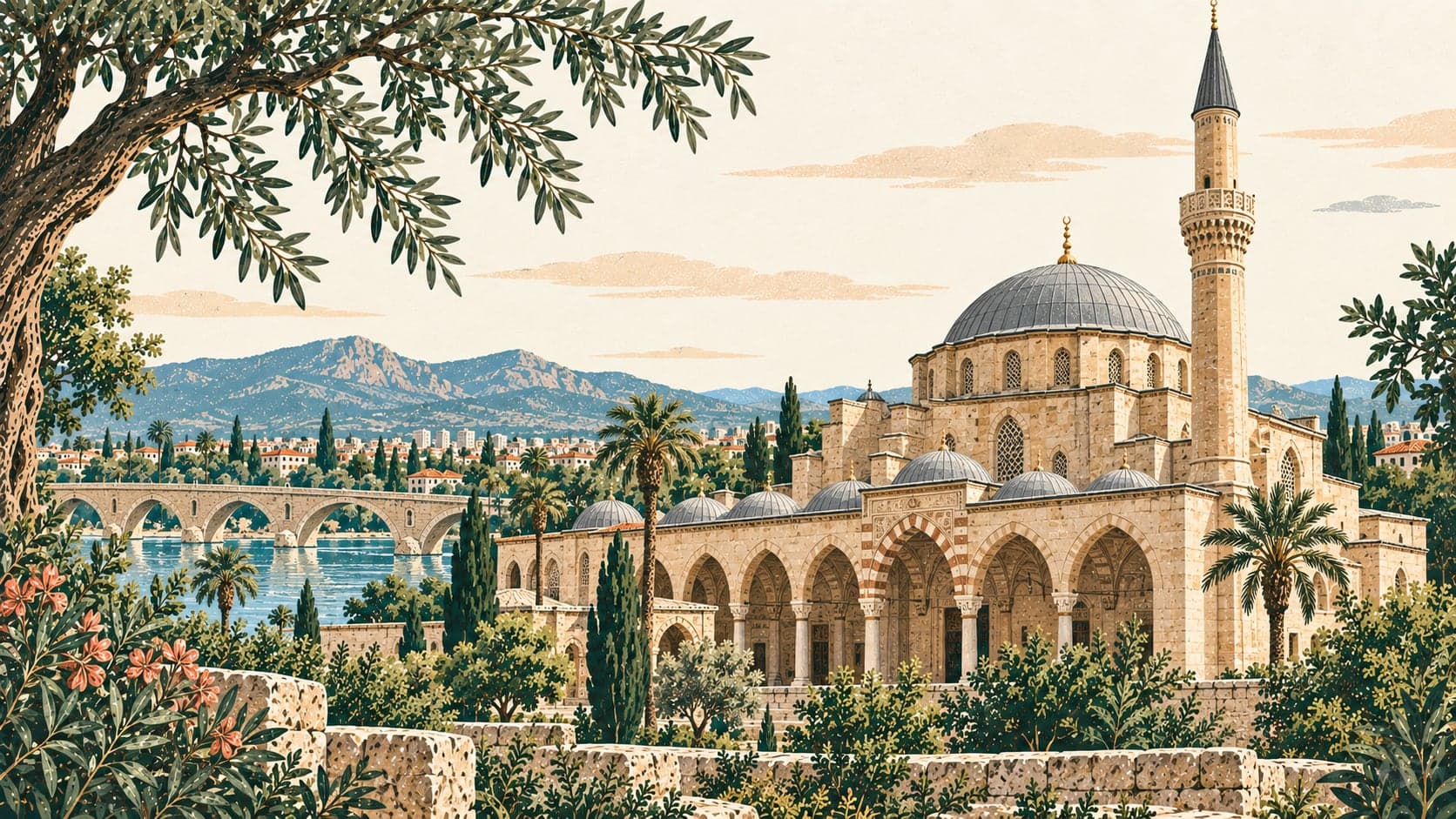
The Great Mosque of Adana is the masterwork of the Ramazanid emirate and one of the most important historic buildings in the city. It remained the largest mosque in Adana until the Sabancı Central Mosque opened in 1998, and it gathers in one place the architectural character of the Seljuk, Mamluk and Ottoman periods.
The sources differ on when work began: the Wikipedia article gives 1509, while the provincial directorate, reading three separate inscriptions on the building, gives about 1513. They agree on the rest — the mosque was begun by Halil Bey of the Ramazanoğulları and finished and opened for worship in 1541 by his son Piri Mehmet Paşa. Halil Bey and Piri Mehmet Paşa, with two of the paşa's sons, lie in the tomb of 1541 south-east of the mosque.
The entrance on the west side is known to have been Halil Bey's work. Above that doorway rises a conical roof with stalactite work, stepping upward to a point in the Seljuk manner; from this it is thought that the Ramazanoğulları, still a small beylik in the sixteenth century, first built a small mescit here, and that the present building followed once the mescit no longer sufficed.
The mosque measures 34.50 by 32.50 metres overall, a rectangle close to a square, and the courtyard is entered by two large doors on the west and the east. Because the region is hot and more worshippers had to be accommodated, part of the courtyard was roofed over in timber to form a large porch in addition to the prayer hall.
Black and white marble brings colour to the elevations, and the outlines of the half-pointed arches are worked with stalactites and plant motifs. Above the western door are a dome carrying two carved serpents and an inscription, with further inscriptions above the eastern door and above the minbar.
The prayer hall is a rectangle laid out crosswise, divided into two aisles by four columns set parallel to the qibla wall and linked by slightly pointed arches. The mihrab is framed by a border of black marble, and the sixteenth- and seventeenth-century tiles covering the qibla wall are what catch the eye first; the mosque's tilework is well known.
With the transverse space west of its prayer hall, shaped like a porch, the mosque influenced a number of local buildings, among them the Hasan Ağa and Kemeraltı mosques in Adana and the mosque of Kurtkulağı village in Ceyhan.
The mosque belongs to the Ramazanoğlu complex, which once held a medrese, a tomb, a soup kitchen, a school of hadith, a hospital and a primary school. Of these the medrese, the tomb and the reception quarters of the Ramazanoğlu palace survive; the medrese serves today as a Turkish-Islamic culture centre, and the palace quarters are open to visitors as a culture centre under Çukurova University. On the site of the vanished soup kitchen stands a historic school building — once the Adana reformatory, then the Hamidiye industrial school, then the İnkılap primary school — now a religious vocational middle school.
The mosque was damaged in the Adana-Ceyhan earthquake of 1998 and was repaired and reopened for worship between 1998 and 2004.