Guide
Mimar Sinan built this tomb in Eyüp for the household of the grand vizier Siyavuş Paşa, the one from Kanizsa. There is no building inscription and it is thought to date from between 1582 and 1584. Sinan's register of works mentions separate tombs for the pasha and for his children, but no separate tomb was in fact built for him: when he died in 1602 he was buried in his children's. An inscription about his death is set in the tympanum arch of the window that opens onto the street.
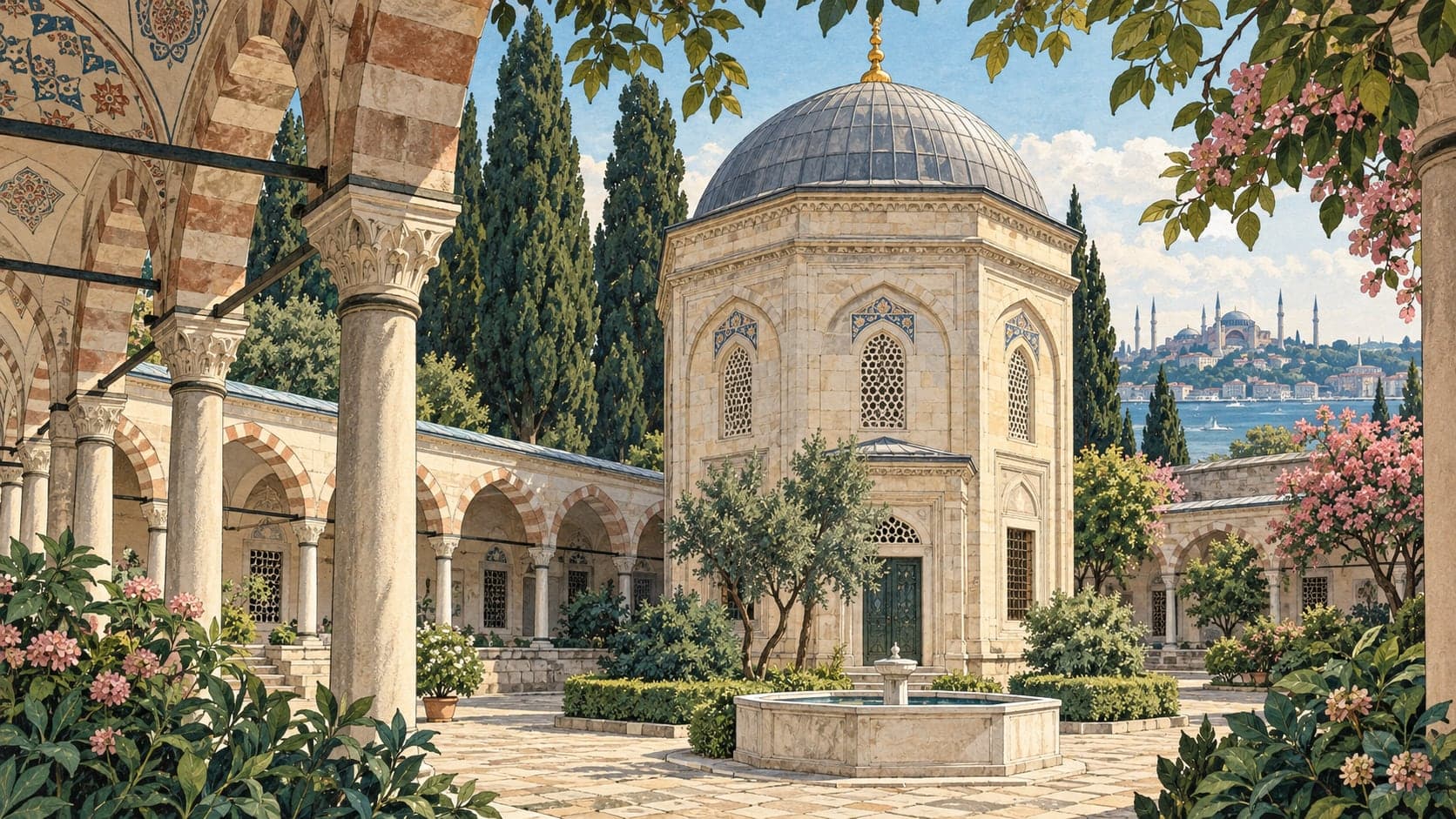
The tomb stands in a courtyard with three of its faces projecting beyond the courtyard wall. It is cut stone, sixteen-sided on the outside and turning to an octagon within; the façades are framed with mouldings, finish in a profiled cornice and carry single windows above and below in alternating bays — rectangular below, with a marble tympanum inside the pointed relieving arch, and pointed-arched above with round outer openings. A single-domed porch stands before the north entrance, its dome, drumless and reached through pendentives, carried on four columns with muqarnas capitals, free-standing in front and engaged in the wall behind. The entrance front is faced with marble, and the depressed-arched doorway, built up of breccia and marble in palmette form, is set in a rectangular frame under a Qur'anic inscription. Inside, the dome sits on eight piers linked by pointed arches; because those arches are kept wide, the interior opens out in every direction, with a turban niche in each side wall.
Three kinds of decoration work together here. Tiles are used on the panels either side of the entrance, on the window tympana, in the band of verses running round the building, over the doorway, on the pendentives and inside the turban niches, the verses written in white thuluth on a deep blue ground. Painted work covers the porch and, within, the dome and pendentives. The woodwork is kündekârî — geometric interlace on the door and the window shutters. Two wooden cenotaphs and nine marble ones carved with plant ornament stand on the floor. The building was restored between 1940 and 1970, when the painted work was renewed and the glazing replaced.