Guide
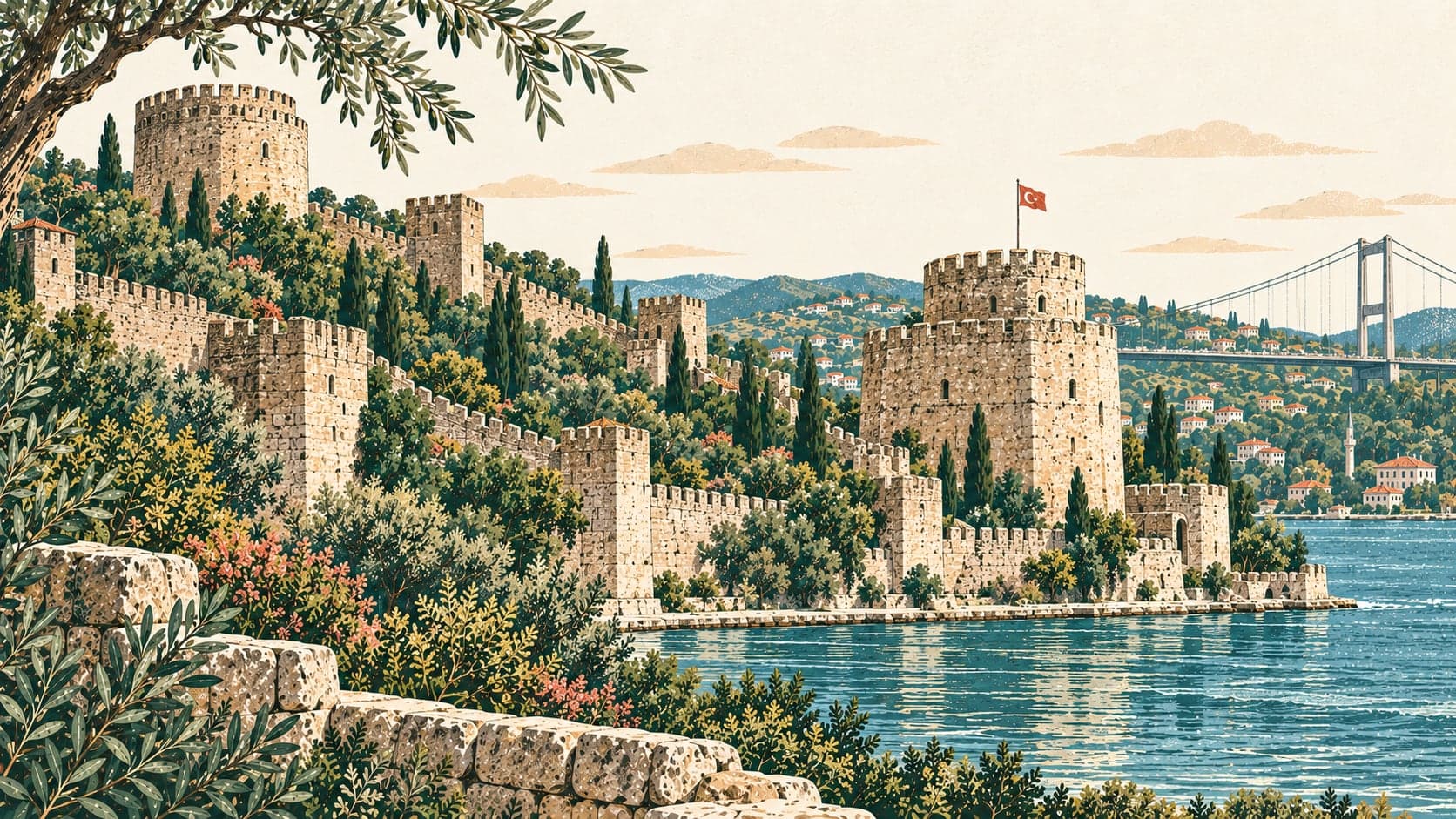
Rumeli Hisarı stands on the Bosphorus in the Sarıyer district of İstanbul and gives its name to the quarter around it. It was built for Mehmed II before the conquest of İstanbul, to stop attacks that might come from the Black Sea, at the narrowest point of the strait — 698 metres — directly opposite Anadolu Hisarı on the Asian side. It is known by other names as well: Yenicehisar, Boğazkesen Hisarı, Yenikale, Başkesen Hisarı and Kara Kale. In Mehmed's own deeds of endowment it appears as Kulle-i Cedide, in the history of Neşri as Yenice Hisar, and in the histories of Kemalpaşazade, Aşıkpaşazade and Nişancı as Boğazkesen Hisarı.
The fortress covers 32,000 square metres; elsewhere the source gives the area of the work as 60,000 square metres, with a masonry volume of about 57,700 cubic metres. It is made up of thirteen towers and the walls joining them, and its three great towers are among the largest fortress towers in the world. They take their names from the pashas who oversaw their building: Saruca Paşa, Zağanos Paşa and Halil Paşa. Counting the ground floors, the Saruca Paşa and Halil Paşa towers have nine storeys and the Zağanos Paşa tower eight. The Saruca Paşa tower is 23.30 metres across, with walls seven metres thick, and stands twenty-eight metres high; the Zağanos Paşa tower is 26.70 metres across with walls 5.70 metres thick and stands twenty-one metres; the Halil Paşa tower is 23.30 metres across with walls 6.5 metres thick and stands twenty-two metres.
Building began at the end of March 1452 and the fortress was finished in ninety days. The timber came from İzmit and Karadeniz Ereğli and the stone from Anatolia. Mehmed came from Edirne and ordered the foundations laid on the slope of the hill formerly known as Fonea, giving it the name Başkesen. He assigned the building of the three towers by the water to his pashas, who had them built at their own expense, and took on the building of the towers and the other parts himself. Dukas records that a thousand masters worked on the construction; according to the architect E. H. Ayverdi about three hundred masters, seven to eight hundred workmen, two hundred carters, boatmen, carriers and other hands were employed.
After the conquest of İstanbul the fortress remained a garrison for a time, and the Saruca Paşa tower later came to be used as a prison. It was badly damaged in the great İstanbul earthquake of 1509 but repaired at once, and its wooden parts were destroyed in a fire in 1746; it was repaired again in the reign of Selim III. After the eighteenth century it lost its military character entirely, and in 1876–77 forty-six households were recorded within the fortress and around its edge.
Rumeli Hisarı is used today as a museum, with works displayed in the open and exhibition halls within it.