Guide
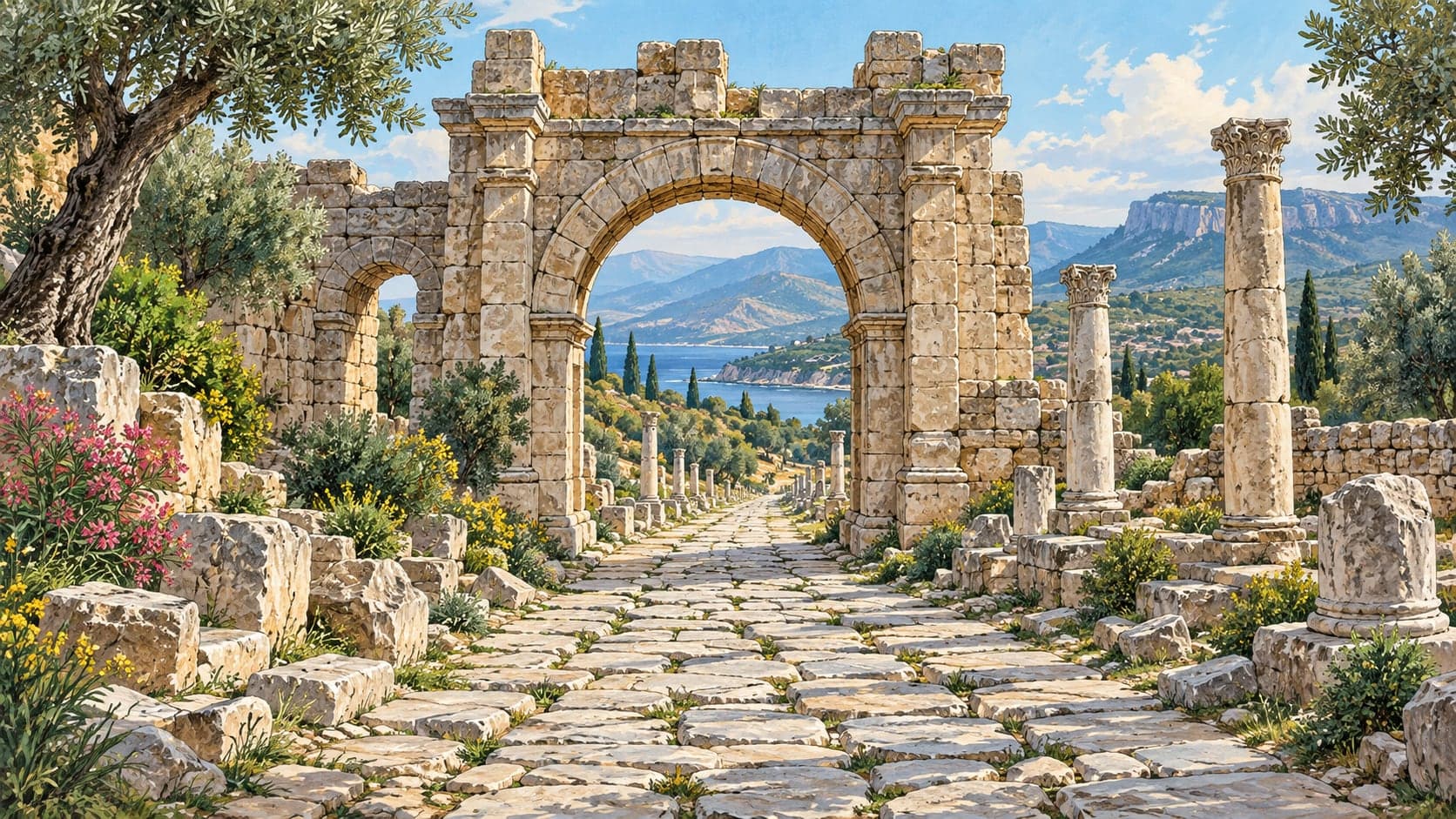
The Roman road above Sağlıklı village, in the Tarsus district of Mersin, is paved in limestone laid on the bedrock. It was probably built in the first century AD and remained in use until about the middle of the fourth. Where it survives well it is made of rectangular limestone blocks with raised kerbs on both sides to stop carts running off, and two features stand out: curves that follow the terrain to ease the passage of vehicles, and wider stretches left so that two carts could pass one another. The width varies; the intact length is about two to three kilometres, and the kerbstones along the edges are still in place. The road has been known since the nineteenth century, and at its northernmost point, at Bozagac, a Latin rock inscription records that the emperor Caracalla had it repaired.
At a point where the road looks out over the Tarsus plain as far as the sea stands a monumental gate. No inscription for it has been found, so neither its purpose nor its date is established: travellers have written that it was built as a triumphal arch, while some researchers hold that it marked the start of the borders of Cilicia and was a frontier gate. It is a single arch of simple workmanship. Be aware that it collapsed in recent times and was rebuilt using its own stones, so it no longer stands as original fabric. The site is fifteen kilometres from Tarsus and needs a car.