Guide
The Rahmi M. Koç Museum sits on the Golden Horn at Hasköy and has been open since 1994. The museum calls itself the first and only industrial museum in Türkiye, and its subject is the history of industry, communication and transport: more than 14,000 objects, most of them from Rahmi M. Koç's own collection, added to each year by donation and long-term loan.
The things people remember are the big ones. There is a real Second World War submarine you can go through, a nostalgic train ride, aircraft, classic cars, and the historic Fenerbahce ferry, one of the emblems of İstanbul. Smaller but no less striking are an 1898 Malden steam car, a 1963 Anadol — the first car built in Türkiye — steam engine models, a celestial globe dated 1384, a transit telescope and the patented original model of Edison's telegraph.
The collection is arranged in nine sections: Atatürk, road transport, rail transport, maritime, aviation, nostalgic shops, communications equipment, scientific instruments, and machines, models and toys. There are education programmes and workshops for children, and the museum is explicitly built for a long day rather than a quick visit.
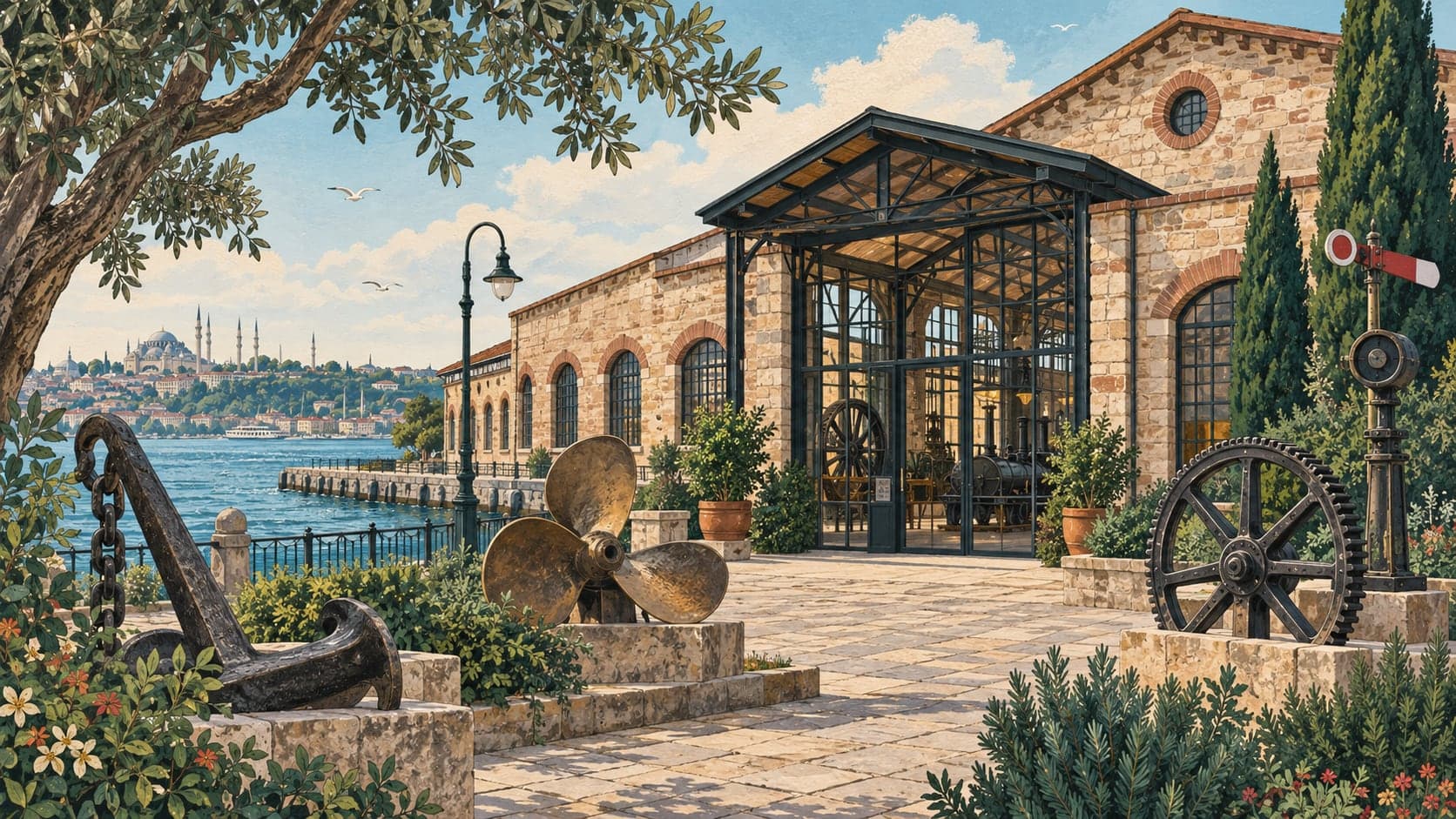
The site runs to about 27,000 square metres in three parts: the Mustafa V. Koç / Lengerhane building, the Hasköy dockyard, and open-air display areas. 'Lenger' was the Ottoman word for the chain and anchor thrown out to hold a ship, and a lengerhane was where they were made. The building stands on the foundations of a 12th-century Byzantine structure and was established in the reign of Ahmed III (1703-1730) to make chain and anchor for the dockyards; in later years it became the Cibali tobacco factory. The Rahmi M. Koç Museology and Culture Foundation bought it in 1991.