Guide
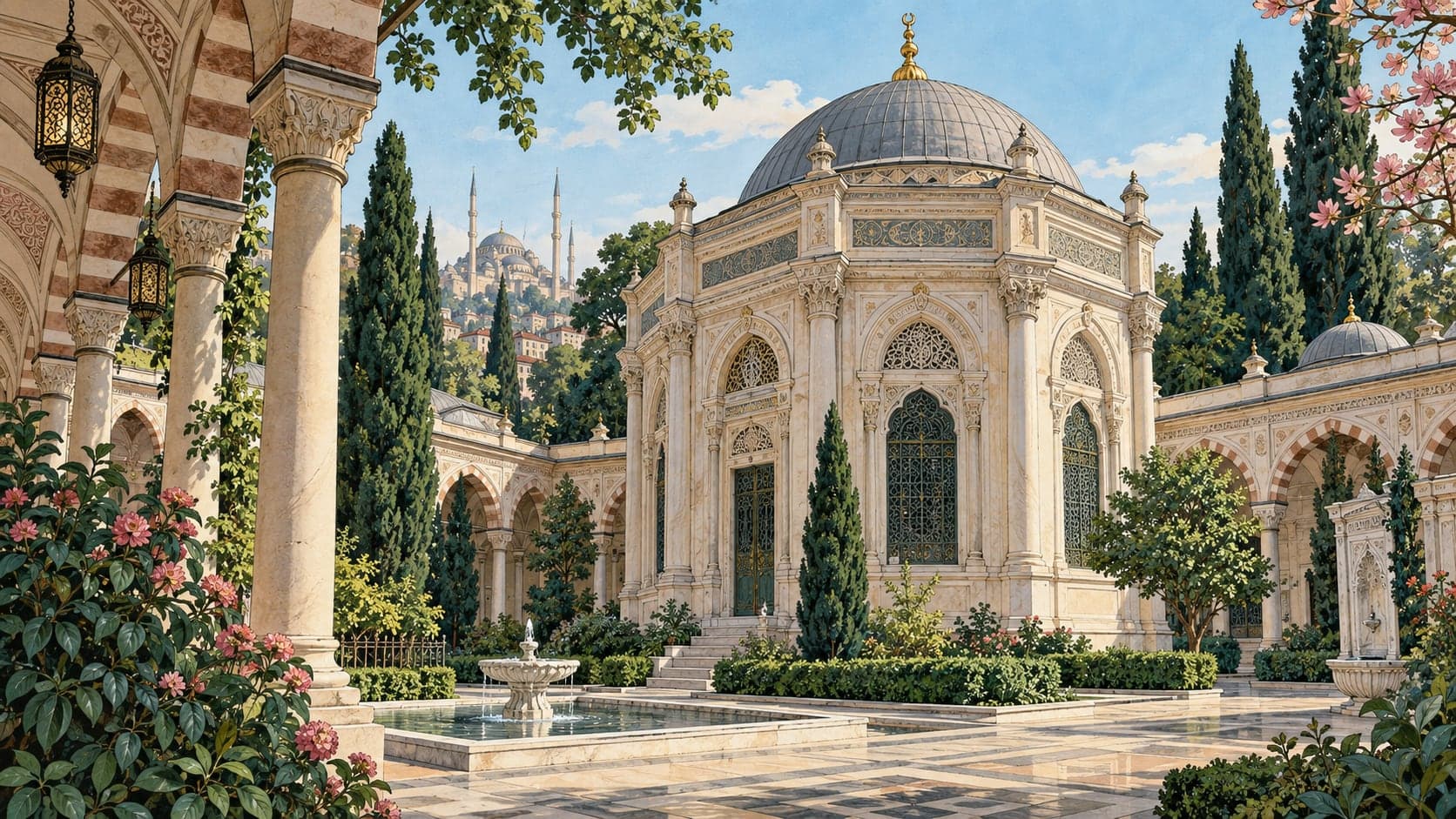
This tomb has been moved twice, and that is the first thing to know about it. It stands at the north-west corner of the courtyard of the Pertevniyal Valide Sultan mosque at Aksaray — a position that ought properly to have been on the qibla side — because the road came for it. It was taken down and set back between 1926 and 1929 to widen the tramway, demolished again in 1958 to be pulled back further under the Prost plan, and finally assembled where it now stands during the rearrangement of Aksaray Square in 1968–69 after Vatan and Millet avenues were cut through. Buried in it, besides Pertevniyal Valide Sultan herself, is Mehmed Sâdeddin Efendi, the son of her grandson Yûsuf İzzeddin Efendi.
The entrance front is extremely plain: a marble-jambed door with four windows, and above the door the verse 'Peace, a word from a merciful Lord' in celî sülüs. The side facing the street is another matter, faced entirely in worked marble — fluted pilasters dividing it into three, windows in a gothic manner with cast grilles, rectangular panels on every surface and a carved band running round the eaves. It was plainly a carefully made building, and it is equally plain that the dismantling and re-erection damaged it badly. Like the rest of the complex it now sits below the level of the road, and the all-marble timekeeper's room that once stood at a corner of the courtyard facing the mosque was taken down during the works and never put back up.
The tomb belongs to the complex that Pertevniyal Valide Sultan — wife of Mahmud II and mother of Abdülaziz — had built at Aksaray Square: mosque, school, tomb, tomb-keeper's room, library, timekeeper's room, guardhouse, six fountains and seven shops. The ground was assembled by buying up the land around the burnt-out Kâtib Mosque, an expropriation that took two years.
The building accounts survive in the Topkapı archive and cover 1867 to 1871. They name the architect as Sarkis Balyan, working with his brothers Agop and Bedros — which settles a long-standing attribution to the Italian Montani. Pertevniyal's instruction was that the mosque should be "as large as the Ortaköy mosque"; Sarkis matched its prayer hall and gave it a wider courtyard. Construction ran 121 weeks and was paid for out of her endowment income.