Guide
The Ottoman House Museum stands in Bursa opposite the complex of Murad II and shows the Ottoman way of life in the seventeenth century.
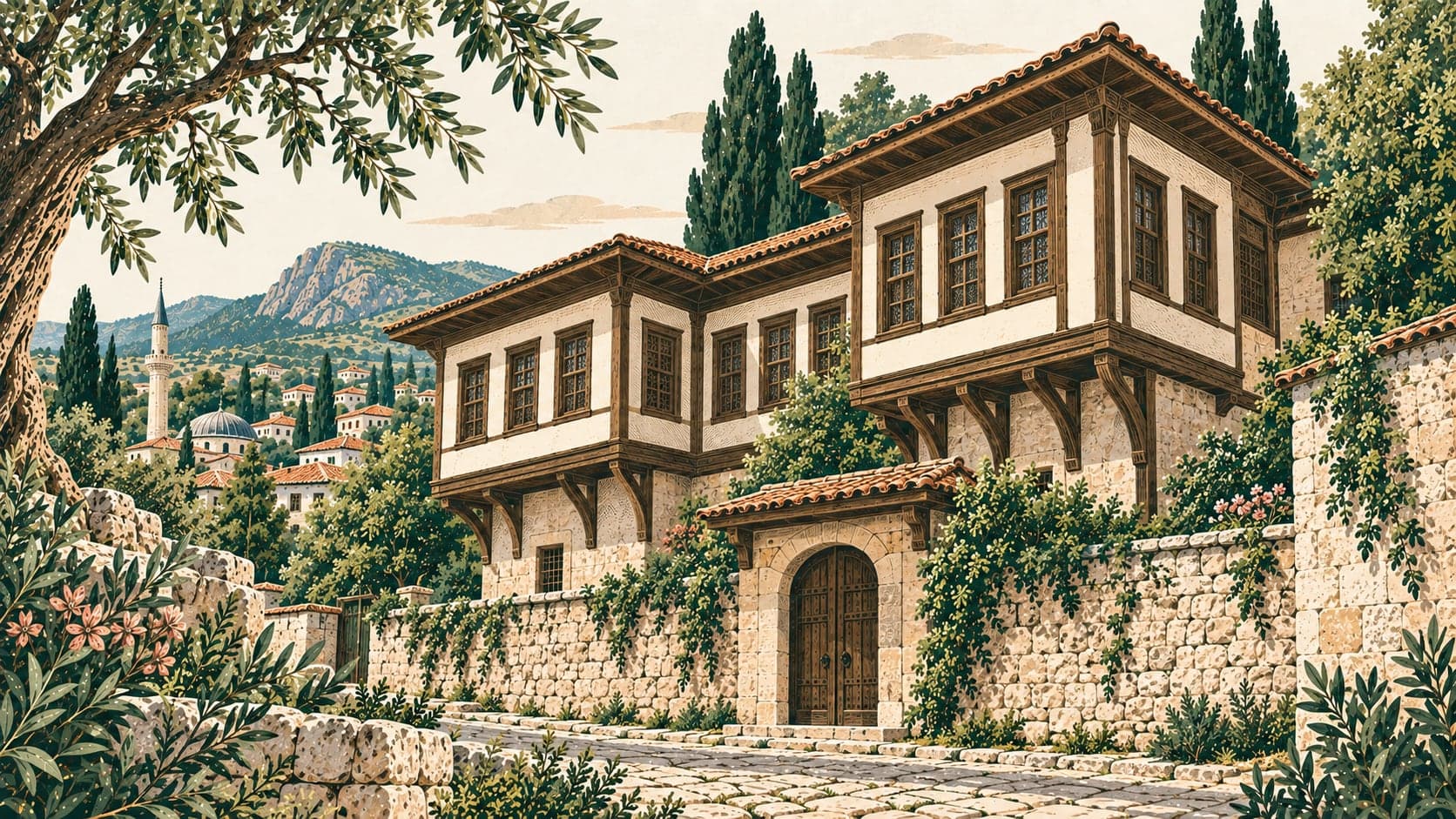
The three-storey wooden house that serves as the museum dates from that century and is one of the oldest houses still standing in Bursa. A pavilion of Murad II is thought to have stood on the spot before it, and for that reason the house is also known as the one where Mehmed the Conqueror was born. Alongside the display of Ottoman life, clothing and dress of the period are shown here.
The building is thought to have been put up in the seventeenth century as the residence of a pasha. It was expropriated and restored in 1946 by the general directorate of antiquities and museums, and opened as a museum in 1958. It was repaired and rearranged in 1973, closed to visitors in 1992, and opened again in 2005 after a third rearrangement by the general directorate of cultural heritage and museums.
The house rests on a stone foundation. Its eastern face is plastered up to the level of the first floor, and on the slightly projecting first floor brick is laid in a zigzag pattern between wooden tie beams. The windows of the rooms on the ground and first floors open onto the outer hall. The first floor was entirely closed to the street when the house was built, and four windows were opened later in its eastern face, which looks towards the Muradiye complex. On the second floor there are nine windows at eye level and five above them, all with wooden shutters.
The ground and first floors are entered from the western face. The ground floor opens outwards through a balcony with a wooden balustrade and the floor above through windows in the Bursa arch manner. The northern part of the building is plastered and the southern face is blind. There is a hall with an open-fronted iwan, and the iwan has a room on either side; the plan repeats on the upper floor. At the centre of the first floor, reached by a wooden stair, are the reception room, the dining room and the rooms of the household.
On 22 June 1989 two gilt copper candlesticks were stolen from the museum. They were traced to an auction held by Sotheby's in London on 24 April 1991, returned to Türkiye that year through direct negotiation, and placed for safekeeping in the Bursa Museum.