Guide
The House of the Virgin Mary is a Catholic shrine on Bülbüldağı near Ephesus, seven kilometres from Selçuk. Catholic pilgrims visit it in the belief that Mary, the mother of Jesus, was brought to this stone house by the apostle John and lived here until she was taken into heaven — the Assumption in Catholic doctrine, the Dormition in Orthodox. The Catholic Church has made no pronouncement on whether the house was really hers, but pilgrimages have come here regularly since it was found.
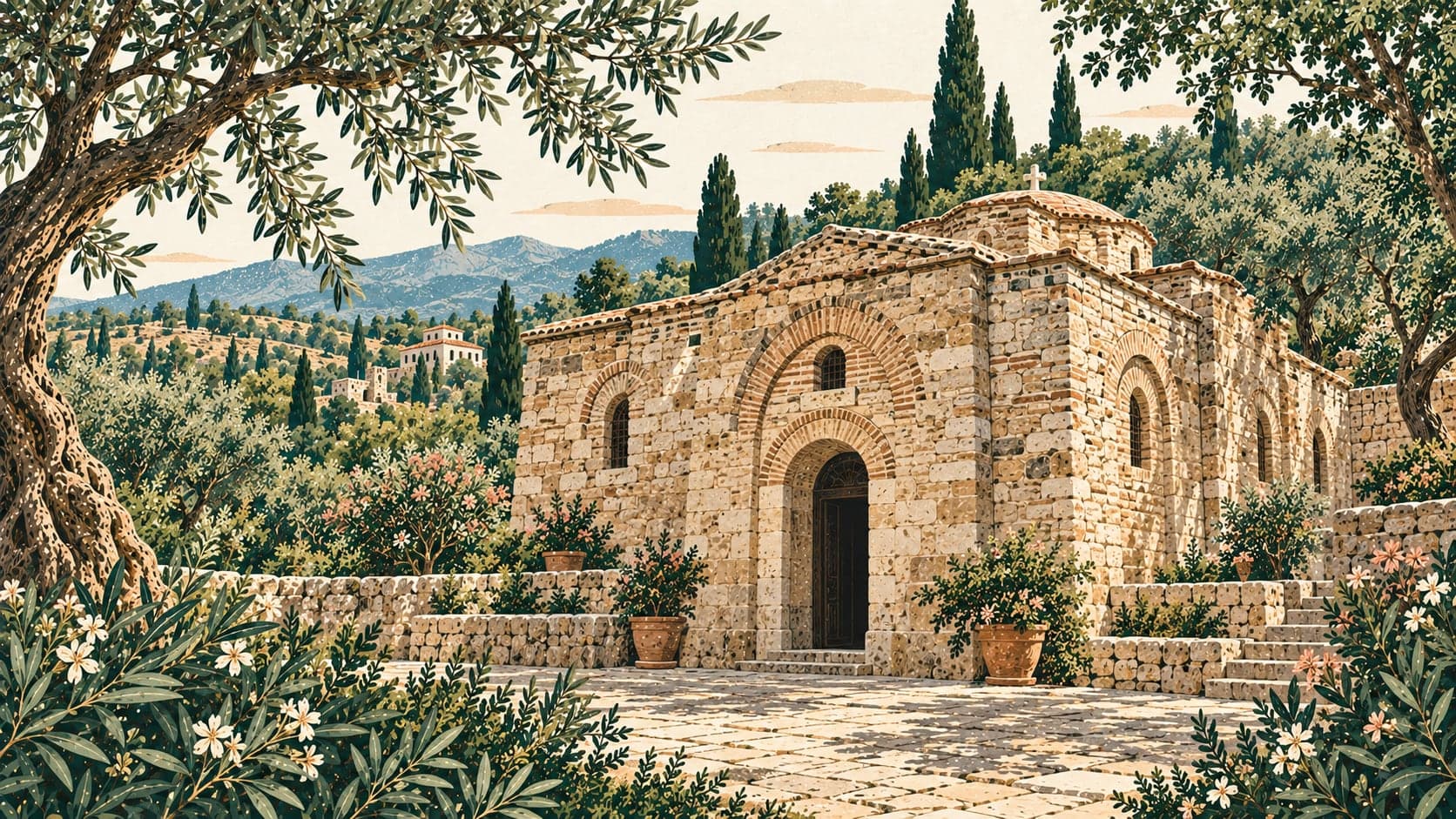
The site is reached past the upper gate of the ancient city of Ephesus, and a small Byzantine church stands on it. Christians hold the place sacred and come here to seek healing for the sick and to make vows.
The shrine is modest rather than large. Its construction and the stones that survive reach back to the age of the Apostles, consistent with other buildings preserved from that time; only small garden works and additions for worship outside the building have been made since. Entering, visitors come into a fairly wide room with a statue of the Blessed Virgin set forward at the centre and an altar opposite. To the right is a smaller room, held by tradition to be the room where the Virgin slept; tradition also holds that in that room, where she slept and rested, there is a kind of channel carrying running water out to the fountain outside the building.
Outside the shrine is a wall where visitors tie their personal intentions to it in paper or cloth. Fruit trees and flowers grow around it, and lighting has been added outside so that the house can be seen better. There is also a fountain or well that some visitors believe has extraordinary power to grant children and to heal.
The house was found by following a book of visions. At the beginning of the nineteenth century Anne Catherine Emmerich (1774–1824), a bedridden Augustinian nun in Germany, reported a series of visions in which she said she saw the last days of the life of Jesus and details of the life of his mother. She lived in the farming community of Dülmen and had long been ill, but was known in Germany for her mystical powers and visited by people of standing. One of her visitors was the writer Clemens Brentano, who after his first visit came to see her every day for five years in Dülmen and wrote down what she described. After her death Brentano published a book based on the visions he had collected, and a second appeared after his own death.
One of the visions described the house John had made at Ephesus for Mary, where she lived to the end of her life. Emmerich gave a series of details about its position and the lie of the land around it: that Mary lived not exactly in Ephesus but somewhere near it; that the house stood on a hill to the left of the road from Jerusalem, three and a half hours from Ephesus; that the hill sloped steeply up from the city, which lay on rising ground to one approaching from the south-east; and that a narrow path ran south towards a hill, on whose summit was an irregular plateau reached in half an hour's walk. She described the house too: built of rectangular stones, with the windows set high near the flat roof, in two parts, with a fireplace at the centre, and she gave details such as the position of the doors and the shape of the chimney. The book containing these details was published in Munich in 1852.