Guide
In Selçuk, a single column is almost all that stands of the sanctuary of Artemis of Ephesus. The ground itself was sacred for an unusually long time: the oldest finds here go back to the Late Bronze Age, and according to the Selçuk municipality the site has served the cult of the goddess since the start of the Iron Age at the latest, the end of the 11th century BC.
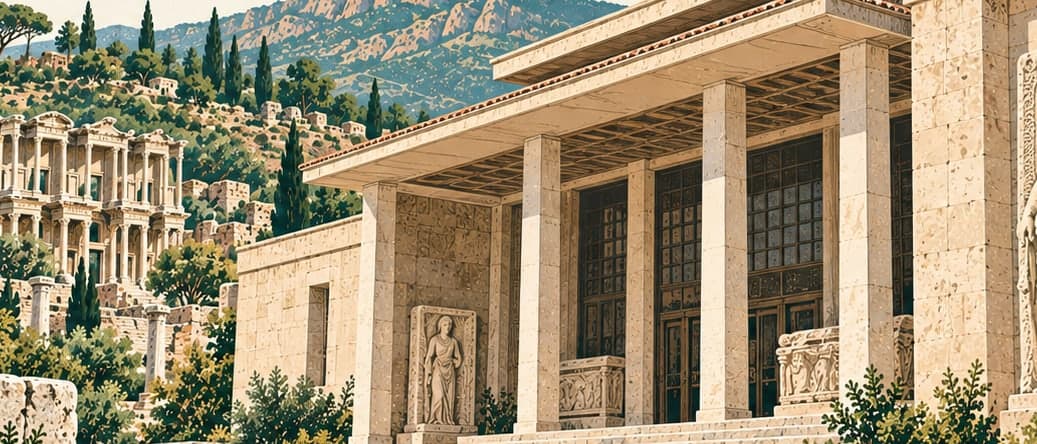
The sanctuary grew through a sequence of ever larger temples, all facing west. The earliest, no longer visible, was a small Archaic building of about 13.5 by 8.5 metres with stone walls and wooden columns set on stone bases; inside, a wooden cult statue stood under a canopy carried by six columns. Shortly before 560 BC work started on the first great marble temple, a double-colonnaded dipteros that Croesus, king of Lydia, helped to finance. It was over 100 metres long and roughly 60 metres wide, with 106 columns, many of them carved with reliefs. Only the colonnades were roofed; the walls enclosed an open court that sheltered the older shrine and, in its eastern half, the building that held the cult statue.
In 356 BC that temple was destroyed in a fire started by Herostratos. Rebuilding began at once and repeated the main features of the older design, down to its figured gutter, but on a grander scale: the new temple probably had 127 columns 18.4 metres high and stood on a stepped platform 2.7 metres above the earlier floor, with a stair inside leading down to the old level.
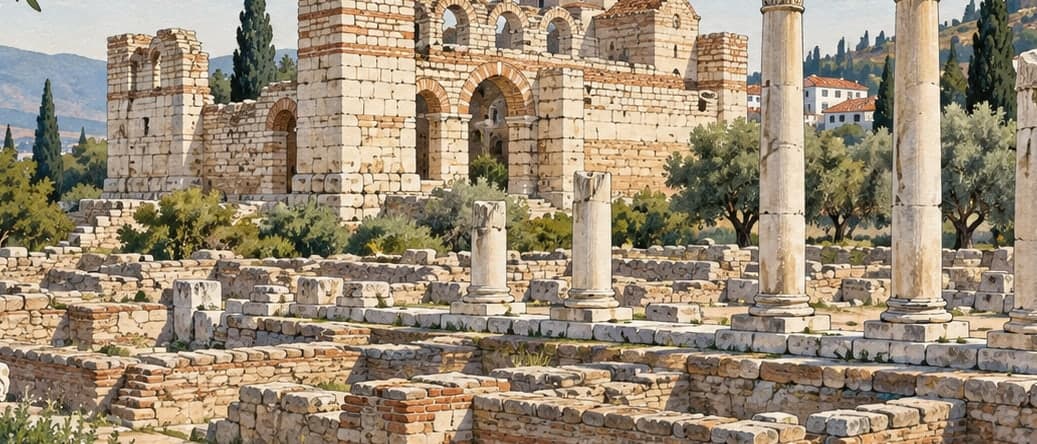
The column you see today was put up in 1973 as an architectural experiment, assembled from drums of different columns; it rests on an original base from the 4th-century temple with a piece from the 6th-century building beneath it, and the original columns were about four metres taller. Other remains of the Archaic temple are a short wall on the west side, sections of the court wall and a fallen church column lying to their south. The site was found by J. T. Wood in 1869; the British Museum excavated here in 1904–05 under D. G. Hogarth and A. Henderson, and from 1965 the Austrian Archaeological Institute, led by A. Bammer, uncovered the court altar and the oldest sacred building.