Guide
Maltaş is an open-air Phrygian sanctuary cut into the Akkuş Yuvası rocks that close the Göynüş valley on its western side, within the bounds of Kayıhan in the İhsaniye district. Local people gave it the names Maltaş and Malkaya in the belief that treasure lay inside it. With the other Phrygian rock monuments of the region it is dated between the eighth and the sixth century BC.
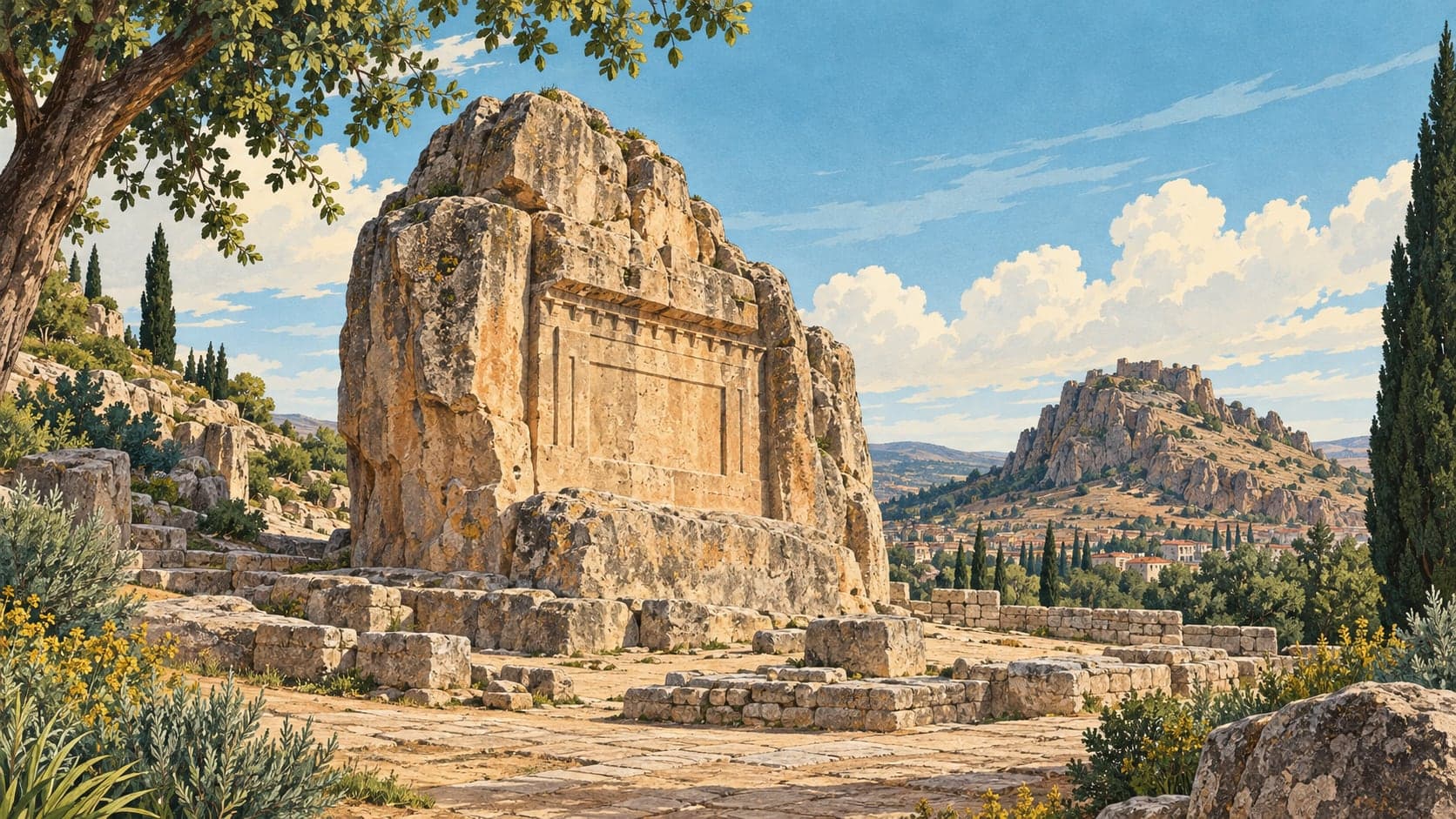
W. M. Ramsay was the first to study it, in 1881, and A. Gabriel, M. P. Devambaz, E. Haspels and C. Brixhe worked on it after him. The monument was made by levelling a face on the steep south-east side of the rock mass — a panel of 12.25 by 11 by 9.56 metres, cut back 0.85 metres — and carving into it. From the floor of the niche to the top of the roof it stands 8.64 metres, and it is 8.98 metres wide at the base.
The carved roof is pitched with eaves stepping outward, and the pediment is framed by three stepped mouldings, the middle ones decorated with lozenges. A thick central post, also set with lozenges, rises through the middle of the pediment, and the wall surface is covered with geometric motifs laid out in repeat, framed on both sides by lozenge mouldings. A Phrygian inscription survives at the top of the left-hand moulding, eleven letters of it legible.
The niche in the front is two metres square, inside a double frame. Console-like projections in the form of spools, with volute-like carving at their sides, sit at the top corners and centre of the first frame — the shape of the projecting timbers of a wooden building, translated into rock. A second, badly worn line of Phrygian runs on a narrow moulding just below them. A socket at the centre of the niche floor probably held a portable statue of Cybele, and the door leaves carved facing each other inside suggest the doors of the temple standing wide open.
Behind the front, 2.6 metres back and on the same axis as the niche, there is a well. A large opening in the back wall of the niche leads down to its floor; treasure hunters have broken and widened it, so it no longer has the circular form found at the Phrygian well monuments of Bahşeyiş and Deliklitaş. The well is an irregular quadrilateral, 9.13 metres deep and narrowing downward, with two steps inside it that were probably tied to wooden platforms used in sacrifice.