Guide
Of all the tombs in İstanbul this is the one to see for its tiles. It stands in front of the mihrab of the Mahmud Paşa mosque in the quarter of that name near Eminönü, built in 1473 for the grand vizier of Mehmed II whose complex this is. An unremarkable door carries a three-line building inscription and, beside it, a repair inscription of 1730.
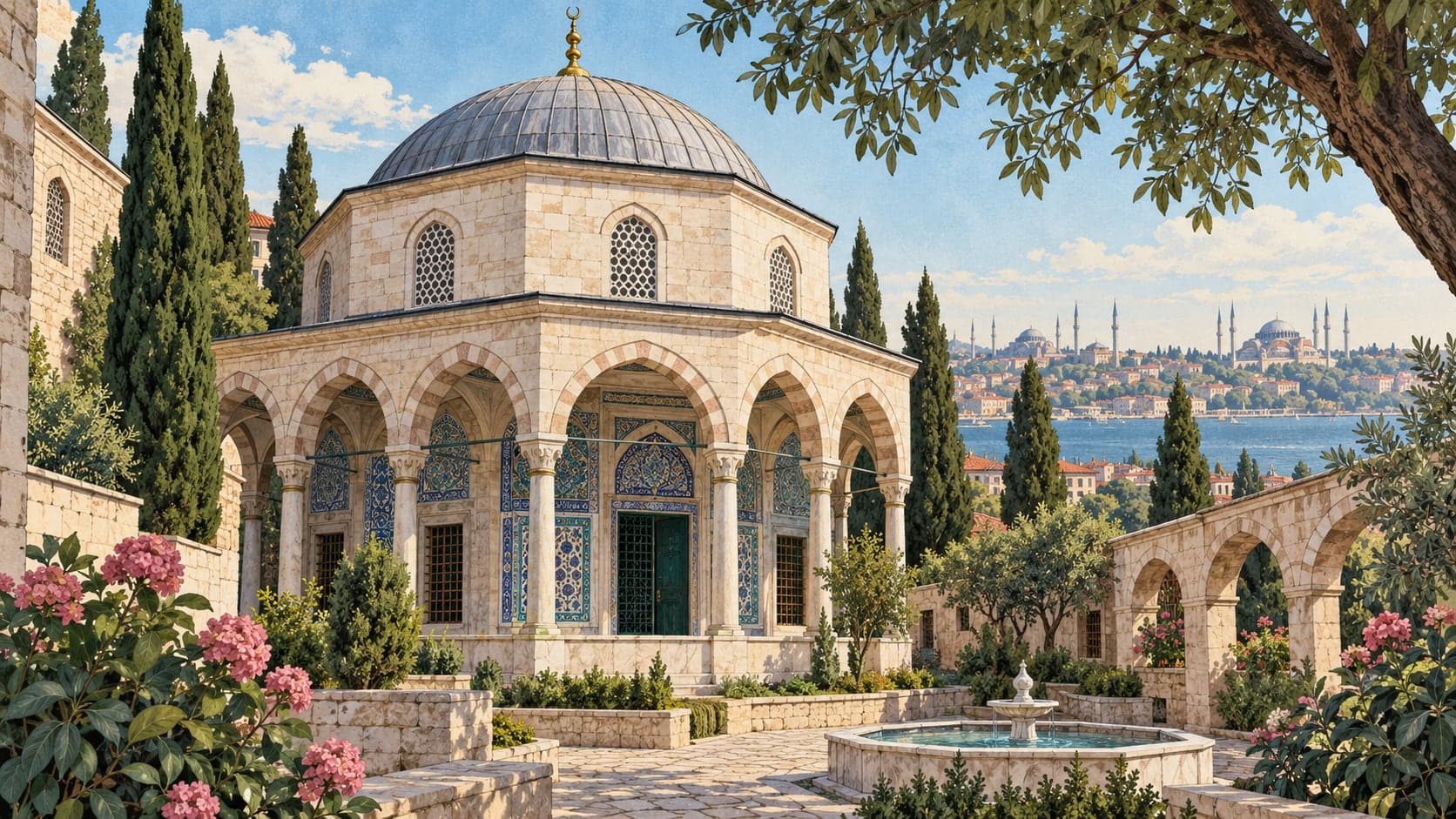
The plan is an octagon under a drumless dome. Each of the eight faces is set within a frame rising to the eaves cornice, and inside that a second moulded frame holds two windows, one above the other — the lower rectangular with a pointed tympanum and its own moulding, the upper pointed-arched. Up to the level of the top of the lower windows the walls are plain küfeki stone; above that they are inlaid, the stone hollowed out and turquoise and dark blue tiles set into the sockets in the same shapes. Tilework of this Seljuk kind is found nowhere else in the city.
The interior is by contrast very plain. Under the wooden floor lies the original brick paving. In the middle, on a marble base, stands Mahmud Paşa's cenotaph, with a smaller one belonging to his son towards the door. The building was restored in 1827 and again between 1949 and 1950, and the tile facing was left untouched both times. In the burial ground between the mosque and the tomb lie members of the palace and senior men of religion and state.