Guide
The ancient city of Magnesia lies within the bounds of the village of Tekin, in the Ortaklar sub-district of the Germencik district of Aydın, on the Ortaklar–Söke road.
By legend the city was founded by the Magnetes, who came from Thessaly. They are said to have come to Anatolia on the prophecy and guidance of Apollo, but where the first Magnesia they founded stood is not known. Diodorus writes that the Athenian Thibron moved the city in 400 and 399 BC, because the Meander kept changing its bed and flooding, bringing outbreaks of disease, and because of the Persian threat. In all likelihood Thibron did not found a new city so much as bring the people of Magnesia to Leukophrys, on the skirts of Mount Thorax below the present site, and protect them there; on that reading the Magnesia we see today was founded at a later date.
The new Magnesia was ringed by a wall, covered an area of roughly 1,300 by 1,100 metres and was laid out on a grid of streets. Standing within the triangle formed by Priene, Ephesus and Tralleis, it held an important position for trade and in strategic terms.
What Magnesia is known for today is the architect Hermogenes, whose designs and buildings have come down to us. According to the ancient writer and architect Vitruvius, Hermogenes was the first to set out the pseudodipteral temple plan and to define temple types by the spacing of their columns, and Vitruvius names the temple of Artemis Leukophryene at Magnesia as his chief work. Hermogenes built that temple in the Hellenistic period on the ruins of an earlier Archaic one. It is of the Ionic order with eight columns by five, and at 67.5 by 40 metres it is the fourth largest temple of the Hellenistic period in Anatolia.
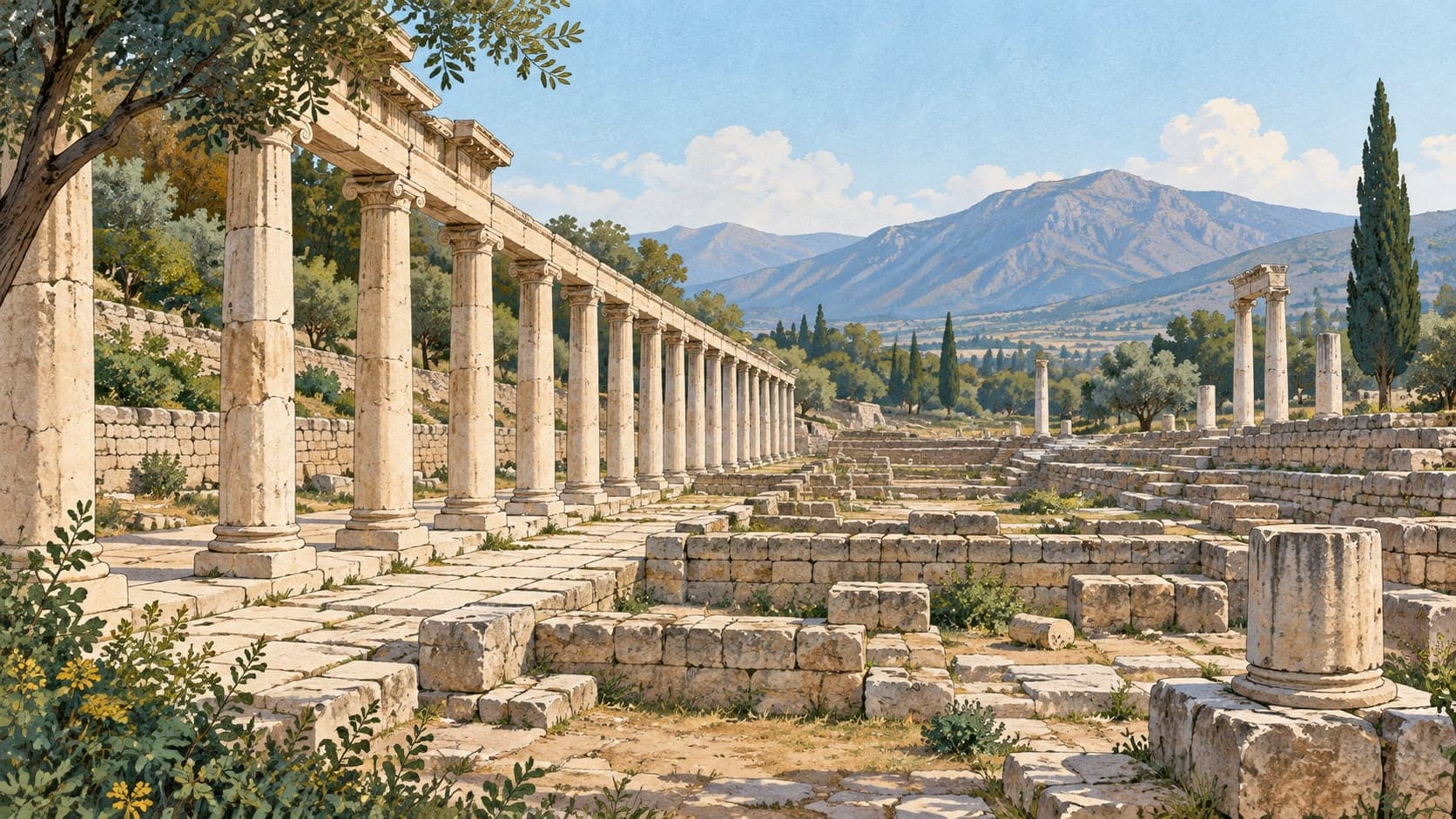
Excavation in the sanctuary of Artemis between 1994 and 2001 uncovered a marble-paved ceremonial area between the altar in front of the temple and the agora. Reliefs of gods reaching three metres in height run around this area, with rings for sacrifice before them. Inscriptions naming the places where the associations or groups taking part in the ceremonies were to stand are cut into the paving blocks bounding the two sides of the area, and parts of the stoa enclosing the sanctuary have been uncovered.
Another of the important buildings of Magnesia is its agora, which has disappeared beneath the silt. The agora was entered from the sanctuary of Artemis through a sacred gate, and the propylon has been uncovered in full. At 26,000 square metres and with 414 columns, the agora was among the largest markets of its day.