Guide
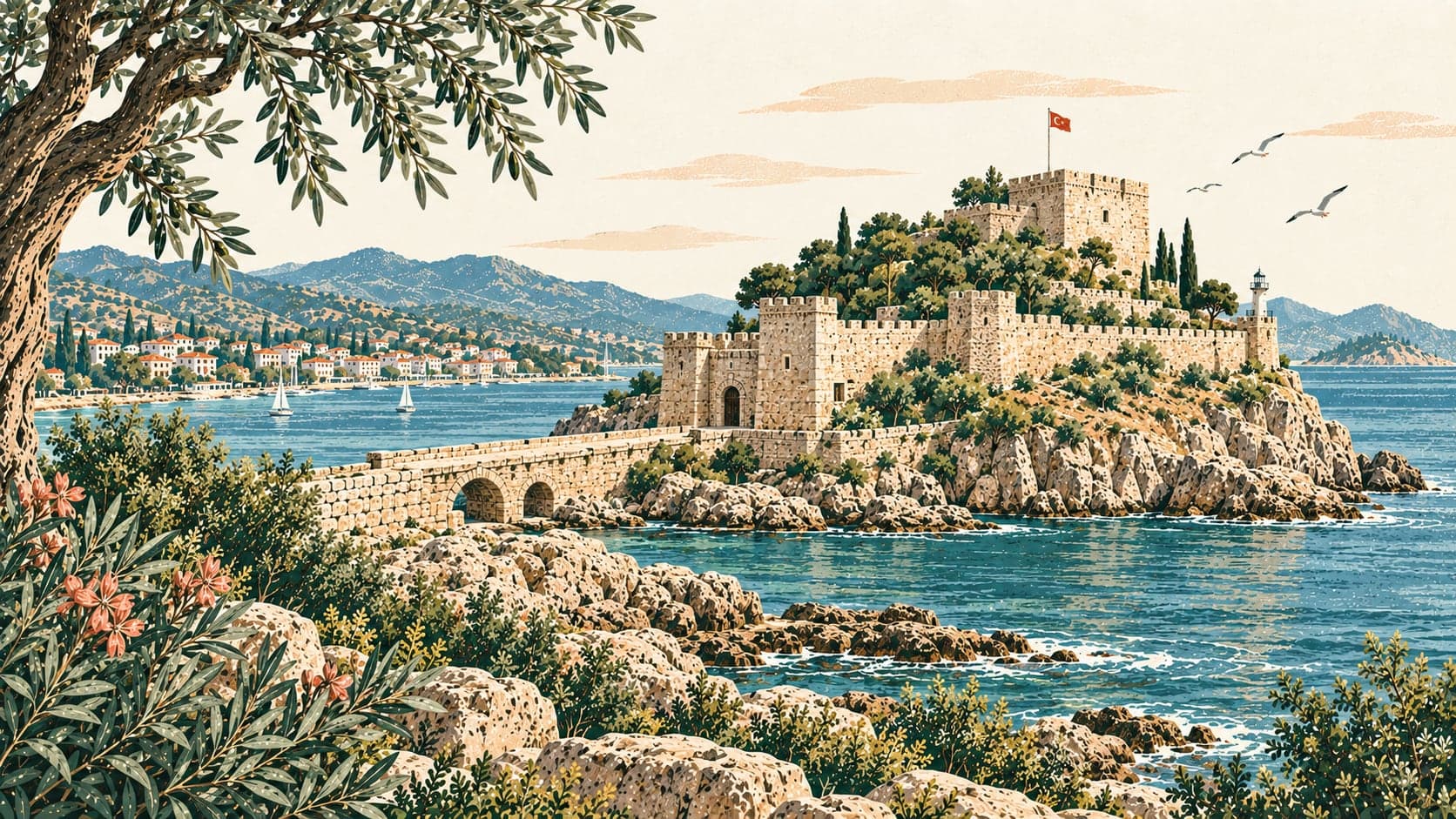
Güvercinada Castle stands on Güvercinada, the pigeon island, a natural rock off the Kuşadası district of Aydın, and takes its name from it. Its history goes back to the Genoese, who came to Kuşadası at the end of the thirteenth or the beginning of the fourteenth century. It was renewed under the Ottomans, and because the island also served as a watch post against pirates in that period it is known as the Pirate Castle as well.
The inner castle and the town armoury on the island were built by Barbaros Hayreddin Pasha, appointed in 1533 as the first governor-general of the province of the White Sea Islands. After Kuşadası was granted as property to the grand vizier and imperial son-in-law Öküz Mehmed Pasha in 1613, he had the castle repaired. During the Greek uprising in the nineteenth century the outer walls and the walls around the castle were repaired in 1826 and 1827 by the subaşı İlyas Ağa, and the castle was repaired and strengthened again in 1834. In 1957 it was joined to the shore by a breakwater, and further repairs were carried out in 2013, including work on some of the buildings inside. UNESCO placed the castle on the tentative world heritage list in 2020 within the file on the fortified and walled settlements along the Genoese trade route from the Mediterranean to the Black Sea.
In early travellers' descriptions and in a surviving engraving, the only fortification on the island is the square tower. It measures 15.7 by 17.35 metres on the outside and rises on the long side from a stepped base, which is in fact a cistern, a partly buried vaulted space. The tower is entered from the south, the door reached by a platform with steps. The outer walls are deeply broken by openings cut for gun batteries. Inside, a stair of twenty-two steps in the north-east corner leads up to the roof, where channels that once carried rainwater down to the cisterns no longer serve their purpose.
The walls of the castle ring the island completely and stand about three metres high. The island rises as a natural cone with steep sides on three faces, and the walls were pushed up against that steep slope, so that the rock serves as their foundation and at the same time makes the castle far more secure along those stretches.
The castle gate lies on the southern side, reached by steps facing east. It has a round arch and is guarded by two towers, the northern one five-sided and the southern one cylindrical. To the left of the tower door, at the level of the arrow slits, a marble inscription is set into the wall.