Guide
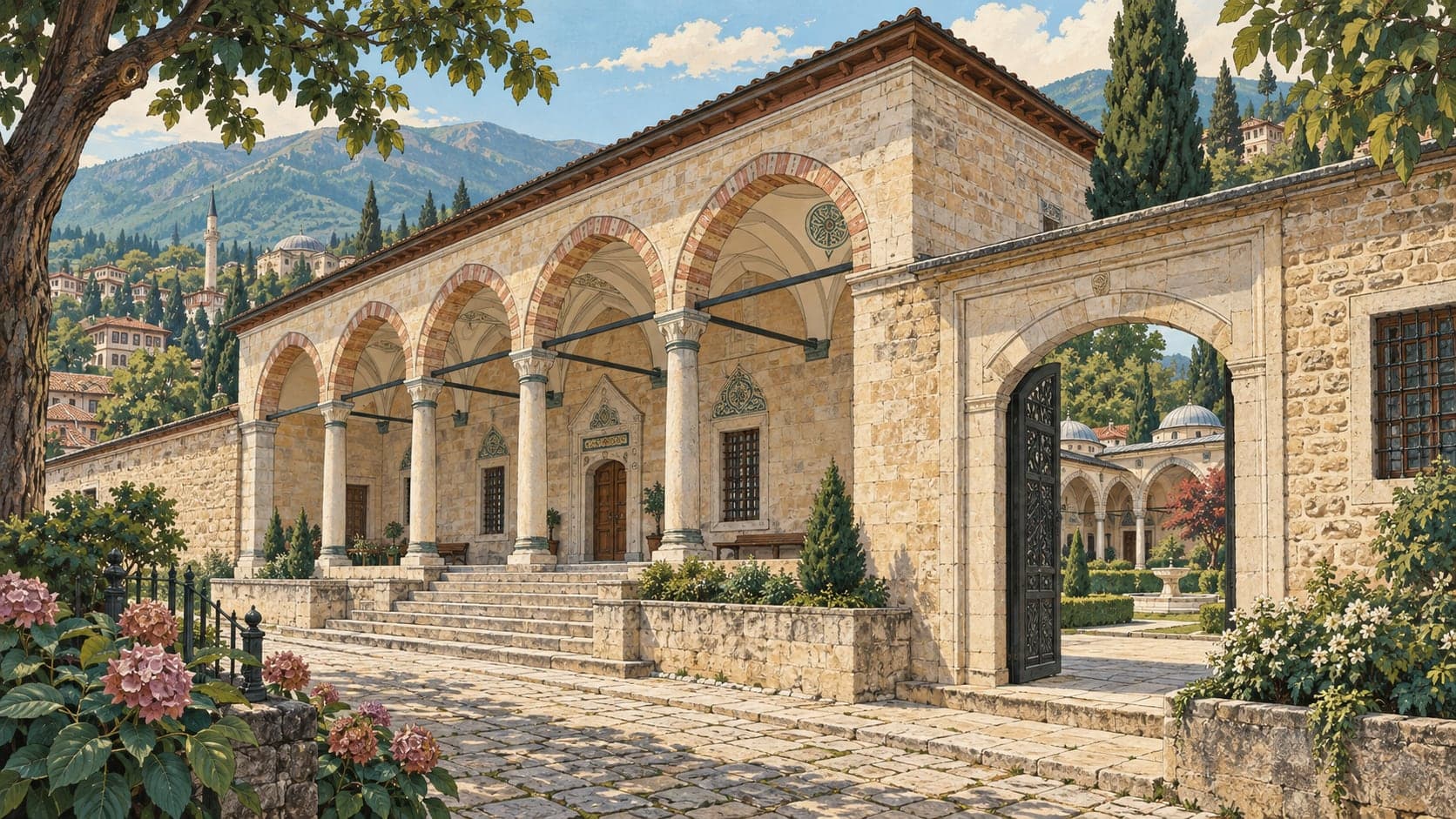
The manuscripts museum in Bursa occupies the medrese of the Muradiye complex, and the building is half the reason to come. Sultan Murad II had it built in the first years of the fifteenth century; its endowment deed of 1430, drawn up together with the mosque, is held in the archive of the directorate general of foundations. It follows the early Ottoman plan — a portico around an open court, one main eyvan, fourteen student cells and two smaller eyvans, with an octagonal marble pool at the centre of the square courtyard. After the republic the first major repair came in 1951, and for years afterwards the rooms housed a tuberculosis clinic and an early cancer diagnosis centre. The metropolitan municipality restored the medrese together with the rest of the complex from 2014, finishing in 2017, and the site was inscribed as world heritage in 2014.
The museum opened on 18 January 2019. The cells and the portico are all display space; the courtyard, now roofed, is used for events and workshops. From the room on the right of the entrance through to the tenth, the sequence follows the writing of the Qur'an in chronological order through the art of calligraphy, from the earliest revelation onwards. Beside the calligraphy are examples of the other Islamic book arts — binding, illumination, miniature painting and marbling — with short films showing how each was made. In the main eyvan facing the entrance hang an eighteenth-century cover for the cenotaph of Murad I and panels bearing the names of the other sultans buried in Bursa.
The complex around it repays the walk. Muradiye was built as a mosque, medrese, bath, soup kitchen, fountain and the founder's own tomb, and because princes and members of the palace were buried in its graveyard it grew by additions over more than a century: thirteen tombs in all, from that of Şehzade Alâeddin and the 1449 tomb of Hüma Hatun to Şehzade Mustafa's of 1553. In the same quarter stand the fifteenth-century Şair Ahmet Paşa medrese, now a museum of Ottoman folk dress, a seventeenth-century Ottoman house, the tomb of Karşıduran Süleyman Bey, and the Hüsnü Züber house, a typical nineteenth-century Ottoman dwelling that once served as the Russian consulate.
Getting there
The museum is at Prof. Dr. Halil İnalcık Sokak No. 3 in the Muradiye neighbourhood of Osmangazi, a short ride from the centre of Bursa. Ramps reach every part of the building, so wheelchair users can see the whole museum. It is closed on Mondays, on 1 January and on the first day of the religious holidays.