Guide
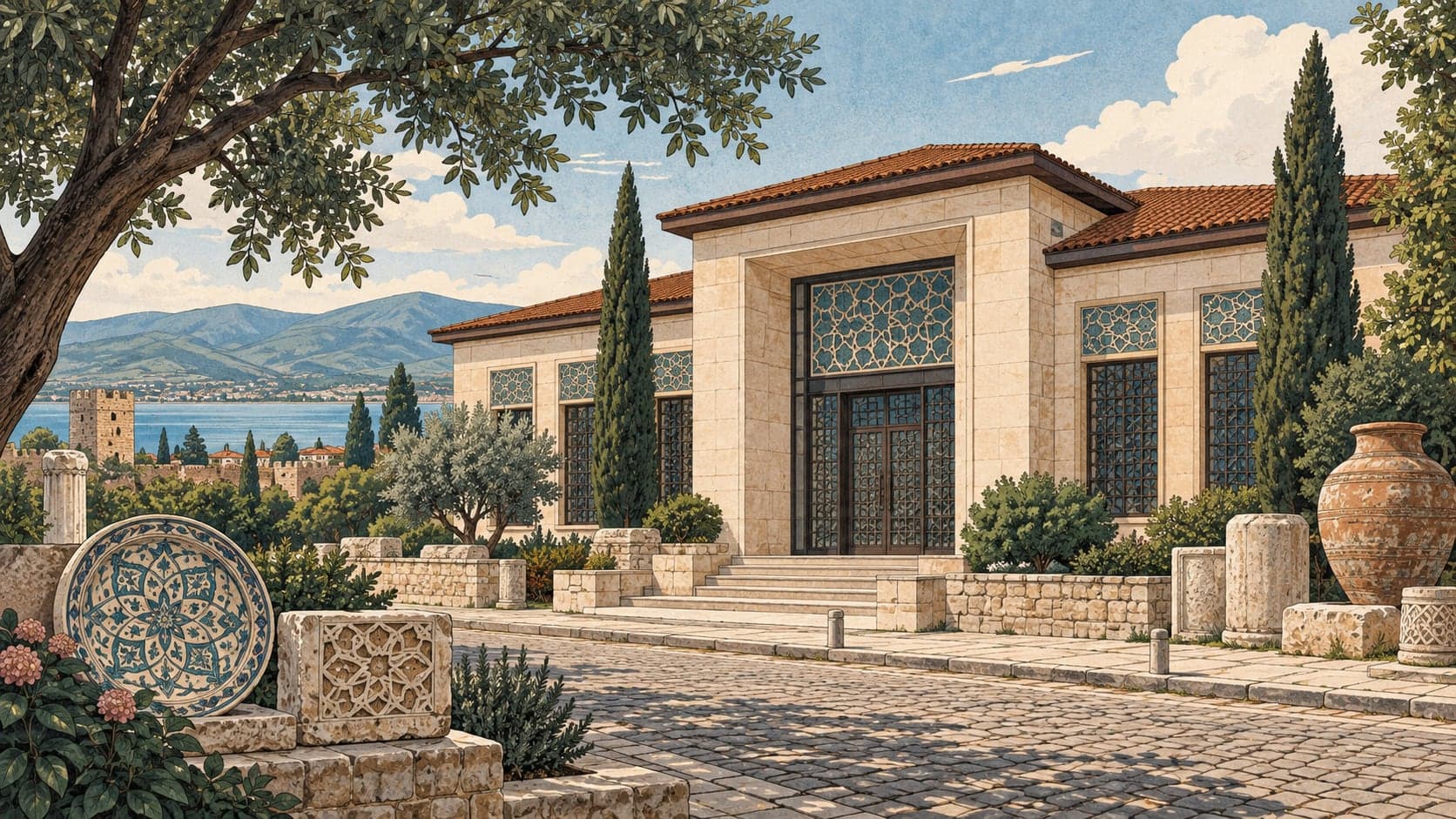
The İznik Museum opened in 1935 in the Yakup Çelebi zaviye and moved in 1960 to the Nilüfer Hatun soup kitchen, where both archaeological and Turkish-Islamic works were shown together. Between 2020 and 2022 the Ministry of Culture and Tourism put up a new museum building in İznik and the archaeological material was moved into it. The Nilüfer Hatun building carries on as the Museum of Turkish and Islamic Works, while the new building has been open since 16 January 2023 as the İznik Museum, showing the archaeology.
Close to 1,500 objects are on display, the oldest of them reaching back to around 6500 BC.
One of them is a Roman marble board game, known as ludus duodecim scriptorum, the game of twelve markings. It combines chance and strategy in a manner close to backgammon: each player has fifteen pieces, and play begins once both have set them out on the board in the same way.
The Achilles sarcophagus is a richly worked coffin dedicated to the Greek hero. Carved figures on all four sides show the Trojan war, the Achaean king Agamemnon, Achilles himself, held to be half divine, and his captive Briseis. One face carries figures standing for spring, summer and autumn.
The Antigonos sarcophagus, dated to the second century AD, is among the important coffins from the Hisardere necropolis. The man buried in it died at about forty-five to fifty and was laid to rest wrapped in three layers of woollen shroud. Part of the shroud survives, along with the wooden pillow under the head and part of the wooden bed under the body, which is what makes the find matter: it shows that the dead were shrouded and laid on a wooden bed rather than directly on the stone. The sarcophagus was made at the order of his wife Arete, and it carries her figure together with the lament she had written for him — newly translated after eighteen hundred years — in which she cries out from the grave, tears her hair in grief, and says that the misfortune of death took hold of her instead of releasing this man she valued.
The Nike-Eros sarcophagus, also of the second century AD, is of the Dokimeion type, with figures of Nike and Eros carved independently of one another and a lid worked in the form of a pediment. Traces of shroud and cloth were found on the body of the person buried in it.