Guide
The agora of İzmir lies on the northern slope of Pagos, today Kadifekale, where the ancient city of Smyrna moved in the fourth century BC. Ringed by the important public buildings of its day, this was the state agora of the city.
Agora is a Greek word meaning a gathering place, a city square, a market. In antiquity the agora served commercial, political and religious purposes and was the focus of the city, where art gathered and much of public life took place. Every ancient city had at least one; larger cities generally had two, a state agora surrounded by public buildings where the business of government was done, and a commercial agora where trade concentrated.
The agora was founded in the Hellenistic period, but most of the remains that have come down to us belong to the Roman agora rebuilt after the earthquake of AD 178 with the support of the emperor Marcus Aurelius.
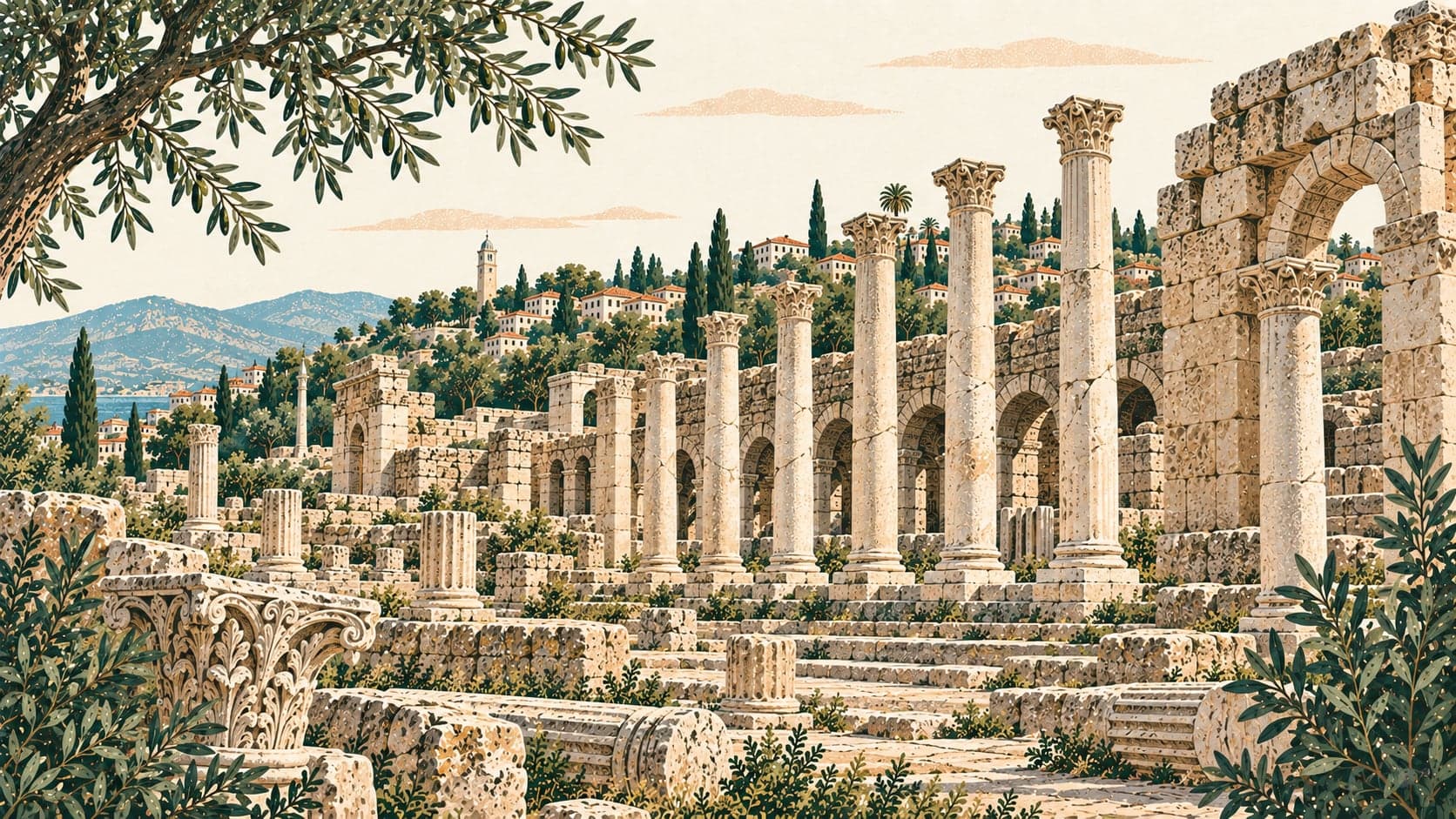
The agora is rectangular, with a wide courtyard at its centre ringed by colonnaded galleries. The north and west stoas uncovered by excavation rise above a basement floor, and in its plan the north stoa is a basilica.
Roman basilicas were laid out with a wide, high space at the centre and narrow, lower parallel aisles at the sides. They led in plan to the Christian churches, and served the city as a kind of courthouse where legal business was done; merchants and bankers who directed the commercial life of the city also favoured them.
The basilica on the northern side of the agora is rectangular and measures 165 by 28 metres overall. On those measurements the source calls it the largest known Roman basilica. The cross vaults at the eastern and western ends of its surviving basement are among the finest examples of Roman architecture, and of the two monumental doors opening onto that basement on the northern face, the western one has now been fully uncovered. Rows of vaulted shops uncovered on the northern face show that towards the end of the Roman period the state agora was taking on a commercial character.
The west stoa, made up of aisles divided by three rows of columns, likewise rose above a basement. What is seen today is mostly the arched basement; in antiquity two floors stood above it.