Guide
İğneada Longoz Forests became Türkiye's 39th national park when the ministerial decision of 3 November 2007 was published in the official gazette on the 13th of that month. It covers 3,155 hectares within the İğneada district, 25 kilometres from the town of Demirköy in Kırklareli.
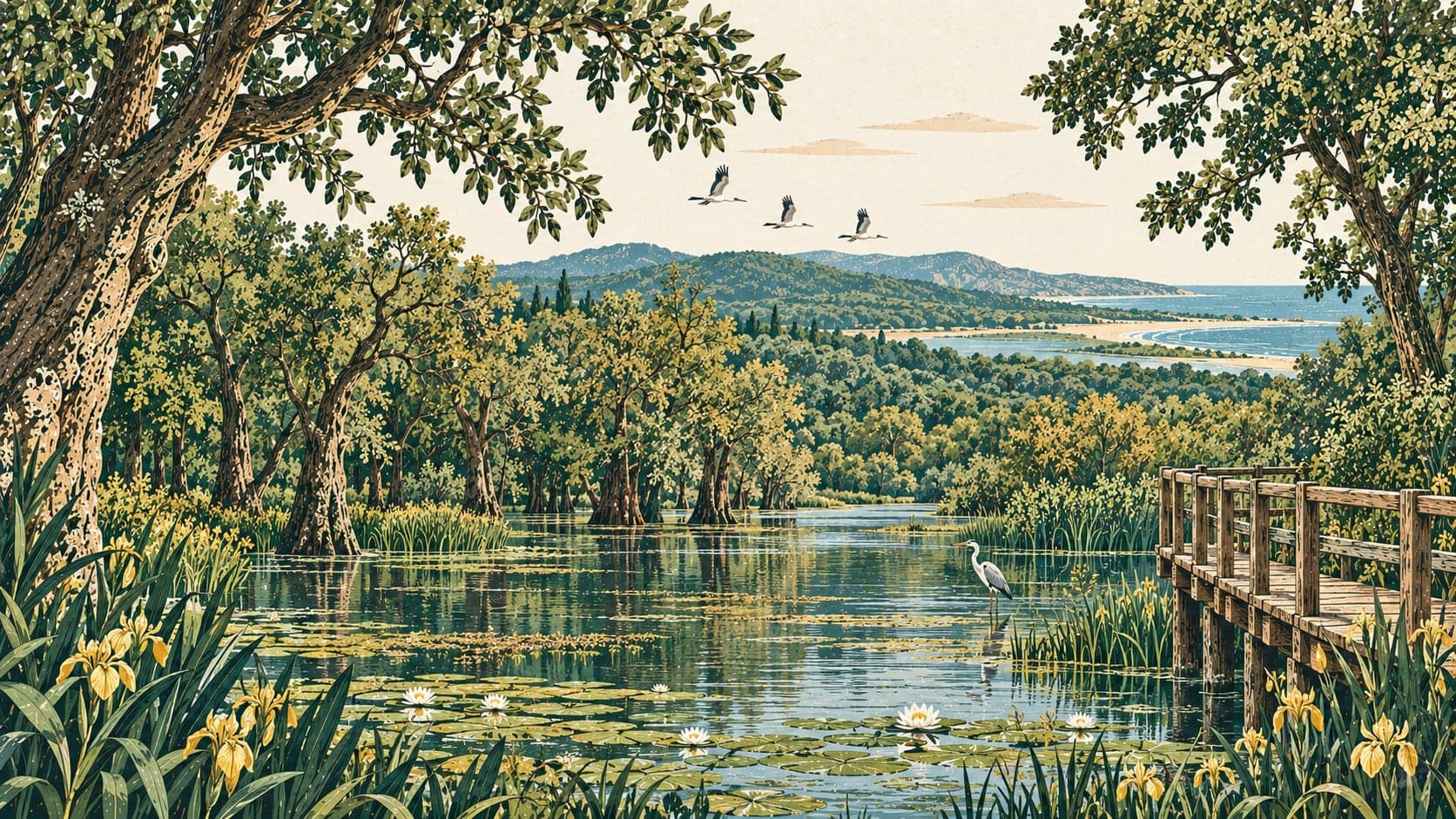
The park exists because of what the water does here. Streams running off the Yıldız mountains towards the Black Sea do not reach it: they end at İğneada in lakes and in the marshes around them. Between the flooded forests and the dunes lie lagoon lakes of varying size, and further inland are lakes enclosed by forest — six in all, with rich aquatic vegetation. The lagoons are Erikli, Mert, Deniz and Saka; the inland lakes are Hamam and Pedina. Because a dune barrier cuts the four lagoons off from the sea, the excess water of spring backs up and spreads across the flat ground, and those flooded areas are what produce the water-covered forest and the meeting of sea, lake and forest ecosystems. The coastal dune strip separating those forests from the sea is the most fragile part of the park.
Four of the dune plants — the coastal mullein Verbascum degenii, the coastal hog's fennel Peucedanum obtusifolium, Silene sangaria and the Kilyos cornflower Centaurea kilaea — are endemics found in Europe only on the Black Sea coast of Thrace. Four more are rare species protected under the Bern convention: Aurinia uechtritziana, Centaurea arenaria, sea kale and the sea daffodil. Around the lakes, marshes and meadows grow summer snowflake, flowering rush, yellow flag, duckweed, white water lily, reed, water chestnut, lesser bulrush, snowdrop, crocus, grape hyacinth, bee orchid and cyclamen. The forest itself is field maple, alder, hornbeam, oriental beech, five species of oak, white and aspen poplar, white willow and narrow-leaved ash.
Mammals recorded here include hedgehog, mole, brown hare, red squirrel, wolf, fox, beech marten, badger, otter, wildcat, wild boar and roe deer. Among the birds are great crested grebe, shag, great and little egret, grey heron, white and black stork, white-tailed eagle, common buzzard, chukar, eagle owl and long-eared owl; the reptiles include Hermann's tortoise, green lizard and nose-horned viper.
One practical point before visiting: the Directorate states that the day-use areas, tent and caravan grounds, country restaurant areas and open-air event areas are still under construction and not operating. What does work is the bird-watching tower at the Mert lake viewpoint, which looks out over the lake and İğneada beyond it, the jetties on Hamam and Erikli lakes, and three walking routes — one at each of Hamam, Erikli and Mert. The park is roughly 180 kilometres from İstanbul, 200 from Edirne, 130 from Tekirdağ and 640 from Ankara.
- Designated
- 13.11.2007
Entry fee
- Marmara group 2 · category 1 · Per person
- 75 ₺