Guide
An octagon of küfeki stone in Fatih, built for Deli Hüsrev Paşa — governor of Diyarbekir, Aleppo and Damascus, who rose to the governorship of Rumelia and the rank of second vizier — and, on the clear evidence of the registers listing his works, by Mimar Sinan. It belongs to Sinan's early years, and what is surprising about it is how showy it is: the tombs he built for far more famous men are plainer, and the exterior decoration here goes well beyond what was usual for tombs of the period. Another of his buildings, the Bâlî Paşa mosque, stands nearby, along with the tomb of Neccâr Mehmed Efendi.
The inscription in two lines above the door gives 952 (1545), which is odd, since the pasha's death is generally put at 951 (1544). A second question hangs over who is buried here: Ayvansarâyî, writing about the neighbouring mosque, recorded that the grand vizier Hüsrev Paşa executed at Tokat under Murad IV was interred in this tomb, which raises the possibility that his severed head was brought here.
The building suffered badly. The great fires that repeatedly ran from the shores of the Golden Horn towards the Marmara caught this quarter, damaging the tomb and the market the same vizier had built beside it; the last of them, in 1918, injured its architecture again. It stood derelict in the middle of a burnt-out site for years and was repaired to a degree in 1950. Nothing of its furnishing or its cenotaphs survives, and the windowed wall of cut küfeki around it has been renewed in recent times.
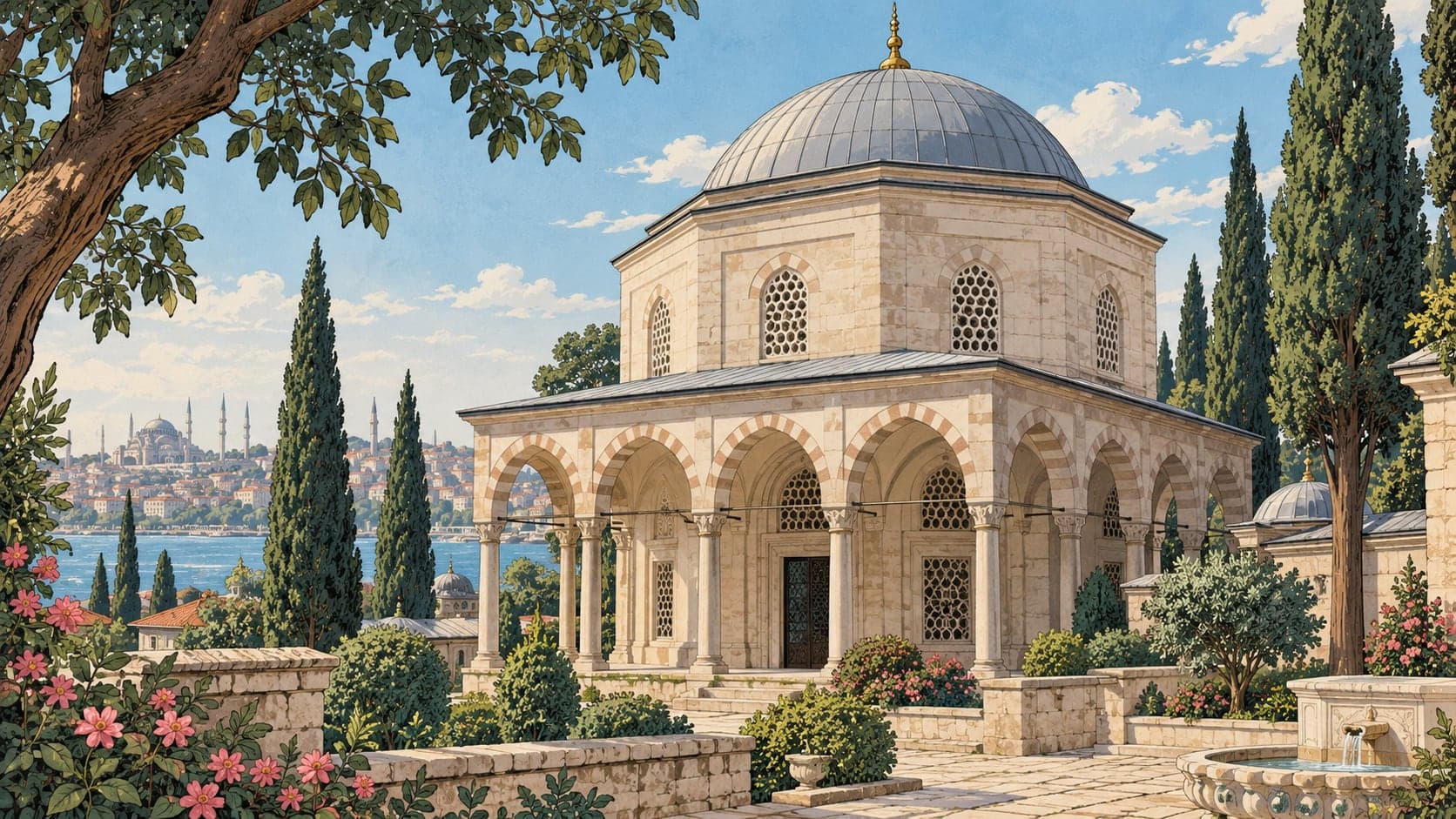
Octagonal both inside and out, it has two pointed-arched windows, one above the other, in each of its seven façades other than the entrance side. The corners are worked as slender piers, every face is framed with mouldings, the inscription sits above, and over that come tympana repeated on each face and rows of stone buds carved in relief. The lead dome rests on a narrower blind drum with relief ornament on its outer face and buds along the ridge line. Whether a domed porch on two columns once stood before the entrance is a reasonable thought, but no trace of such a thing has been found; Ekrem Hakkı Ayverdi suggested that at most there may have been a wooden eave on a pair of brackets driven into the wall. Inside, the transition to the dome is made by a band of muqarnas cornice, and fragments suggest the walls were originally faced with tiles.