Guide
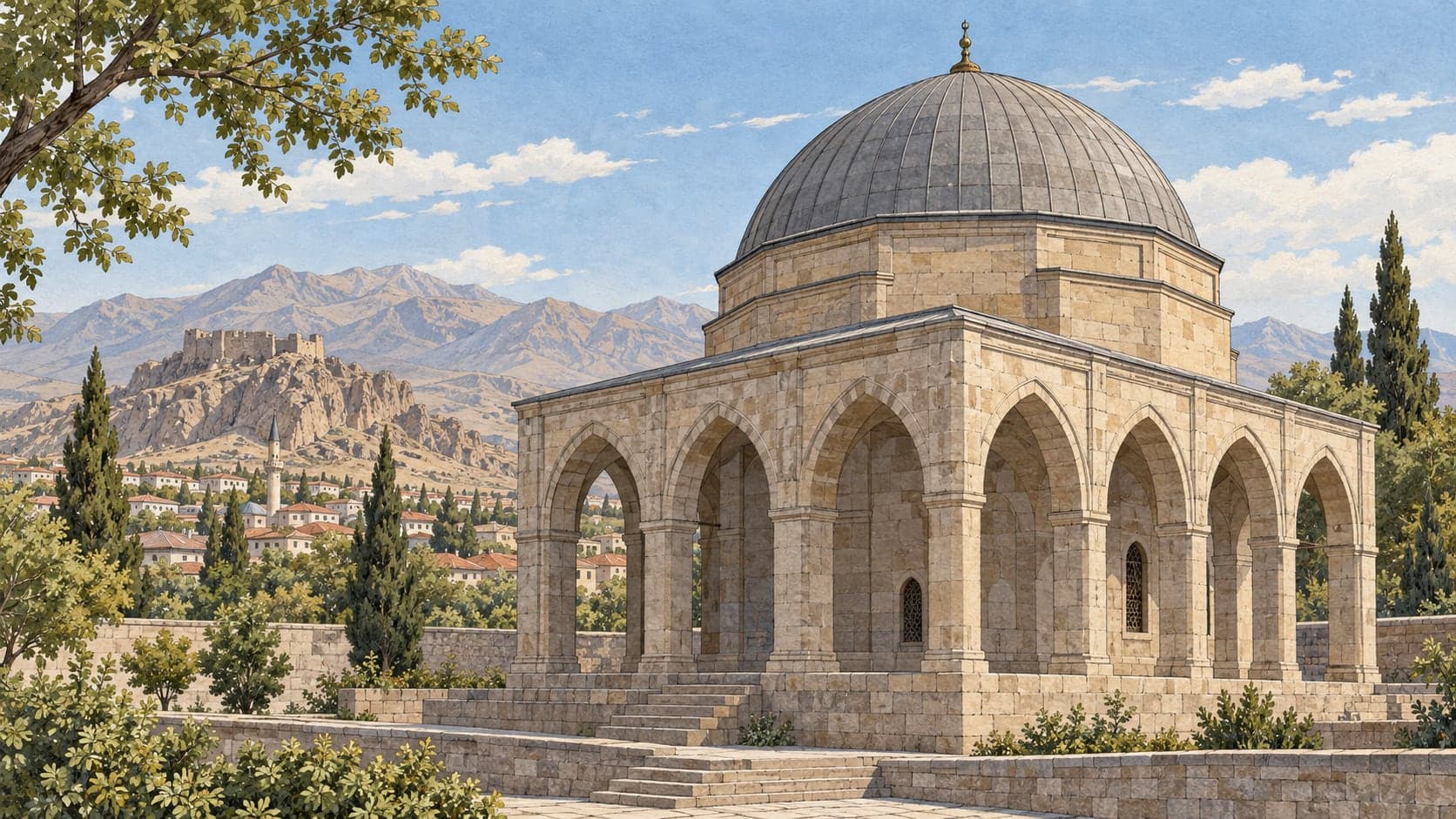
The tomb of Hudavend Hatun in Niğde is dated by the building inscription over its portal to 712 in the Hijri calendar, 1312-13, and it was commissioned by Hudavend Hatun, daughter of the Anatolian Seljuk ruler Rükneddin Kılıç Arslan IV. It has been repaired at times but keeps its original character. It belongs to the group of single-storey octagonal tombs: an octagonal body rising from an eight-sided base, turning above into a sixteen-sided drum, closed by a dome within and an eight-sided pyramidal cap outside.
The materials are the reason to look closely. The body is fine-grained yellowish trachyte. White marble was used for the jambs, arches and lintels of the doors and windows and for the bands and inscriptions on the drum. A harder, finer, reddish stone was used for the ornament in the pointed-arched pediments of the drum and for the figured decoration and tracery of the windows, and black cut stone for the blind pointed arches of the interior dome drum — an unusually rich range for a building of this size, and the workmanship is clean and careful throughout. The tomb is remarkable as much for its carving as for its architecture: plant and geometric ornament, and, less usually for this period, figural relief. It stands in the Yenice quarter in the centre of Niğde, within walking distance.