Guide
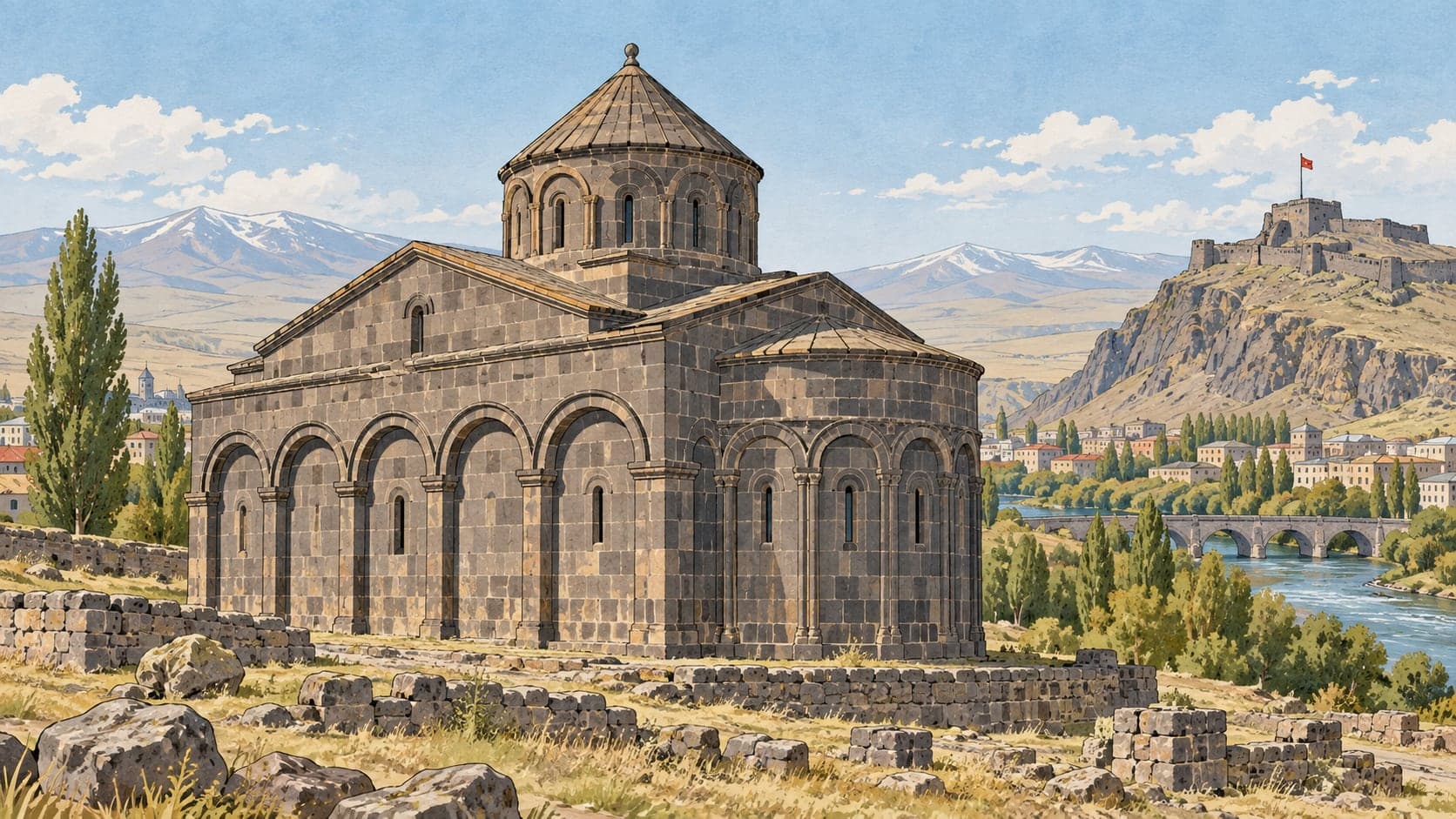
The Hamur tomb tower stands north-east of the district centre of Hamur in Ağrı, at the middle of the cemetery overlooking the valley the town was built in. Who built it and when is not known for certain. It was built in a manner different from Turkish-Islamic tomb architecture and has no parallel; from a distance it looks like a great sarcophagus.
Regular cut stone was used throughout. The building is of off-white tuff apart from four bands of black basalt. The upper band, projecting outward where the walls give way to the roof, rises at the line of the doorway and so marks the entrance. In its materials it resembles the İshak Paşa palace at Doğubayazıt.
The tower is rectangular and consists of an entrance court and the burial chamber proper. A portal in the form of a pointed-arched eyvan at the south-west corner leads into the court, which connects to the chamber through a rectangular door with a straight lintel. There is one slit window in the court and four in the chamber. Both parts are covered by a mirror vault within and a ridged roof without, and the inside is kept as plain as the outside.
In the court, the south wall has a pointed-arched lamp niche and the east wall a slit window; the grave in this section has been destroyed entirely. The burial chamber has two slit windows in each of its east and west walls and, in the west wall, a lamp niche like the one in the court. The four graves inside it have also been completely destroyed, and only a few pieces of gravestone survive. The ornament on those stones shows Seljuk and Ottoman influence.