Guide
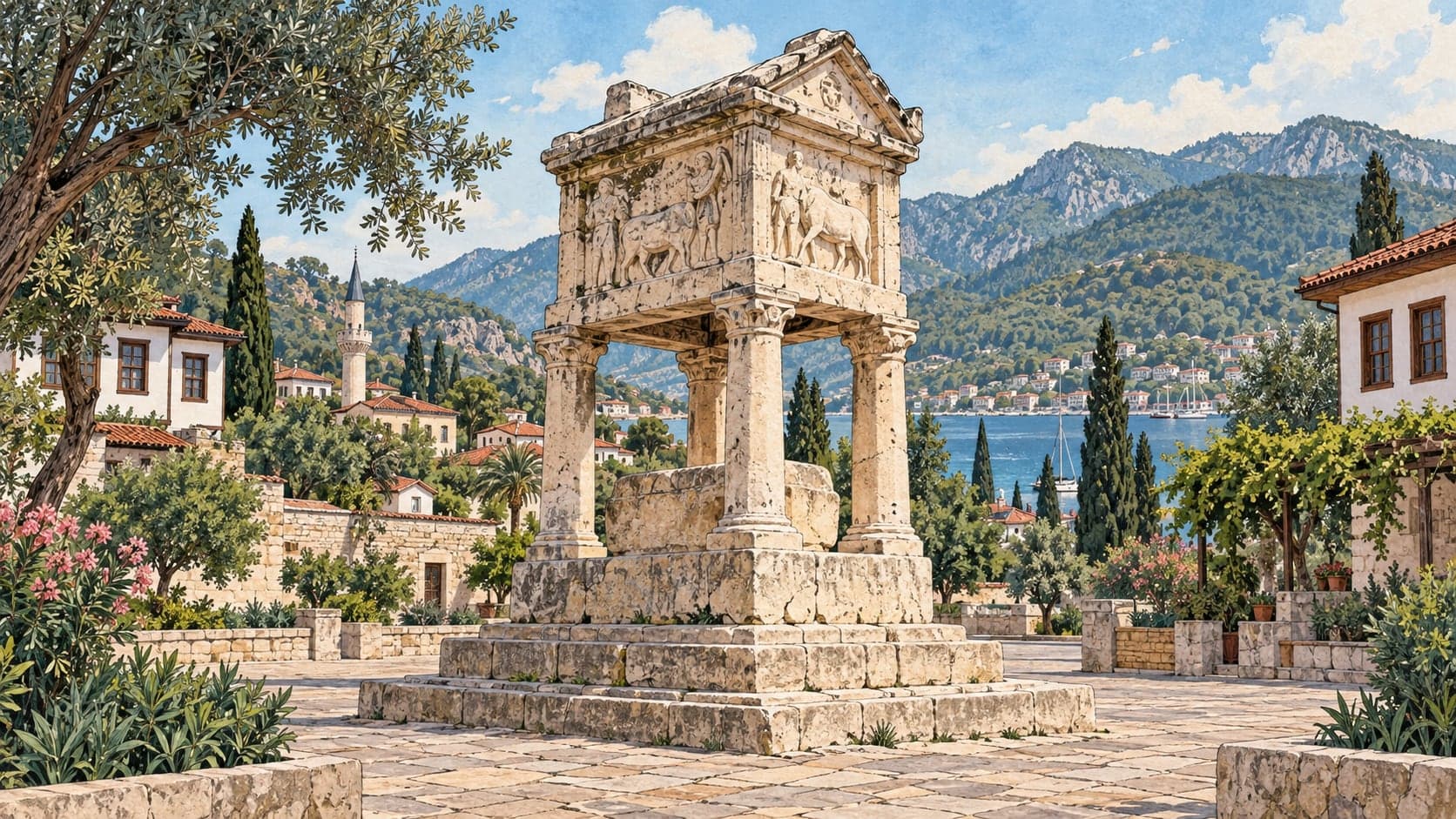
The Gümüşkesen tomb monument stands within the necropolis of the ancient city on the eastern slope of Sodra Dağı in Milas. A monument on this scale could only be built in its day by decision of the city senate, and it was probably raised for a senior figure of Milas — a governor or a commander — and his family. On the evidence of its construction technique and the character of its marble ornament it is dated to the middle of the second century AD.
It is built of grey-veined marble quarried on Sodra Dağı and stands on a level platform cut into sloping ground. It has three parts: the burial chamber where the dead were laid, the middle level surrounded by columns where religious ceremonies were performed, and the roof level carried on those columns; the total height is 8.45 metres. Inside the ground floor are four piers supporting the ceiling slabs, with beams laid north to south above them, and the piers have plain moulded capitals. The ground-floor walls are built of large, regularly cut marble blocks. The upper structure takes the form of a stepped pyramid, and it is because of this overall shape that the monument is thought to recall the Mausoleum at Halicarnassus, one of the seven wonders of the world, and to be a small copy of it.