Guide
The Church of the Young Women is one of the buildings registered as immovable cultural property at Ani. It is also known as the Convent of the Virgins and as the church of Surp Hripsime. The monastery stands at the furthest point of the Türkiye–Armenia border, on the north slope above the Arpaçay, on steep rock near the valley floor.
When it was built and by whom is not known. According to a manuscript said to have been written in this monastery it was built, most probably in the thirteenth century, by Tigran Honents, a merchant of Ani; some researchers, however, think the building dates from the beginning of the eleventh century.
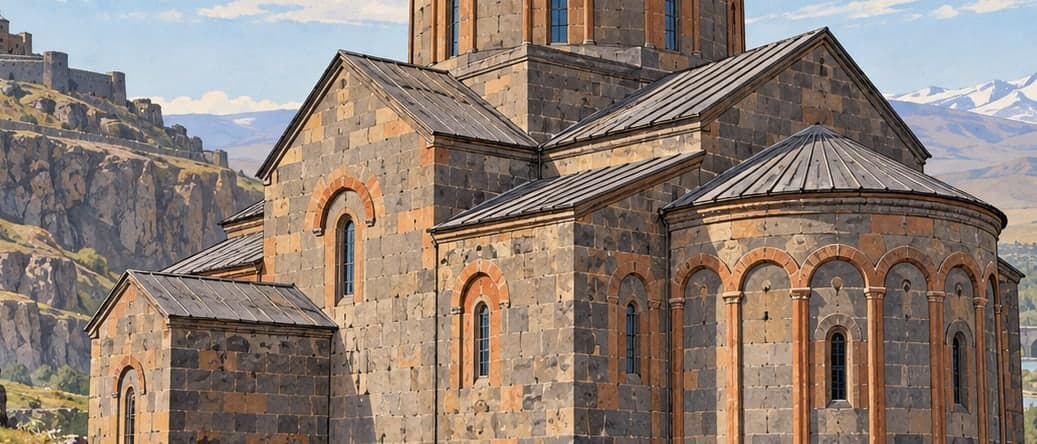
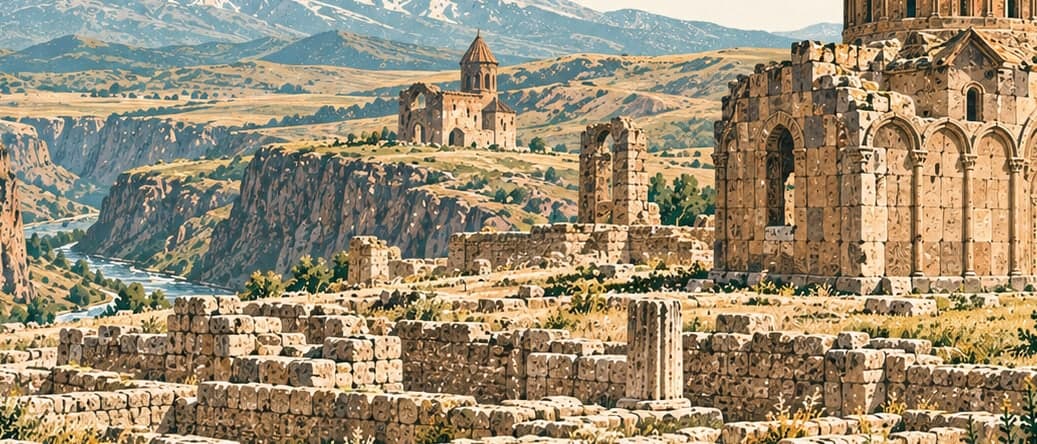
The monastery is basilical in plan and was a place of worship set apart. Because it stands on the steepest rock at the site and is the hardest place to reach, it has come down relatively intact. Enclosed by high walls and dedicated to the nuns of Saint Hripsime, its best-preserved building is the church. West of the church is a gavit, now almost entirely collapsed, and to the south a chapel in sounder condition.
The church is covered by a conical cap on a high drum. That form, called a half-open umbrella, was used a great deal in Armenian architecture at this period, but its application here appears to be the only one at Ani. The church is very small, built of regular reddish cut stone, with its single entrance on the axis of the west front. The surfaces of the arches are decorated with various interlacing geometric and plant motifs; some of the tympana carry rosettes with geometric ornament and animal figures, and the spandrels are filled with scrolling branches, rumi and palmette motifs.